Language is full of tiny details that change everything. One extra letter can turn a real expression into something that looks right but isn’t.
That’s exactly what happens with the phrase “in the nick of time.” Some people write “knick of time”, and while it sounds similar, only one version is correct, historically accurate, and widely accepted.
This guide walks you through the meaning, the origin, the proof, examples, synonyms, memory tricks, and usage tips—so you’ll never question it again.
Think of this article as your personal rescue rope… arriving just in the nick of time.
What Does “Nick of Time” Mean?
The phrase “in the nick of time” means something happens at the last possible moment—right before disaster, failure, or loss could occur.
Imagine:
- Catching a flight as the gate agent reaches for the door.
- Pulling dinner from the oven seconds before it burns.
- Making it to your exam with 60 seconds left.
Those aren’t coincidences. They’re “nick of time” moments.
The keyword here is urgency. Not early. Not late. Precisely on time.
“Nick of time” = the final second when success is still possible.
Why People Get Confused: The Misconception Behind “Knick of Time”
You’ve probably seen both versions floating around:
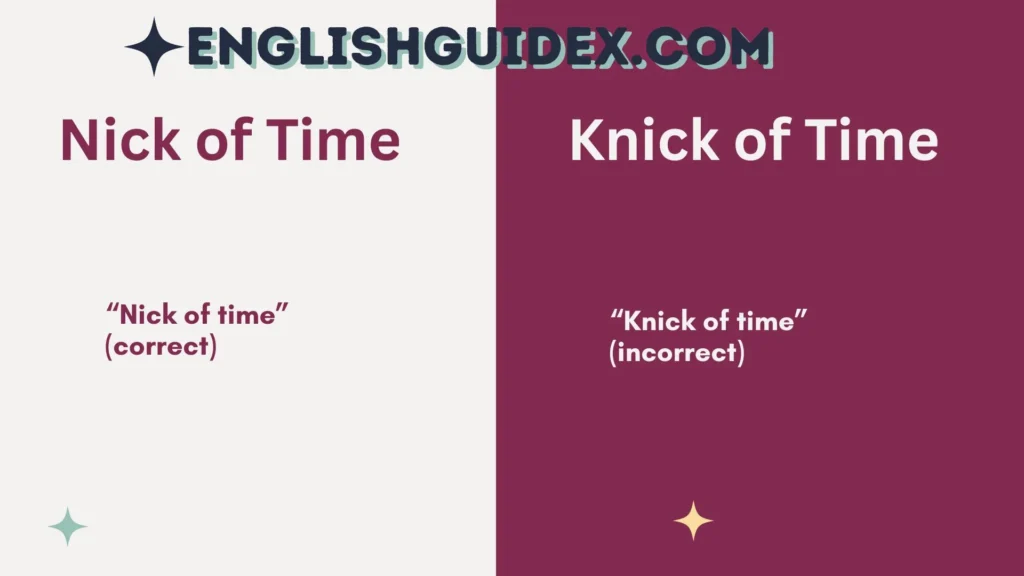
- “Nick of time” (correct)
- “Knick of time” (incorrect)
So why do people add a K that doesn’t belong?
It happens because the brain connects sounds, not spelling.
Words like:
- knickknack
- knickers
- knock
- knee
…all start with a silent K. So some assume “nick” should be spelled the same way. But that extra K has no historical or linguistic basis here.
Quick Comparison
| Version | Status | Why |
|---|---|---|
| Nick of time | ✅ Correct | Matches meaning + history + dictionaries |
| Knick of time | ❌ Incorrect | No evidence, no origin, no accepted usage |
If you write “knick,” you’re spelling the phrase wrong. It’s that simple.
The Real Origin of “Nick of Time”: Where the Phrase Comes From
The root word here is nick, which once meant:
- a notch or cut
- a precise, marked point
- a critical or exact moment
Before clocks, people carved notches into wood to mark time increments. Each notch was a nick, a tiny cut that represented a precise point. Hitting that mark meant something happened just on schedule.
So:
To arrive “in the nick of time” meant landing exactly at the notch.
Over centuries, the meaning evolved from literal wood markings to a metaphor for last-minute timing.
You’ll find echoes of this in older writing:
- A nick as a notch in a scoring board
- A nick as a winning moment
- A nick meaning the exact point at which something must happen
This explains why adding a K makes no sense—it has nothing to do with the phrase’s evolution.
Why the Correct Spelling is “Nick of Time”
Let’s be blunt. There’s only one logically correct choice:
Nick = correct
- Matches the historical meaning
- Aligns with dictionary definitions
- Used in literature, media, and formal writing
- Ties directly to the metaphor of precision
Knick = incorrect
- Doesn’t exist in this context
- Creates confusion
- No historical support
- No confirmed usage by credible sources
If you wrote “knick” in a professional setting—a paper, resume, business email—it would look like a misspelling.
How Language Evolved But the Phrase Stayed the Same
English spelling shifts. Meanings drift. But some idioms stay rooted because their imagery remains clear. Just like:
- “By the skin of your teeth”
- “Bite the bullet”
- “Break a leg”
These phrases resist change. Nick of time is the same. Even though pronunciation has stayed consistent, spelling remained stable.
It survived:
- Middle English shifts
- Standardization periods
- Printing press reforms
- American vs British spelling divides
Some idioms change over eras. This one didn’t.
Synonyms for “Nick of Time”
Sometimes you want a different expression with the same punch. Try these:
- Just in time
- At the last second
- Right under the wire
- With moments to spare
- At the eleventh hour
- By the skin of one’s teeth
- Barely made it
Sentence Examples
- “I reached the platform at the last second.”
- “Her answer came right under the wire.”
- “We escaped by the skin of our teeth.”
A varied vocabulary keeps writing alive. Swap phrases to fit tone.
Case Study: When the Right Wording Matters
Scenario: A teacher reads a college admissions essay.
- Option A: “I arrived in the knick of time to submit my application.”
- Option B: “I arrived in the nick of time to submit my application.”
Option A looks careless. Option B reads confident and literate.
Correct spelling signals mastery, and that matters—especially in:
- Scholarship essays
- Legal writing
- Emails to leadership
- Journalism
- Academic research
- Web content
A single letter impacts credibility.
Where You Should Use “Nick of Time” (Practical Usage)
This isn’t just a phrase for books. Use it in everyday speech and writing.
Formal Settings
- “The report was submitted in the nick of time before the review closed.”
- “Emergency services arrived in the nick of time.”
Casual Settings
- “Dude, you showed up in the nick of time—we were about to leave!”
- “Got to the shop just in the nick of time before they sold out.”
Creative Writing
- “Rain hammered the rooftop as the lantern flickered out. And then—just in the nick of time—the door burst open.”
Use it confidently. Use it intentionally. Use it correctly.
Memory Tricks So You Never Misspell It Again
- Nick = like nick a surface → a small cut → a tiny moment.
- No K. No confusion.
- Nick = quick → both rhyme.
- Remember: You can nick a piece of wood. You cannot knick it.
Say this aloud:
There’s no K in “nick of time,” but there is a moment to catch.
Quick Reference Table
| Term | Meaning | Correct? |
|---|---|---|
| Nick of time | Last possible moment | Yes |
| Knick of time | Common misspelling | No |
| Nick | Notch / exact point / moment | Correct root |
| Knick | Unrelated; used in other words only | Incorrect here |
Frequently Asked Questions
Is it “Nick of time” or “Knick of time”?
It’s always “nick of time” with no K.
Can “knick” ever be correct in this phrase?
No. It has no historical basis or linguistic relevance here.
Is “nick of time” formal or informal?
Both. It fits academic writing, email, conversations, storytelling, and journalism.
Is the phrase used worldwide?
Yes. It’s common in US, UK, Canadian, and Australian English.
Why does the phrase still matter today?
Because precision in language reflects precision in thinking—and this idiom expresses urgency like nothing else.
Conclusion
“In the nick of time” is an expression rooted in history, precision, and vivid imagery.
It survived centuries because it works—it paints a picture, communicates urgency, and feels natural in both casual and formal settings.
The extra K in knick only causes confusion, and it doesn’t belong.
If you remember just one thing from this article, make it this:
Arrive in the nick of time. Spell it in the nick of time. Never add the K.
Your writing will thank you.

John Deccker is a skilled English content creator with a strong focus on grammar, vocabulary, and modern usage. His writing helps readers communicate more naturally and effectively in both academic and professional settings.