Most people type “perogative” because it sounds right. It rolls off the tongue quickly, so the missing r goes unnoticed. But the correct spelling—the one accepted in professional writing, legal documents, academic work, and reputable publications—is:
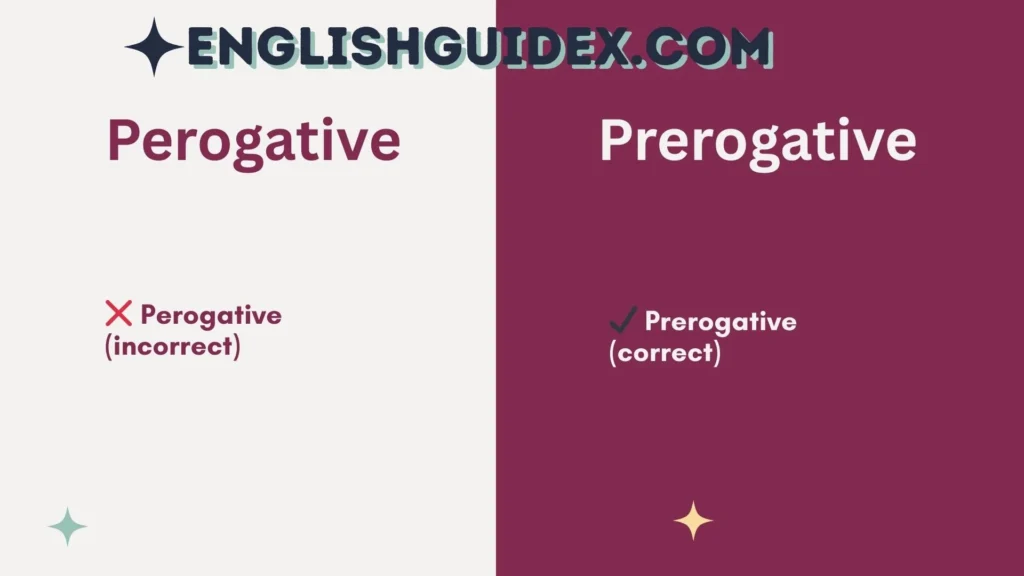
✔️ Prerogative (correct)
❌ Perogative (incorrect)
This article breaks down the spelling, pronunciation, meaning, and real-world usage of prerogative so you can use it confidently. Expect examples, case studies, a memory trick, comparisons, and practical applications you can actually use.
Why So Many People Spell It “Perogative”
Human speech influences spelling. When we speak, we smooth out the word so it sounds like “peh-rog-uh-tiv.” That creates the illusion that the first r doesn’t exist.
Short reasons the error happens:
- The silent “r” gets lost in informal pronunciation.
- Auto-correct often doesn’t catch the misspelling.
- The eye expects phonetic spelling; English breaks the rules.
- People repeat the spelling they see online.
Think of it like “Febuary” vs. February or “libary” vs. library—speech patterns hide characters.
The Correct Word: What Does “Prerogative” Mean?
Prerogative = a right, privilege, or authority belonging to a person, group, or position.
It suggests power or freedom to decide without needing approval. The meaning has evolved from royal authority to everyday personal choice.
In simple terms:
- It’s something you’re allowed to decide because it’s yours to decide.
- It’s a right rooted in identity, role, or position.
Common Meaning Breakdown
| Context | Meaning of Prerogative |
|---|---|
| Personal Life | Your choice, preference, boundary |
| Corporate or Workplace | Authority based on job title or responsibility |
| Legal or Government | Power granted by constitution or law |
| Creative Fields | Artistic choice or stylistic freedom |
Examples in Sentences
- “It’s your prerogative to change careers if the job no longer fulfills you.”
- “The manager used her prerogative to approve the proposal without a meeting.”
- “Executive prerogative allows leaders to make decisions during emergencies.”
Why “Perogative” Is Incorrect
The misspelling perogative removes the root of the word—prae (before). Without it, the structure collapses. English spelling rarely bends for convenience, so the correct spelling must preserve historical structure and meaning.
Common Misconceptions
| Belief | Why It’s Wrong |
|---|---|
| It’s spelled “perogative” because that’s how people say it. | Pronunciation does not define spelling. |
| One letter doesn’t matter if meaning is clear. | In formal or professional settings, it affects credibility. |
| It’s a regional variant. | There is no accepted regional spelling of “perogative.” |
If you write perogative in a job application, professional email, or legal document, it damages authority. Language signals competence—accuracy matters.
The Origins and Evolution of “Prerogative”
The word comes from Latin:
Praerogativa → prae (before) + rogare (to ask or propose)
Originally, it described the privilege of speaking or voting first. Later it became associated with those who held power or authority.
Historical Path
- Latin: praerogativa (privilege to vote or act first)
- Old French: prerogative
- Middle English: prerogatyf / prerogative
- Modern English: prerogative
The core idea never changed: someone had the right to act because of who they were or the position they held.
Real Usage of “Prerogative” in Today’s World
Government & Law
Prerogative appears in constitutional discussions, particularly in executive power:
- emergency authority
- national decisions
- administrative judgment
This isn’t about personal preference—it implies structural power.
Corporate Leadership & Workplaces
In professional settings, it suggests:
- authority granted by responsibility
- decision-making autonomy
- leadership expectations
Example:
“Department heads have the prerogative to approve budget changes without committee approval.”
Everyday Personal Decisions
Here, it’s more casual:
- “It’s my prerogative to rest today.”
- “It’s her prerogative to refuse invitations.”
It reflects boundaries, identity, and self-respect.
Media, Culture & Common Speech
You’ve heard this word before—you just may not have noticed.
Famous Quote
“That’s my prerogative.” — A widely repeated modern phrase in music, interviews, and social culture.
Why Pop Culture Confuses Spelling
Songs and dialogue focus on sound, not spelling. The ear hears “perogative.” The brain writes it that way.
How to Remember the Spelling
If you struggle with the word, use memory hooks.
Three Easy Mnemonics
- PRE + ROGATIVE → PRE = before, authority comes before permission.
- “PRE because the right comes before the action.”
- “If you have the right to choose, you’re first. PRE means first.”
Phonetic Breakdown
pre-ROG-a-tive
(pruh-ROG-uh-tiv)
Micro Practice
Fill in the blank:
- “It’s my ____ to choose where I work.” → prerogative
- “He used executive ____ to finalize the plan.” → prerogative
Word Comparisons That Prevent Confusion
| Word | Meaning | When to Use |
|---|---|---|
| Prerogative | A right connected to authority or identity | When someone has the right to decide |
| Privilege | A benefit or advantage not everyone has | When something is granted or allowed |
| Right | Something protected or earned through law or principle | When something is legally or ethically guaranteed |
| Choice | A personal decision | When it’s simply a selection |
Practical Use in Sentences (Copy and Paste)
Professional Email Templates
- “As project lead, it’s within my prerogative to approve the schedule.”
- “The director exercised her prerogative to fast-track the proposal.”
Conflict-Free Language
- “It’s your prerogative to decline; no explanation is required.”
Personal Autonomy Statements
- “Changing priorities is a prerogative, not a flaw.”
Case Studies & Realistic Examples
Case Study 1: Office Leadership Decision
A senior manager approves a hiring decision without a meeting because her job description grants authority. The team questions the choice, but policy confirms it’s her professional prerogative.
Lesson: prerogative = authority rooted in role.
Case Study 2: Creative Industries
A director refuses to change artistic direction despite producer suggestions. He says:
“Creative direction remains my prerogative.”
Lesson: prerogative = identity-driven decision.
Case Study 3: Personal Boundaries
Someone declines invitations repeatedly. Instead of apologizing, they assert:
“Solitude is a personal need, and that’s my prerogative.”
Lesson: prerogative = self-respecting personal choice.
FAQs
Is “perogative” ever correct?
No. “Perogative” is always a misspelling.
Is prerogative formal or informal?
Both. It appears in legal writing, professional communication, and casual conversation.
How do I pronounce prerogative?
pruh-ROG-uh-tiv (the first “r” is subtle, not silent).
Can prerogative mean personal preference?
Yes. Modern usage includes personal choice and boundaries.
Is prerogative related to rights or power?
Yes. It implies a right that comes from authority, identity, or position.
Conclusion
The confusion between perogative and prerogative comes down to sound versus structure. One is a casual phonetic error; the other carries centuries of meaning.
Whether you’re asserting boundaries, leading teams, or writing professionally, spelling shapes credibility. Use prerogative, and you reinforce clarity, authority, and confidence.

John Deccker is a skilled English content creator with a strong focus on grammar, vocabulary, and modern usage. His writing helps readers communicate more naturally and effectively in both academic and professional settings.