Choosing between afterward and afterwards seems small, but it reveals a lot about where you write, who you write for, and how polished your language feels.
These two spellings share the same meaning—a time later than something else—yet they carry different identities depending on geography, publishing standards, and audience expectations.
This guide breaks down everything in a friendly, conversational style so you never second-guess yourself again.
You’ll learn the history, usage rules, grammar placement, regional preferences, and smart habits editors use to avoid mistakes.
Afterward or Afterwards: Why This Spelling Choice Actually Matters
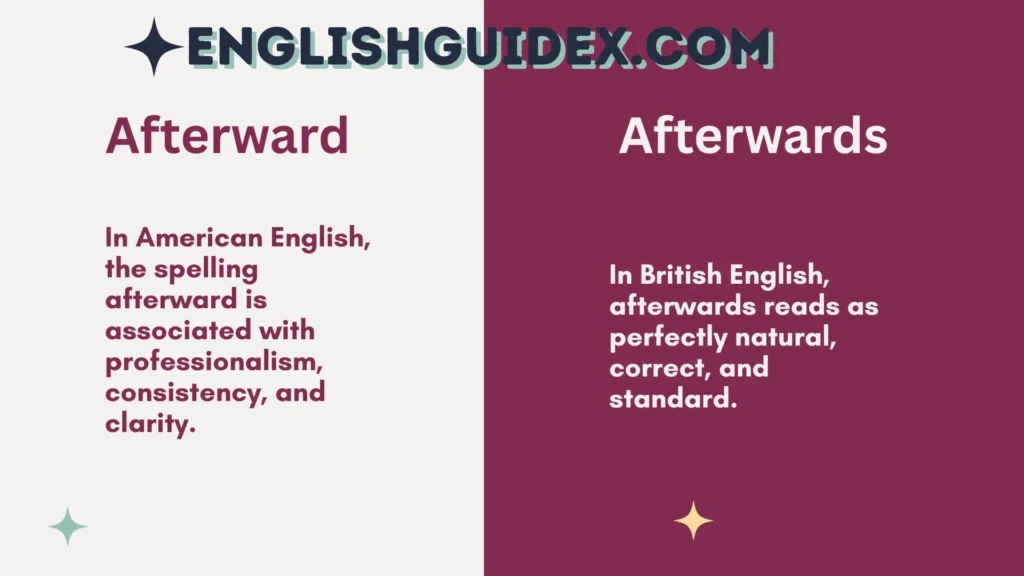
A simple s at the end changes nothing in meaning, but it changes a lot in perception. In American English, the spelling afterward is associated with professionalism, consistency, and clarity. In British English, afterwards reads as perfectly natural, correct, and standard.
Writers feel stuck because:
- Both spellings appear in respected publications.
- Grammar tools flag one or the other depending on settings.
- People write for international audiences more than ever.
The good news? The confusion is fixable—and understanding the rules gives your writing authority.
What “Afterward” and “Afterwards” Mean
Both words are adverbs of time that refer to something happening later. There is no change in meaning. None. Zero.
| Word | Meaning | Function |
|---|---|---|
| Afterward | Later in time | Adverb of time |
| Afterwards | Later in time | Adverb of time |
Examples:
- We got dinner afterward.
- We talked afterwards.
In both sentences, the action takes place later than something else. The meaning stays consistent. The spelling reflects the writer’s linguistic audience.
Where the Difference Comes From: -ward vs. -wards
English developed with two competing suffixes: -ward and -wards. Both imply direction or movement—literal or metaphorical.
Here’s what that looks like across similar words:
| American Standard | British/Commonwealth Standard |
|---|---|
| toward | towards |
| backward | backwards |
| upward | upwards |
| afterward | afterwards |
So afterward fits into a pattern embraced in American writing, while afterwards aligns with British and Commonwealth tradition.
💡 Think of it as two correct roads leading to the same destination—just from different starting points.
Regional Usage: Who Uses Which and Why
Different English-speaking countries favor different spellings. That’s why your editing software reacts to one or the other—it depends on the language settings.
| Region / Country | Preferred Form |
|---|---|
| United States | Afterward |
| Canada | Afterward (mixed usage, but US form is rising) |
| United Kingdom | Afterwards |
| Ireland | Afterwards |
| Australia | Afterwards |
| New Zealand | Afterwards |
| India (English-medium) | Afterwards (mostly British influence) |
Quick rule of thumb:
- Writing for Americans? Use afterward.
- Writing for British or Commonwealth countries? Use afterwards.
You aren’t wrong either way. You’re tailoring.
How “Afterward / Afterwards” Fits in a Sentence
Both forms act as adverbs. That means they modify the verb by showing when something happened. They work in the beginning, middle, or end of a sentence:
Beginning:
Afterward, we took the train home.
Middle:
I’ll call you afterward if I have time.
End:
We can decide on dinner afterwards.
Each placement affects tone. Starting a sentence with it adds emphasis, placing it at the end feels casual, and putting it in the middle sounds like a smooth narration.
Grammar Facts
- They never describe nouns.
- They don’t change form based on tense.
- They don’t take plural or possessive endings.
There’s no such thing as afterwardses or afterward’s (unless you mean possession, like the afterward’s message, which is rare and not idiomatic).
Case Studies: How Professionals Choose
Seeing real use cases helps solidify the choice. Here’s how different fields lean:
| Field | Why It Matters | Preferred Form |
|---|---|---|
| American journalism | AP Style prioritizes uniformity | Afterward |
| British academia | Traditional linguistic consistency | Afterwards |
| Global corporate communication | Audience-based variation | Depends on region |
| Fiction writing | Authorial tone and character voice | Flexible |
| Technical writing | Clarity + consistency | Follow house style |
“Clarity isn’t just about correctness; it’s about making the reader forget there was ever a question.”
—Editorial principle taught in professional copy desks
Common Confusion: Afterward vs. Afterword
Many writers mistake afterward/afterwards for afterword, but one letter changes everything. Afterword is a publishing term—a section at the end of a book.
Clear Comparison Table
| Term | Meaning | Example |
|---|---|---|
| Afterward | Later in time (US spelling) | We went home afterward. |
| Afterwards | Later in time (UK spelling) | They had tea afterwards. |
| Afterword | Final section in a book | The author included an afterword about her research. |
A helpful memory trick:
- Afterword ends in “word” → it’s something written.
- Afterward/Afterwards end in “ward” → think moving forward in time.
How to Choose the Right Word (Even When You’re Stuck)
Use these checkpoints to decide confidently:
Ask yourself:
- Who is my audience?
- Where will this be published?
- Does the platform follow a style guide?
- Can readers from multiple regions access this content?
If you’re still unsure:
- Choose afterward for an American audience or neutral tone.
- Use afterwards for British/Commonwealth readership.
Consistency is more important than perfection
Once you choose, stick with it.
Memory Tricks to Avoid Mistakes
- US spelling is shorter → US = afterward.
- UK spelling keeps the S → S stands for Shakespeare.
- If it’s about books, check for the “WORD” in afterword.
A simple analogy
Think of it like spelling color/colour.
Same meaning, different identity.
Examples in Real-Life Context
Casual conversation:
We finished the movie and got burgers afterward.
Professional email:
The onboarding documents will be shared afterwards.
Narrative writing:
Rain swallowed the city. Afterwards, the streets smelled like metal and memory.
Academic tone:
The theory developed in the 1920s; afterward, it expanded through empirical challenge.
Frequently Asked Questions
What is the main difference between afterward and afterwards?
Nothing except regional preference. Americans use afterward, British and Commonwealth speakers use afterwards.
Is one spelling more correct?
No. Both are standard. The choice depends on audience and location.
Should I mix them in one text?
Avoid mixing. Choose one and stay consistent.
Is afterword related to time?
No. Afterword is a section in a book, like a final note or reflection.
Which do style guides prefer?
AP and Chicago lean toward afterward. Oxford accepts both but leans toward afterwards.
Conclusion
“Afterward” and “afterwards” share meaning, but the spelling you choose communicates something deeper than grammar.
It signals audience awareness, writing maturity, editorial discipline, and linguistic identity. When you understand the choice, you stop second-guessing and start writing with intention.
Whether you lean American, British, or global hybrid, pick your variant, respect your audience, and keep your usage consistent. That’s what strong writing looks like.

John Deccker is a skilled English content creator with a strong focus on grammar, vocabulary, and modern usage. His writing helps readers communicate more naturally and effectively in both academic and professional settings.