
Understanding the difference between “agree” and “agreed” may seem simple at first glance, but even native English speakers often trip over their usage.
Using the wrong form can make your sentences sound awkward, unprofessional, or confusing.
In this article, we’ll break down everything you need to know about agree vs agreed, from grammar rules to conversational tips, examples, idioms, and professional communication.
Understanding “Agree”
Definition and Verb Form
“Agree” is a present tense verb used to express consent, alignment, or shared opinion. It’s the word you use when you’re responding in real-time or expressing your opinion.
For example:
- I agree with your idea.
- We agree that this approach works best.
Key points:
- Always in present tense unless modified.
- Can be formal or informal.
- Often paired with prepositions: agree with, agree on, agree to.
Pro Tip: “Agree” is active—it communicates your participation in the agreement. Passive forms can feel stiff.
How “Agree” Expresses Current Consensus
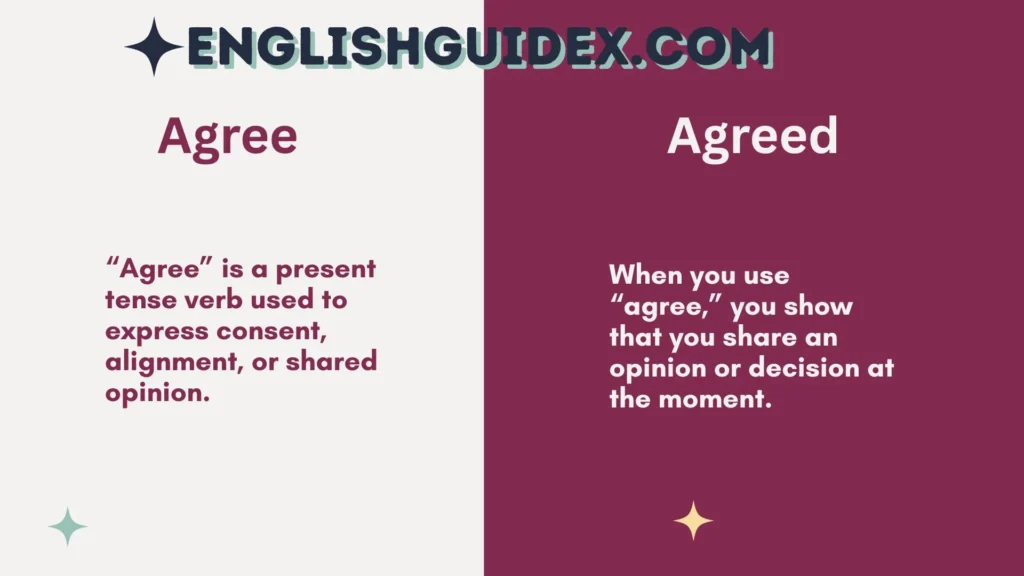
When you use “agree,” you show that you share an opinion or decision at the moment. This can happen in casual chat or professional settings.
Examples:
- Casual: I agree, that movie was amazing.
- Professional: The team agrees that we should start the project next week.
Notice how “agree” emphasizes present alignment rather than past consensus.
Practical Sentence Examples
Here’s a table showing agree in different contexts:
| Context | Sentence Example | Notes |
|---|---|---|
| Casual | I agree with you about the restaurant. | Everyday conversation |
| Professional | We agree to the proposed budget plan. | Meetings, emails |
| Formal Writing | Scholars agree that climate change is real. | Academic or formal context |
| Conditional | I would agree if the data were correct. | Hypothetical or conditional |
Exploring “Agreed”
Definition and Past Tense Function
“Agreed” is the past tense of “agree” and can also function as an adjective to describe a finalized decision or consensus.
Examples:
- Past tense: I agreed with her suggestion yesterday.
- Adjective: It is an agreed policy among the team.
Quick Tip: Use “agreed” when referencing something already decided or when affirming a statement.
Using “Agreed” in Conversation
In spoken English, “agreed” often stands alone as a response. It communicates approval or acceptance efficiently.
- Example dialogue:
- Let’s meet at 3 PM tomorrow.
- Agreed.
Situational usage:
- Casual conversations: friends, peers
- Meetings: colleagues, team agreements
- Negotiations: contracts, agreements
Examples in Dialogue
Scenario 1: Workplace
- Manager: “We need to submit the report by Friday.”
- Employee: “Agreed. I’ll make sure it’s done.”
Scenario 2: Friends making plans
- Friend 1: “Let’s try that new cafe this weekend.”
- Friend 2: “Agreed! I’ve been wanting to go.”
Notice how “agreed” signals immediate acceptance without repeating the whole sentence.
Key Differences Between “Agree” and “Agreed”
Understanding tense and context is crucial. Misusing these words can confuse your readers or listeners.
| Feature | Agree | Agreed |
|---|---|---|
| Tense | Present | Past / Adjective |
| Function | Express current consensus | Confirm past or finalized consensus |
| Common Usage | Dialogue, statements | Responses, formal statements |
| Example | I agree with your plan. | It’s agreed that the plan will start Monday. |
| Tip | Active participation | Affirmation or conclusion |
Common Mistakes to Avoid:
- Saying “I agreed with you now” → wrong tense.
- Using “agree” when confirming a past decision.
Advanced Usage and Nuances
Professional Communication
In emails, reports, or meetings, the difference between “agree” and “agreed” matters:
- Agree: Use when discussing ideas or ongoing discussions.
- We agree on the project timeline.
- Agreed: Use to confirm a decision or conclusion.
- It is agreed that the budget will be finalized by Monday.
Tip: “Agreed” makes your communication concise and professional.
Expressing Stronger Agreement
Sometimes, you want to convey enthusiasm or total alignment. Here are common phrases:
- I couldn’t agree more.
- Agreed wholeheartedly.
- I fully agree with your point.
These expressions are versatile and suitable for both spoken and written English.
Idiomatic and Less Common Constructions
- Agreed upon terms → Refers to finalized agreement details.
- Agreement reached → Formal announcement in business or law.
- Agreed to disagree → When two parties decide to respect differing opinions.
Idioms like these enrich language and make professional writing sound polished.
Tips to Remember
Here’s a quick memory toolkit:
- Agree → present, active, current opinion
- → past, finalized, response or confirmation
- Casual response: Use “agreed” alone to show acceptance.
- Professional writing: Use “agreed” to signal decisions clearly.
Fun Trick: Think “Agree = talking now” and “Agreed = decided already.”
FAQs About Agree vs Agreed
What is the difference between agree and agreed?
Answer: “Agree” is present tense for current consensus; “Agreed” is past tense or used as a confirmation.
Can you use agreed in informal speech?
Answer: Yes, it works perfectly as a short response to show agreement with someone.
When should I use agree in an email?
Answer: Use “agree” when discussing ideas or proposals in real-time communication.
Is “Agreed upon” grammatically correct?
Answer: Yes, it’s used to describe terms or rules that have been mutually accepted.
Can I say “I agreed with you yesterday” in casual English?
Answer: Yes, it’s correct for past events, emphasizing that your agreement happened earlier.
Conclusion
Mastering agree vs agreed is more than a grammar exercise—it’s about communicating clearly and confidently. Remember:
- Use agree for present opinions or current consensus.
- Use agreed for past decisions, confirmations, or responses.
- Context matters—casual vs professional, spoken vs written English.
- Practice in dialogue, emails, and writing to make it natural.
With these tips, tables, and examples, you’ll never hesitate to use the right form again.

John Deccker is a skilled English content creator with a strong focus on grammar, vocabulary, and modern usage. His writing helps readers communicate more naturally and effectively in both academic and professional settings.