The words annunciate and enunciate look so similar that many speakers assume they mean the same thing. They don’t. One deals with making an announcement. The other deals with how clearly you speak.
This confusion happens because both verbs revolve around communication, yet they operate in entirely different lanes. Readers, teachers, actors, call center employees, religious speakers, and even corporate leaders mix them up.
The goal here is to remove that confusion permanently and give you the confidence to choose the right word every time.
This guide follows a clear structure, offers side-by-side comparisons, and includes examples you can actually use. You’ll walk away knowing exactly when to use each word in academic writing, workplace communication, public speaking, or casual everyday conversation.
Definitions at a Glance: Annunciate vs Enunciate
Before diving into deeper explanation, here’s the quickest way to remember the difference:
| Word | Core Meaning | Quick Memory Trick |
|---|---|---|
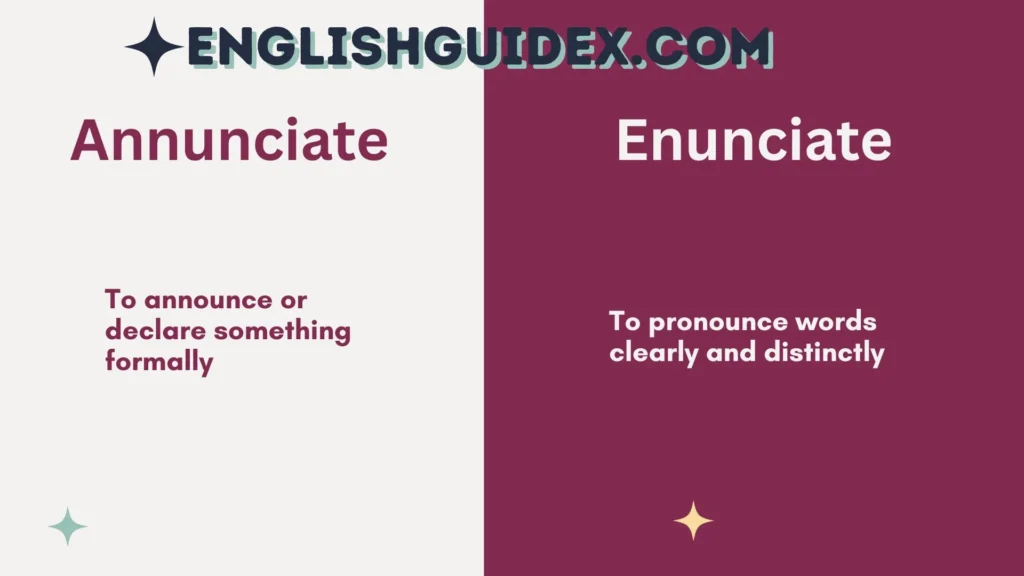
| Annunciate | To announce or declare something formally | Announciate ≈ Announce (same root idea) |
| Enunciate | To pronounce words clearly and distinctly | EnunCiate ≈ Clear Consonants |
In one sentence:
Annunciate relates to announcing a message.
Enunciate relates to articulation and clarity of speech.
Etymology & Origins
Language evolves, but roots matter. Understanding where a word came from helps you understand how to use it today.
Annunciate
- Comes from the Latin root annuntiare — meaning to announce or declare.
- Connected historically to formal messages, often with religious connotations.
- Shows up in ceremonial, authoritative, or solemn communication.
Enunciate
- Comes from the Latin enuntiare — meaning to articulate or speak out clearly.
- Evolved into a practical term for pronunciation and diction.
- Commonly used today in speaking, teaching, performance, and customer service.
Think of annunciate as public proclamation; enunciate as speech clarity.
How Usage Has Evolved Over Time
Language moves with culture. These words shifted as society’s communication needs changed.
- Annunciate used to appear more in sermons, royal declarations, and ceremonial speeches. Now it’s less common outside formal contexts. In most everyday cases, announce replaces it because it’s shorter and clearer.
- Enunciate gradually became a mainstream term across broadcasting, education, theater, leadership, and customer interaction. It’s the standard word for clear articulation.
Modern Comparison
| Context | Most Natural Word |
|---|---|
| Schools, training, speech therapy | Enunciate |
| Religious messages or proclamations | Annunciate |
| Professional customer communication | Enunciate |
| Ceremonial announcements or formal statements | Annunciate |
Annunciate: Meaning, Usage & Real-World Context
Annunciate isn’t dead, but it has a very specific purpose. It creates a tone. A mood. A sense of authority.
Correct Definition
Annunciate means to formally announce or proclaim something.
Where You’ll Hear It
- Religious services
- Ceremonial events
- Diplomatic or governmental statements
- Historical or literary writing
Examples in Clear Context
- “The cathedral bell rang as the priest prepared to annunciate the message.”
- “They will annunciate the new charter at the commencement ceremony.”
- “The ambassador will annunciate the revised peace agreement this evening.”
If it feels formal, solemn, traditional, or official, annunciate fits.
When NOT to Use Annunciate
Avoid using it when a simpler verb works better:
- Don’t say: He will annunciate his new phone number.
- Say instead: He will announce his new phone number.
If the message is casual, use “announce.”
Enunciate: The Art of Clear Speech
Where annunciate deals with the message, enunciate deals with how the message sounds.
Correct Definition
Enunciate means to pronounce words clearly and distinctly.
Where Enunciation Matters Most
- Public speaking
- Acting, theater, and voice work
- Classroom instruction
- Customer-facing communication
- Broadcasting or podcast recording
- Job interviews and presentations
People often judge credibility by how clearly someone speaks. Slurred or mumbled speech damages trust; enunciated speech builds it.
Examples in Real Context
- “Please enunciate so everyone on the call can hear you.”
- “Actors practice tongue twisters to improve their enunciation.”
- “Interview coaches teach candidates to slow down and enunciate key points.”
Practical Techniques for Better Enunciation
- Slow down your pace.
- Pause between thought groups.
- Open your jaw slightly more on vowels.
- Emphasize consonant endings.
- Practice reading aloud daily.
Enunciation isn’t about sounding perfect. It’s about being understood.
Professional Settings: Which One Fits Where?
To make this easier, here’s a reference table you can screenshot or save:
| Situation | Correct Word | Why |
|---|---|---|
| A priest delivering a ceremonial message | Annunciate | Formal proclamation |
| A manager giving instructions on a Zoom call | Enunciate | Needs clarity to avoid confusion |
| A theater coach training young actors | Enunciate | Focused on vocal clarity |
| A government official declaring new laws | Annunciate | Authoritative tone |
| Customer service staff speaking to clients | Enunciate | Prevents miscommunication |
Sentence Examples Side-by-Side
Seeing both verbs used correctly is the fastest path to mastery.
| Annunciate (Announcement) | Enunciate (Pronunciation) |
|---|---|
| “The bishop will annunciate the annual message at dawn.” | “The instructor asked students to enunciate their consonants carefully.” |
| “A spokesperson will annunciate the district’s new policy later today.” | “Radio hosts train to enunciate every word clearly for the audience.” |
| “They gathered to annunciate the opening of the hall.” | “If you don’t enunciate, the audience won’t understand you.” |
Quick Diagnostic Test
Ask yourself these two questions:
Are you declaring something publicly?
✔ Use annunciate
Are you speaking clearly and pronouncing each word?
✔ Use enunciate
That’s it. Your confusion is gone.
Common Mistakes
- Using annunciate in casual conversation where it sounds unnatural.
- Assuming enunciate is a fancy version of “pronounce.”
- Thinking the words are interchangeable just because they look similar.
- Overusing annunciate when announce is cleaner and more natural.
Short Case Studies
These real-world style examples prove how the meaning changes depending on the context.
Case Study 1 — The Public Speaker
A conference host keeps stumbling over technical terms. Their coach says:
“Don’t speak faster. Enunciate.”
Correct: the issue is clarity, not formality.
Case Study 2 — The Cathedral Ceremony
A choir director prepares a script for a traditional holiday service.
“At this part of the program, the Archbishop will annunciate the message.”
Correct: the focus is on formal proclamation.
Case Study 3 — Customer Service Call
A customer complains that they can’t understand the representative.
“Slow down and enunciate, please.”
Correct: pronunciation problem, not message delivery.
Memory Cheat Sheet
Annunciate = Announce a message
Enunciate = Speak with clarity
Pin it. Screenshot it. Tattoo it on your brain.
FAQs
What does annunciate mean?
Annunciate means to formally announce or proclaim information in a ceremonial or official context.
What does enunciate mean?
Enunciate means to speak clearly, articulate words, and pronounce sounds distinctly.
Can I use annunciate in normal conversation?
You can, but it will sound overly formal. “Announce” is typically the better option.
Is enunciate the same as pronounce?
Not exactly. Pronounce refers to how a word is said; enunciate refers to clarity and articulation.
Which one is more common today?
Enunciate is far more common in modern speech. Annunciate is niche, formal, and context-specific.
Conclusion: Annunciate vs Enunciate
If you’re announcing something formally or ceremonially, annunciate is the right choice.
If you’re focusing on clarity of speech, articulation, or diction, enunciate is the correct term. They belong to different communication categories, and mixing them up can confuse your audience.
Clear communication builds trust. The more precisely you choose your words, the more professional, confident, and credible you’ll sound.

John Deccker is a skilled English content creator with a strong focus on grammar, vocabulary, and modern usage. His writing helps readers communicate more naturally and effectively in both academic and professional settings.