Gratitude shapes conversations. A simple phrase like “appreciate it” or “appreciated it” can build trust, strengthen relationships, and communicate respect—yet many English learners struggle to choose the right version.
Timing, tone, and context determine which one fits. When you master both phrases, your communication becomes smoother, more confident, and more natural.
This guide explains the difference between appreciate it (present tense) and appreciated it (past tense) with examples, comparisons, case studies, and memory tricks that actually work.
Everything here follows the writing principles you provided: conversational tone, clarity, personal connection, and varied sentence structure.
What Does “Appreciate It” Mean in American English?
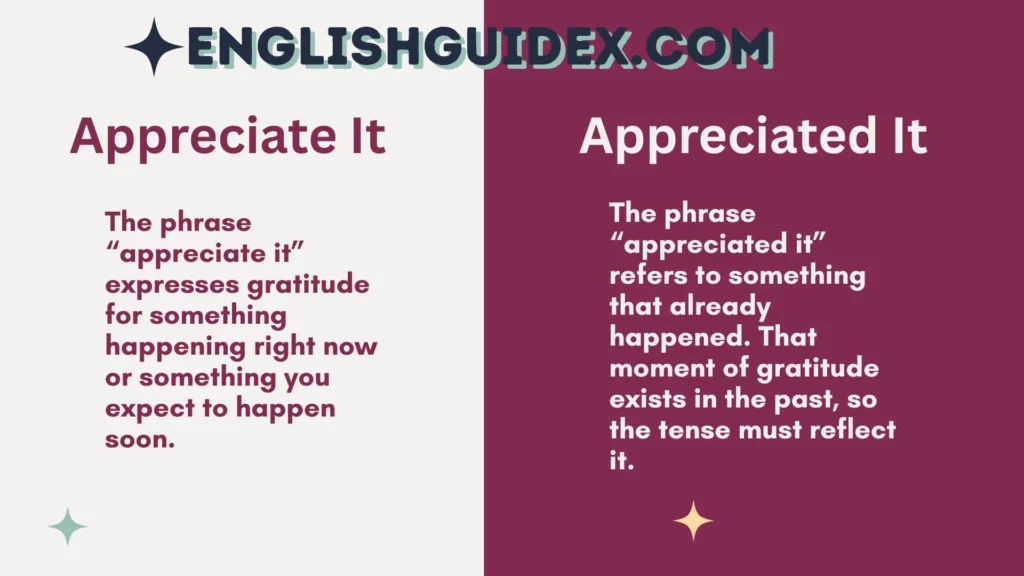
The phrase “appreciate it” expresses gratitude for something happening right now or something you expect to happen soon. It communicates positive feeling and acknowledgment, and it carries an immediate tone.
Think of it as the right now or in progress version.
You use “appreciate it” when:
- Someone is currently helping you.
- You’re thanking them as the favor happens.
- You’re requesting something politely.
- You expect an action in the near future.
Examples:
- “Thanks for carrying these boxes. I really appreciate it.”
- “If you can call me back today, I’d appreciate it.”
- “I appreciate it when you show up on time.”
This version sounds warm and conversational. It also works well for daily life, customer service, emails, and professional communication.
Tone characteristics:
- Polite
- Present-focused
- Respectful
- Slightly formal, but friendly
When to Use “Appreciated It” Correctly
The phrase “appreciated it” refers to something that already happened. That moment of gratitude exists in the past, so the tense must reflect it. Choosing this version shows emotional maturity and reflection. It signals that someone’s effort mattered—even after time passed.
You use “appreciated it” when:
- You are referring to a previous event.
- You’re acknowledging support after the fact.
- Something is finished, done, and over.
Examples:
- “I appreciated it when you visited me last week.”
- “They helped us during the move, and we appreciated it more than they know.”
- “You stepped in yesterday and I appreciated it.”
Tone characteristics:
- Retrospective
- Respectful acknowledgment
- Softer emotional expression
- Past-focused and complete
Grammar Snapshot: Appreciate It vs. Appreciated It
Grammar shouldn’t feel like a battle. Here’s a snapshot that simplifies everything.
| Phrase | Tense | When It’s Used | Emotional Tone | Example |
|---|---|---|---|---|
| Appreciate it | Present | For current or future actions | Active gratitude | I appreciate it if you can stay. |
| Appreciated it | Past | For completed actions | Reflective gratitude | I appreciated it when you stayed. |
| I’d appreciate it | Conditional | Polite requests about future help | Soft request / courteous | I’d appreciate it if you could wait. |
| I really appreciated it | Emphatic past | Strong feeling about past help | Deep thankfulness | I really appreciated it yesterday. |
Quick rule:
➡️ If it’s happening now or will happen soon — say appreciate it
➡️ If it already happened — say appreciated it
Why Context Changes the Meaning
Even though the phrases are similar, context decides which one works. Switching the tense accidentally changes the timeline and confuses the listener.
Picture this:
- Someone offers to help tomorrow.
Saying “I appreciated it” doesn’t make sense. The action hasn’t happened yet. - Someone helped you last year.
Saying “I appreciate it” feels unfinished or incorrect.
Language timing is emotional timing.
Context examples:
| Situation | Correct Phrase | Reason |
|---|---|---|
| You need a favor tomorrow | I’d appreciate it if you could help. | Future request |
| Someone already helped | I appreciated it when you stepped in. | Past action is finished |
| You’re thanking someone right now | I really appreciate it. | Current gratitude |
How Native Speakers Use These Phrases in Real Life
Native speakers don’t overthink grammar. They listen for emotional timing and choose the phrase automatically based on situation. That’s what makes them sound natural—and you can too.
Here’s where each phrase appears most in American English:
Where You’ll Hear “Appreciate It”
- Customer service: “We appreciate your patience.”
- Emails: “I appreciate your quick reply.”
- Professional meetings: “I’d appreciate it if we could continue.”
- Daily conversation: “I appreciate it, man. Really.”
Where You’ll Hear “Appreciated It”
- Apology conversations
- Reflecting on support
- Personal gratitude stories
- After a completed favor
Quotes from common speech:
“I appreciate it more than you know.”
“I appreciated it back then, even if I didn’t say it out loud.”
“I’d appreciate it if you could let me know today.”
Case Studies: Real Situations That Show the Difference
Short, realistic stories demonstrate how timing decides the phrase.
Case Study #1: The Workplace Email
A manager asks for a document.
❌ Incorrect: I appreciated it if you send me the report.
✔ Correct: I’d appreciate it if you send me the report.
Why: The request is future-focused, not past.
Case Study #2: Thanking a Friend
You got help moving last weekend.
❌ Incorrect: I appreciate it when you helped me move.
✔ Correct: I appreciated it when you helped me move.
Why: The event is over. The help is done.
Case Study #3: Customer Service Message
A company replies to a complaint.
❌ Incorrect: We appreciated your patience. (sounds like the issue is gone)
✔ Correct: We appreciate your patience. (issue still happening)
Why: The situation is still ongoing.
Side-by-Side Comparisons
Here’s proof that tiny changes create huge clarity differences.
| Wrong Sentence | Why It’s Wrong | Correct Sentence |
|---|---|---|
| I appreciated it if you come early. | Past tense with future action | I’d appreciate it if you come early. |
| I appreciate it when you fixed the printer. | Present tense with completed action | I appreciated it when you fixed the printer. |
| I appreciated it, thank you for helping now. | Past tense doesn’t match current help | I appreciate it, thank you for helping now. |
Memory Tricks to Get It Right Every Time
These aren’t generic mnemonic hacks—these actually stick.
- Future = F → F for “Favor coming soon” → Appreciate it
- Past = P → P for “Previously happened” → Appreciated it
- If you can still change the outcome → appreciate it
- If the moment is gone → appreciated it
Lightning test question:
Can the action still happen?
✔ Yes → Appreciate it
❌ No → Appreciated it
Mini Flow Chart
Did the action already happen?
     |
  Yes → Appreciated it
     |
  No → Appreciate it or I'd appreciate it
Mistakes Learners Make and How to Fix Them
These are the most common errors heard in real conversations.
❌ Mixing Past Action With Present Gratitude
- I appreciate it when you helped me. → Wrong
- Fix: I appreciated it when you helped me.
❌ Using “Appreciated It” to Request Something
- I appreciated it if you stay. → Wrong
- Fix: I’d appreciate it if you stay.
❌ Forgetting Tone and Politeness
- Appreciate it. (too short, sounds cold)
- Fix: I appreciate it, thank you.
The Ultimate Usage Table
| Usage Type | Correct Phrase | Sample Sentence |
|---|---|---|
| Ongoing help | Appreciate it | I appreciate it while you set this up. |
| Future request | I’d appreciate it | I’d appreciate it if you could call back. |
| Past acknowledgment | Appreciated it | I appreciated it when you stayed late. |
| Emotional gratitude | Really appreciated it | I really appreciated it yesterday. |
Practice Sentences
Try correcting these on your own first.
| Incorrect | Correct |
|---|---|
| I appreciated it if you answer today. | I’d appreciate it if you answer today. |
| I appreciate it when you visited. | I appreciated it when you visited. |
| I appreciated it now. | I appreciate it now. |
5 FAQs About Appreciate It vs Appreciated It
Is “I appreciate it” formal or informal?
It works in both settings. Tone depends on the delivery and sentence style.
Can I use “I’d appreciate it” in business emails?
Yes. It’s one of the most polite ways to request something without sounding demanding.
Is “I appreciated it” rude?
No. It shows past gratitude. It becomes rude only if tone or context feels dismissive.
Can I say “I really appreciate it” with emotional meaning?
Absolutely. Adding really strengthens sincerity when the moment is current.
Which version is best for requests?
I’d appreciate it if… is the most professional and polite choice.
Conclusion
Choosing between appreciate it and appreciated it comes down to timing. Present and future moments call for appreciate it, while completed actions belong to appreciated it. Once you understand that gratitude moves with the timeline, communication becomes natural, confident, and authentic.
If the moment isn’t finished → appreciate it
If the moment has passed → appreciated it
If asking politely → I’d appreciate it
Language feels like connection when the tense matches the emotion.

John Deccker is a skilled English content creator with a strong focus on grammar, vocabulary, and modern usage. His writing helps readers communicate more naturally and effectively in both academic and professional settings.