English learners often stumble when forming past tense questions, especially when it comes to “Did you have” and the incorrect “Did you had.”
It seems simple, yet this small difference can make a big impact on how natural and grammatically correct your English sounds.
By the end of this guide, you’ll know exactly how to use “Did you have” correctly, avoid common mistakes, and understand the difference from “Have you had.” Let’s dive in.
Understanding Auxiliary Verbs and Past Tense in English
English relies heavily on auxiliary verbs (also called helping verbs) to form questions, negatives, and complex tenses. When asking about past events, “did” becomes the key auxiliary verb.
Here’s the rule that clears the confusion: when you use “did,” the main verb must stay in its base form. Adding “had” after “did” creates a grammatical mistake because the past tense is already indicated by “did.”
Think of “did” as a time machine: it transports your sentence into the past, so your main verb doesn’t need any extra time markers.
Examples:
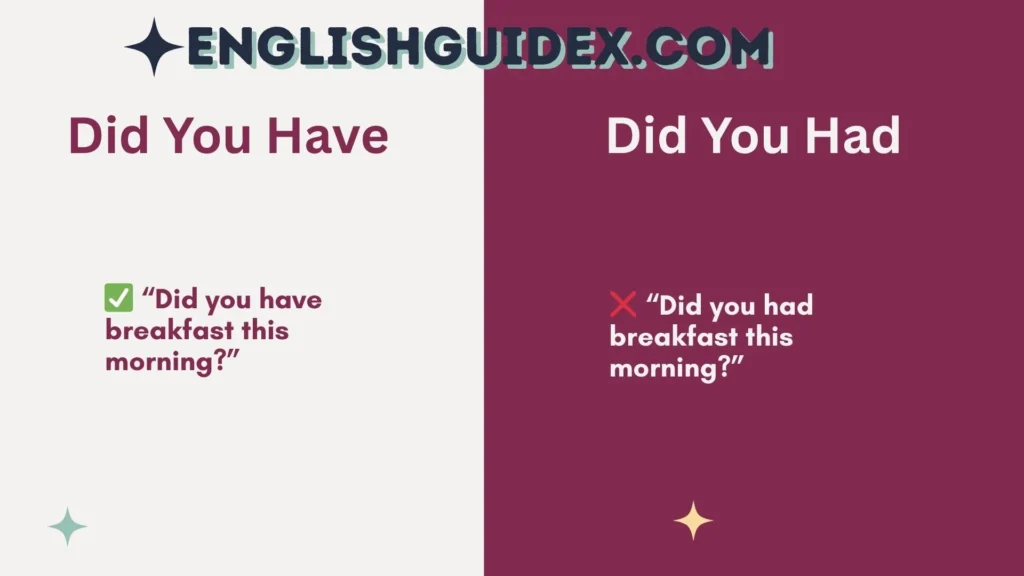
- ✅ “Did you have breakfast this morning?”
- ❌ “Did you had breakfast this morning?”
Notice how the second example adds an unnecessary past tense marker (“had”). It’s redundant and incorrect.
The Role of “Did” in Forming Questions
The auxiliary verb “did” is essential for forming questions in the simple past tense. It signals that the action took place in the past, so the main verb must remain in the base form.
Here’s how it works:
- Affirmative sentence: “She visited the museum yesterday.”
- Question: “Did she visit the museum yesterday?”
Notice that “visited” changes to “visit”. This is the core rule to remember: “did” + base verb = past tense question.
Other examples:
- “Did they see the movie last night?”
- “Did he go to the store this morning?”
- “Did you enjoy the concert?”
Each time, the main verb stays in its simplest form because “did” already carries the past tense weight.
Why “Had” Doesn’t Follow “Did”
One of the most common mistakes learners make is writing “Did you had”. Why is it wrong?
- Grammar rule: “Did” indicates past tense. The main verb should always be in its base form.
- Adding “had” creates double past, which English grammar doesn’t allow.
Think of it like this: If “did” is the driver, then your main verb is the passenger. The driver already sets the destination (past tense), so the passenger doesn’t need to take the wheel again.
Correct examples:
- ✅ “Did you have a good time at the party?”
- ✅ “Did she have lunch yet?”
Incorrect examples:
- ❌ “Did you had a good time at the party?”
- ❌ “Did she had lunch yet?”
You can also contrast this with past perfect tense, which uses “had” differently:
- “Have you had lunch yet?” → Present perfect, asking about experience or completed action relative to now.
- Notice: This is different from past simple and doesn’t use “did.”
Common Mistakes with “Did You Have” and How to Avoid Them
Even advanced learners fall into traps with “Did you have”. Here are the most frequent mistakes and strategies to fix them:
Mistake #1: Using “had” after “did” in all questions
- ❌ “Did they had a meeting yesterday?”
- ✅ “Did they have a meeting yesterday?”
Mistake #2: Confusing past simple vs past perfect
- ❌ “Did you had breakfast?” (past simple error)
- ✅ “Have you had breakfast?” (present perfect for unspecified time)
Mistake #3: Double past in negatives
- ❌ “Didn’t you had time to finish?”
- ✅ “Didn’t you have time to finish?”
Tips to Avoid Errors:
- Always remember: did = past, main verb = base form.
- Use “have” only in base form after “did.”
- If the question is about experience rather than a finished event, switch to present perfect (“have you had”).
Here’s a handy table of common mistakes and corrections:
| Incorrect | Correct | Explanation |
|---|---|---|
| Did you had breakfast? | Did you have breakfast? | “Did” already shows past tense. |
| Did she went home? | Did she go home? | Base form required after “did.” |
| Did they saw the movie? | Did they see the movie? | Past tense of main verb not needed. |
| Didn’t you had time? | Didn’t you have time? | Negative form follows same rule. |
| Did you had any issues yesterday? | Did you have any issues yesterday? | Avoid double past tense. |
Did You Have vs Have You Had – Understanding the Difference
This is a subtle but crucial distinction:
- Did you have → Past simple tense. Use it for specific, completed events in the past.
- Have you had → Present perfect tense. Use it for experience up to the present or unspecified past events.
Examples:
- Past simple:
- “Did you have lunch yesterday?” → The lunch happened at a specific time.
- Present perfect:
- “Have you had lunch?” → No specific time; focuses on the experience.
Think of it this way: Did = when, Have = whether or experience.
Quick visual:
| Phrase | Tense | Usage | Example |
|---|---|---|---|
| Did you have | Past simple | Specific past events | “Did you have a meeting yesterday?” |
| Have you had | Present perfect | Experience, unspecified past or ongoing | “Have you had a chance to see this?” |
Correct Use in Everyday Situations
Knowing grammar rules is one thing, using them naturally is another. Here’s how “Did you have” shows up in real life:
Asking about past events:
- “Did you have a good weekend?”
- “Did you have a chance to read the report?”
Inquiring about past possessions or experiences:
- “Did you have a dog when you were a child?”
- “Did you have any issues with the software?”
Business or professional examples:
- “Did you have a chance to review the meeting notes?”
- “Did you have time to complete the project before the deadline?”
Notice how in all cases, “have” stays in base form.
Strengthen Your Grammar: Practice Examples and Tips
Practice makes perfect. Here’s a set of exercises and tips to solidify your understanding:
Exercise 1: Transform sentences into past tense questions
- She visited the museum. → “Did she visit the museum?”
- They completed the project. → “Did they complete the project?”
- He watched the match yesterday. → “Did he watch the match yesterday?”
Exercise 2: Fill in the blanks
- “Did you ___ (finish) the assignment on time?” → ✅ finish
- “Did she ___ (call) her friend?” → ✅ call
- “Did they ___ (see) the new movie?” → ✅ see
Memory Tip:
- Always ask yourself: “Is ‘did’ already marking past?” If yes, use base form.
Additional Tip:
- Use “have you had” for experience-based questions, e.g., “Have you had a chance to try the new restaurant?”
Case Study: Common Mistakes Among English Learners
In classrooms and language apps, learners often write:
- ❌ “Did you had breakfast?”
- ❌ “Did you had a good time?”
Teachers correct them with:
- ✅ “Did you have breakfast?”
- ✅ “Did you have a good time?”
Observation: Most mistakes come from thinking English mirrors other languages’ past tense rules. Remember: English simplifies past questions with did + base verb.
Quick Comparison Table: Did You Have vs Did You Had
| Phrase | Correctness | Tense | Usage Context | Example |
|---|---|---|---|---|
| Did you have | ✅ Correct | Past simple | Specific past events | “Did you have lunch yesterday?” |
| Did you had | ❌ Incorrect | – | Avoid | “Did you had lunch?” ❌ |
| Have you had | ✅ Correct | Present perfect | Experience or unspecified past | “Have you had lunch?” ✅ |
FAQs
What’s the difference between “Did you have” and “Have you had”?
Answer: “Did you have” refers to a specific past event; “Have you had” asks about experience or unspecified past time.
Can I ever say “Did you had”?
Answer: No, it’s always incorrect. Use “Did you have” for past simple questions.
How do I know when to use “Did you have” vs “Have you had”?
Answer: Use “Did” for finished events at a specific time. Use “Have” for experiences or actions without a clear time.
Is “Did you have” formal or informal?
Answer: It’s neutral. Works in casual conversation, professional emails, or academic settings.
Can “Did you have” be used for possession?
Answer: Yes. Example: “Did you have a car when you lived in New York?”
Conclusion
Mastering “Did you have” vs “Did you had” is simple once you understand that “did” already marks past tense, so the main verb stays in its base form. Remember:
- ✅ “Did you have” → past simple for finished events
- ✅ “Have you had” → present perfect for experience or ongoing relevance
- ❌ “Did you had” → always incorrect
With practice, tables, and memory tips, you can confidently ask past tense questions in English without hesitation. Use these rules in casual chats, professional emails, or classroom discussions, and your English will sound natural and accurate.

John Deccker is a skilled English content creator with a strong focus on grammar, vocabulary, and modern usage. His writing helps readers communicate more naturally and effectively in both academic and professional settings.