Choosing between “envision” and “invision” trips up thousands of writers, students, professionals, and even marketers.
At first glance, both spellings look right and sound identical. That’s why the mix-up keeps spreading—especially online. However, only one spelling is correct in standard English, and using the wrong one can quietly damage credibility in emails, presentations, résumés, and marketing copy.
This guide breaks everything down in a friendly, practical, and highly detailed way. You’ll understand the spelling, the history, the correct usage, the branding exception, and how to never confuse them again. Along the way, you’ll see examples, tables, synonyms, real-world cases, and small writing hacks you can start using immediately.
What’s the Real Difference Between Invision and Envision?
Most confusion comes from phonetics. The word sounds like it has two parts—in + vision—so new writers assume “invision” must be right. But the correct spelling in every major dictionary and professional writing standard is:
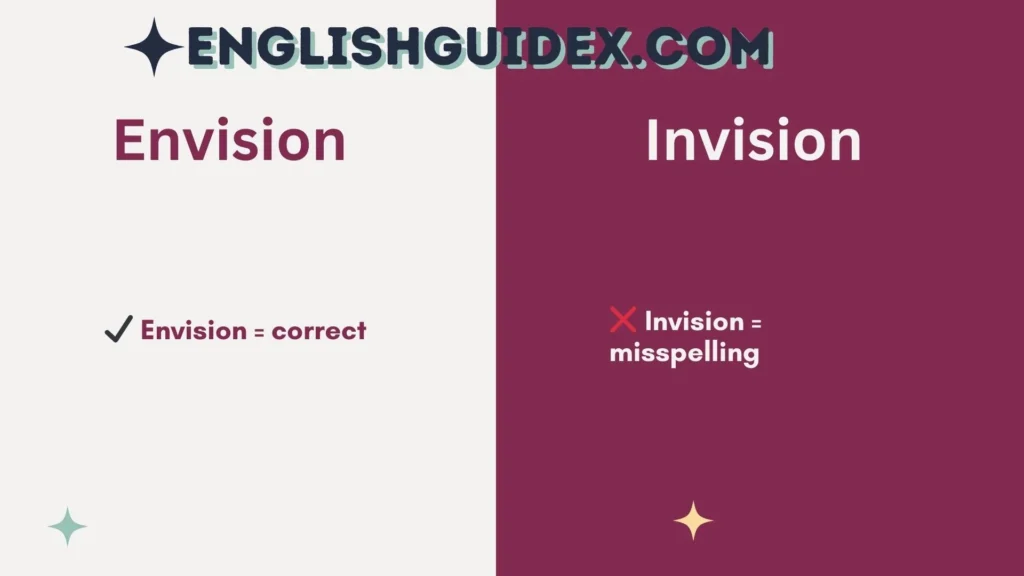
✔️ Envision = correct
❌ Invision = misspelling (unless referring to the company InVision)
You use envision whenever you want to say you picture something in your mind. You use InVision only when you’re talking about the design software brand.
Hook: Why This Spelling Mistake Shows Up Everywhere
You’ve probably seen the mix-up in places like:
- Marketing emails
- Business proposals
- Career statements like “I invision myself as a leader”
- Social media posts about goals and dreams
- UX design conversations
The core issue? Spelling shapes perception. When readers see a common error, they subconsciously downgrade the writer’s authority—even if the message is strong. So mastering the correct spelling matters.
Short rule to lock into memory:
Envision the future. InVision the software. Invision is a mistake.
A Quick Definition for Clarity
| Term | Correct? | Function | Meaning |
|---|---|---|---|
| Envision | ✔️ Yes | Verb | To imagine or picture something mentally |
| Invision | ❌ No | Incorrect spelling | Not standard English |
| InVision | ⚠️ Brand only | Proper noun | A UX/product design platform |
Where the Word “Envision” Came From (In Simple Language)
Envision traces back to language roots that connect to the act of seeing:
- Latin & French origins: “en” (to make) + “vision” (seeing)
- Gradually merged into a single concept focusing on mental imagery
- Adopted into modern English as a creative-mental-action word
Over time, dictionaries standardized envision as the official spelling because it maintains the structure of similar verbs:
- Empower
- Enrich
- Enlighten
- Enclose
So even if “invision” sounds logical, it doesn’t match English word-building patterns.
American vs. British Usage: Does It Change?
American English prefers envision. It’s used in business, education, media, literature, and academic research.
British English accepts envision, but traditionally leans toward a different word: envisage.
Quick Comparison Table
| Spelling | Region | Meaning | Recommended Use |
|---|---|---|---|
| Envision | US/Global | Imagine or picture mentally | Emails, strategy, writing |
| Envisage | UK/Commonwealth | Consider, foresee, predict | Formal tone, British contexts |
| Invision | None | Incorrect | Never use as a verb |
| InVision | Global brand | Design/prototyping software | UX product name only |
One Sentence that Summarizes It
If you’re talking about imagination, use envision.
If you’re in the UK and want a traditional tone, envisage works.
If you’re talking about UX tools, the brand is InVision.
But never write invision as a regular verb. It’s not accepted.

Why “Invision” Refuses to Die Online
Three forces keep the incorrect spelling alive:
1. Phonetic Confusion
People hear “envision” and mentally separate it into “in + vision.”
2. Autocorrect Errors
Some older devices used to autocorrect envision → invision because the brand name was indexed heavily.
3. Brand Influence
The company InVision popularized the spelling inside the design community.
“We use InVision to prototype our app.” → Correct
“I can invision the final app layout.” → Incorrect
“I can envision exciting updates for our app.” → Correct
When “InVision” Is Correct
Only when referring to the design platform, for example:
- “The team built the mobile prototype in InVision.”
- “UI designers still reference old InVision workflows.”
Everywhere else, stick with envision.
Synonyms for Envision (With Tone Differences)
| Word | Tone/Context | Meaning Shift |
|---|---|---|
| Imagine | Casual | General mental image |
| Visualize | Creative / Coaching | Mental picture more vividly |
| Picture | Emotional / Storytelling | More dramatic or sensory |
| Foresee | Predictive | Future-focused, analytical |
| Conceptualize | Technical | Early planning or design phase |
| Envisage | British / Formal | Predict or consider ahead |
Mixing these helps prevent repetition in writing.
Case Study: How Spellings Affect Professional Tone
Imagine two project update emails:
Email A (Incorrect)
“I invision a stronger client onboarding experience next quarter.”
Email B (Correct)
“I envision a stronger client onboarding experience next quarter, especially with refined handoff stages and clearer metrics.”
The second one:
- Projects confidence
- Looks more competent
- Communicates leadership instincts
Language isn’t just grammar. It’s branding.
How to Choose the Right Word Every Time
Use this checklist before you publish or send an email:
- Does the sentence refer to imagination or mental planning? → envision
- Are you in a UX/product design context? → InVision
- Are you writing with a British formal tone? → envisage
- Are you about to type “invision” without thinking? → Stop. Fix it.
This habit alone boosts clarity.
Real Sentence Examples
- “Leaders envision the finish line before starting the race.”
- “She could envision the company becoming global within five years.”
- “The designer shared the prototype built in InVision.”
- “British publications sometimes prefer the term envisage.”
5 Short FAQs About Envision vs. Invision
What does envision mean?
It means to imagine or picture something in your mind, often with clarity or purpose.
Is invision ever correct?
Only when referring to the brand name InVision, the design platform—not the verb.
Why do people spell it wrong?
Phonetics, branding influence, and autocorrect errors keep the confusion alive.
Is envisage the same as envision?
Close, but envisage leans formal/UK and can carry a predictive tone.
Which spelling should I use in professional writing?
Use envision for all general, business, academic, and personal writing.
Conclusion
The confusion makes sense. The spellings look and sound similar. But now the distinction is clear:
| Thought Process | Correct Use |
|---|---|
| Mental picture | envision |
| UX design tool | InVision |
| Common misspelling | invision |
Choosing the right word shows attention to detail, skill, confidence, and linguistic awareness. Every professional writer, student, marketer, designer, or entrepreneur benefits from getting it right consistently.
Final Rule: Envision the future. InVision the software. Invision is never the verb.

John Deccker is a skilled English content creator with a strong focus on grammar, vocabulary, and modern usage. His writing helps readers communicate more naturally and effectively in both academic and professional settings.