
Have you ever paused mid-sentence, unsure whether to say “I feel happy” or “I felt happy”? Even fluent English speakers sometimes stumble over feel vs felt, two words that seem simple but carry subtle nuances.
Understanding their proper use not only improves your grammar but also makes your speech and writing sound natural, expressive, and precise.
In this article, you’ll learn the meanings, usages, idioms, and common mistakes for feel and felt, along with examples, tables, and tips to master them effortlessly.
Understanding the Verb ‘Feel’
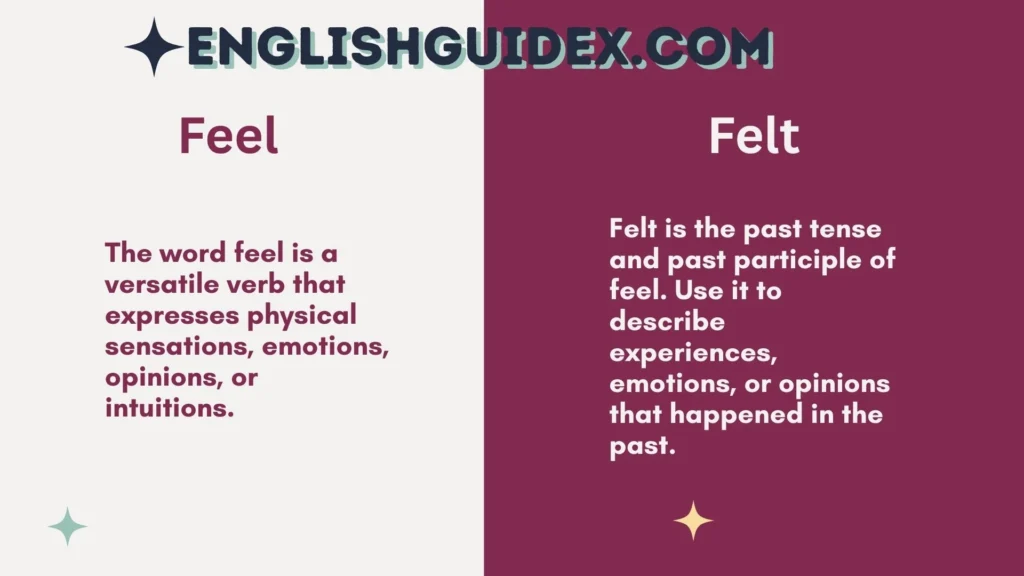
The word feel is a versatile verb that expresses physical sensations, emotions, opinions, or intuitions. It is primarily a present tense verb, used when referring to current experiences.
Present Experiences with Feel
When you want to talk about what’s happening right now, use feel.
- Physical sensation: “I feel cold in this room.”
- Emotion: “She feels nervous before presentations.”
- Intuition or opinion: “I feel this is the right choice.”
Quick tip: In casual speech, you can also use feel with adjectives to make your emotions vivid. For example: “I feel ecstatic!” or “I feel drained after work.”
Idiomatic Expressions with Feel
Idioms often use feel to express figurative ideas:
- Feel under the weather → feeling unwell
- “I feel under the weather today, so I’ll skip the gym.”
- Feel like a million bucks → feeling amazing
- “After the promotion, he feels like a million bucks.”
- Feel at home → feeling comfortable
- “She feels at home in her new apartment.”
Idioms like these show that feel goes beyond just physical sensations—it conveys emotional and social states, too.
Exploring ‘Felt’ – The Past Tense Form
Felt is the past tense and past participle of feel. Use it to describe experiences, emotions, or opinions that happened in the past.
Past Experiences with Felt
- Physical sensation: “Yesterday, I felt tired after work.”
- Emotion: “He felt anxious before the exam.”
- Intuition or judgment: “I felt something was off during the meeting.”
Idiomatic Expressions in Past Tense
Just like feel, many idioms also appear with felt:
- “I felt under pressure during the presentation.”
- “She felt over the moon when she received the award.”
- “They felt left out at the party.”
Remember: Idioms can shift subtly depending on whether you use feel or felt. Present tense implies a current state, past tense indicates reflection.
Grammar Deep Dive: Syntax and Sentiment
Correct usage of feel vs felt depends on tense, sentence structure, and nuance.
Sentence Structure
The basic formula is:
Subject + feel/felt + adjective/noun
- Present: “I feel happy.”
- Past: “I felt happy yesterday.”
Mood and Modality
- Expressing possibility or intuition:
- “I feel this might work.” (present opinion)
- “I felt this might work at the time.” (past opinion)
- Expressing reflection or memory:
- “I felt nervous during my first presentation.”
Common Mistakes
- Using feel in past contexts: “I feel tired yesterday” ❌ → Correct: “I felt tired yesterday.”
- Misusing participles in perfect tense: “I have feel happy” ❌ → Correct: “I have felt happy.”
Conveying Current Sensations and Emotions
Using feel effectively helps you express real-time experiences.
Physical Sensations
- Examples: “I feel cold,” “I feel energized,” “I feel tired.”
- Tip: Pair feel with specific adjectives to make your language vivid.
Emotional States
- Examples: “I feel nervous,” “I feel excited,” “I feel overwhelmed.”
- Using feel in professional contexts:
- “I feel confident presenting this report.”
- “I feel concerned about the project timeline.”
Opinions and Intuition
- Examples: “I feel this decision is wise.”
- Intuition with feel often expresses personal judgment:
- “I feel we should approach the client differently.”
Pro Tip: Using feel instead of “think” often adds warmth and human emotion to your sentences.
Expressing Past Sensations and Emotions
Felt allows you to reflect on past experiences or narrate events with emotional depth.
Examples of Felt in Daily Life
- Emotional reflection: “I felt nervous before my presentation last week.”
- Physical past sensations: “I felt exhausted after the marathon.”
- Intuition about past decisions: “I felt this project would succeed, and it did.”
Using Felt in Storytelling
In narratives, felt adds emotional context and depth:
- “She felt anxious as she stepped onto the stage, but once she began speaking, she felt relieved.”
- “They felt isolated during the lockdown, but writing letters helped them stay connected.”
Tip: Always include a time reference (yesterday, last week, during…) to clarify the past context.
Idiomatic Expressions and Figurative Language
Idioms using feel/felt make your language expressive and natural.
- Present tense: “I feel blue” → current sadness
- Past tense: “I felt blue” → past sadness
Other common idioms:
- Feel like a fish out of water → uncomfortable or out of place
- Feel the heat → experiencing pressure or stress
- Feel free → permission or comfort
Examples in Dialogue:
- Present:
- “I feel like trying something new.”
- “I feel overwhelmed by all these tasks.”
- Past:
- “I felt left out at the meeting.”
- “I felt relieved when the exam was over.”
Idiomatic expressions often change slightly depending on tense, so pay attention to context.
Pronunciation and Common Confusions
Proper pronunciation ensures your words are understood clearly:
- Feel → /fiːl/
- Felt → /fɛlt/
Common Mistakes
- Using feel in past contexts: “I feel tired yesterday” ❌
- Confusing participles: “I have feel happy” ❌
- Overusing feel in formal writing: opt for “I think” or “I am experiencing” if needed.
Tips to Remember:
- Present → feel (now)
- Past → felt (then)
- Add time markers for clarity: yesterday, last week, during…
Regional Differences and Variants
Both American and British English use feel and felt consistently, but some idiomatic expressions vary slightly:
- US: “I feel like going to the store.”
- UK: “I feel like having a cup of tea.”
Casual speech often uses contractions: “I’m feeling tired” (present continuous) vs “I was feeling tired” (past continuous).
Colloquial examples:
- Present: “I feel ya” → informal American English, meaning “I understand.”
- Past: “I felt ya were right” → reflective, casual past statement.
Practical Tips for Using Feel and Felt Correctly
- Memory Trick: Link feel → present, felt → past.
- Sentence Templates:
- Present: “I feel [adjective/noun].”
- Past: “I felt [adjective/noun] [time indicator].”
- Context Awareness:
- Use feel for current sensations, emotions, or opinions.
- Use felt for past reflection or storytelling.
Pro Tip: Mix adjectives, idioms, and time markers for natural, expressive sentences.
Comparison Table: Feel vs Felt
| Word | Tense | Function | Usage Context | Example Sentence |
|---|---|---|---|---|
| Feel | Present | Express current sensation/emotion | Speech, writing | “I feel nervous about the exam.” |
| Felt | Past | Express past sensation/emotion | Speech, writing | “I felt nervous yesterday.” |
| Both | Verb | Idiomatic & figurative use | Idioms & informal speech | “I feel/felt under the weather.” |
Examples in Dialogue
Present tense:
- Friend: “Are you okay?”
- You: “I feel tired today.”
Past tense:
- Friend: “How was your trip?”
- You: “I felt excited the whole time.”
Opinion-based:
- Present: “I feel this is a great idea.”
- Past: “I felt this was the best choice at the time.”
FAQs
What’s the main difference between feel and felt?
Answer: “Feel” is present tense for current sensations or emotions. “Felt” is past tense for past experiences.
Can I use felt in a present sentence?
Answer: No. Use “feel” for present expressions.
Are idiomatic expressions different with feel vs felt?
Answer: Yes. Some idioms are tense-specific, e.g., “feel under the weather” (present) vs “felt under the weather” (past).
How do I avoid mixing feel and felt in writing?
Answer: Check the time reference: now → feel; past → felt.
Can feel and felt express intuition or opinion?
Answer: Yes. “I feel this is right” (present opinion) vs “I felt this was right” (past opinion).
Conclusion
Mastering feel vs felt is easier than it seems. Here’s the takeaway:
- Feel → current emotions, sensations, or intuitions.
- Felt → past emotions, sensations, or reflections.
- Idioms, figurative language, and tense markers add nuance and depth.
- Using these words correctly makes your English sound fluent, natural, and expressive.
Start practicing by describing how you feel right now and how you felt yesterday. With consistent use, it becomes second nature.

David Jonson is an experienced English language writer who specializes in clear, practical, and learner-friendly content. He helps students and professionals improve their communication skills with confidence.