Confused between gases and gasses? You’re not alone. Many writers, students, and professionals mix them up, even in scientific and technical writing.
Understanding the difference is more than just grammar—it affects clarity, accuracy, and sometimes credibility.
In this guide, you’ll discover the real rules, practical tips, mnemonics, and examples that make remembering the difference simple.
Understanding the Core Difference
At first glance, gases and gasses may look almost identical. But they play entirely different roles in English.
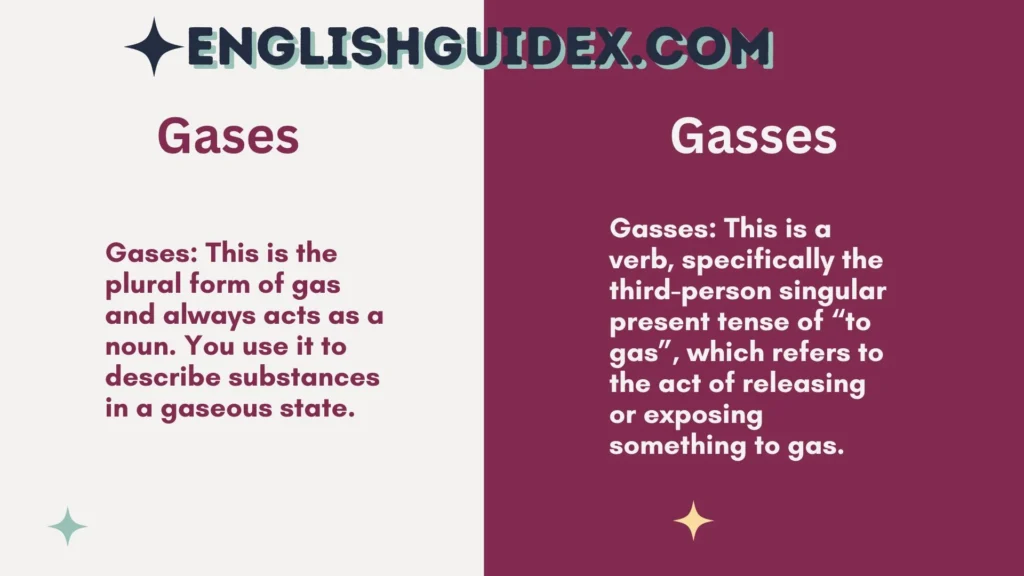
- Gases: This is the plural form of gas and always acts as a noun. You use it to describe substances in a gaseous state.
- Gasses: This is a verb, specifically the third-person singular present tense of “to gas”, which refers to the act of releasing or exposing something to gas.
Here’s a quick reference table:
| Word | Part of Speech | Typical Usage | Example Sentence |
|---|---|---|---|
| gases | Noun | Science, daily context | Oxygen and nitrogen are gases. |
| gasses | Verb | Action involving gas | Mechanics gasses the engine before starting. |
Remember, spelling changes meaning. Confusing them can alter the entire message.
Gases: The Noun You See Everywhere
Gases refers to substances in a gaseous state, one of the three fundamental states of matter (solid, liquid, gas). Scientists and educators use it constantly, but it also appears in everyday life.
Scientific Relevance
Gases make up everything from the air we breathe to industrial compounds. Examples include:
- Oxygen (O₂) – essential for respiration.
- Carbon dioxide (CO₂) – a greenhouse gas influencing climate.
- Hydrogen (H₂) – used in fuel cells and chemical reactions.
- Nitrogen (N₂) – forms about 78% of Earth’s atmosphere.
Fact: The average human inhales and exhales roughly 7–8 liters of gases per minute at rest, illustrating how central gases are to life.
Everyday Usage
Gases are not limited to labs. You encounter them regularly:
- Cooking gas: Propane or butane for stoves.
- Car exhaust gases: Carbon monoxide, nitrogen oxides, hydrocarbons.
- Industrial gases: Oxygen in welding, argon in electronics manufacturing.
Common Phrases with Gases
- Greenhouse gases
- Compressed gases
- Inert gases
Including contextual examples in writing helps avoid confusion with the verb gasses.
Gasses: When It’s a Verb
Unlike gases, gasses describes an action—specifically releasing or applying gas. It is used in a limited set of contexts, often technical or historical.
Definition
- Verb: To apply, fill, or expose to gas.
- Third-person singular present tense: He/She/It gasses.
Common Scenarios
- Fueling engines: “The mechanic gasses the car before testing it.”
- Pest control: “The team gasses the warehouse to eliminate insects.”
- Medical procedures: Historically, “gasses” was used for administering anesthetic gases.
Example Sentences:
- The technician gasses the chamber before the experiment.
- In old movies, villains gasses their opponents (classic historical usage).
Key Tip: If you can replace it with “applies gas” or “fills with gas,” you likely need gasses. Otherwise, it’s probably gases.
Spelling Rules and English Language Logic
English spelling can feel unpredictable, but the difference between gases and gasses follows a pattern.
Doubling Consonants
Verbs ending in a single vowel + consonant often double the consonant when forming third-person singular:
| Verb | 3rd Person Singular |
|---|---|
| gas | gasses |
| pass | passes |
| run | runs |
This rule explains why we don’t write gases as a verb—it would break English spelling conventions.
Historical Context
The verb “to gas” comes from the early 19th century, linked to chemical processes. Meanwhile, the plural noun gases evolved in scientific literature to describe multiple gaseous substances.
Gases in Science and Grammar
Pluralization Rules
- The plural of gas is always gases.
- Never write “gasses” when referring to multiple types of gas.
Example Table:
| Singular | Plural | Correct Usage | Incorrect Usage |
|---|---|---|---|
| Gas | Gases | Oxygen and hydrogen are gases. | Oxygen and hydrogen are gasses. |
States of Matter
A quick overview:
- Solid: Defined shape and volume
- Liquid: Defined volume, takes container shape
- Gas: No fixed shape, expands to fill space
Gases behave differently from solids and liquids, often compressible and invisible, making correct terminology crucial in science and engineering contexts.
Common Scientific Phrases
- “Greenhouse gases contribute to climate change.”
- “Inert gases prevent unwanted chemical reactions.”
- “Noble gases like argon are non-reactive.”
Common Mistakes and Misconceptions
Even educated writers stumble with these terms. Here’s how to avoid pitfalls:
Mistakes:
- Using gasses as the plural of gas.
- Confusing gases and gasses in writing about engines or chemicals.
Quick Fixes:
- Ask: “Is it an action or a thing?” → Verb = gasses, Noun = gases.
- Remember: Gases float, Gasses act.
Mnemonic Tip:
“Gases float as nouns, gasses act as verbs.”
Practical Tips to Remember the Difference
- Visual Mnemonic: Draw a cloud for gases (things that float) and an arrow for gasses (action).
- Checklist Before Writing:
- Is it a substance? → gases
- Is it an action? → gasses
- Contextual Awareness: Scientific papers, textbooks, or industrial manuals almost always use gases.
Real-Life Examples in Sentences
Science:
- “Greenhouse gases like carbon dioxide and methane trap heat in the atmosphere.”
Everyday Life:
- “The chef monitors kitchen gases to prevent leaks.”
Verb Usage:
- “The lab technician gasses the chamber before the chemical reaction.”
- “During World War I, soldiers were gassed in chemical warfare.” (historical context)
Industrial Examples:
- “Factories gasses meat storage areas for pest control.”
Tip: Highlighting correct usage in different contexts reduces ambiguity.
Related Terms and Confusions
To further enhance clarity and SEO, it’s worth exploring terms related to gas/gasses:
- Gas vs gasoline: Gas = substance, gasoline = fuel
- Vapor vs gas: Vapor may condense; gas stays gaseous at normal conditions
- Gassing (verb): Present participle of to gas
- Compressed gases: Cylinders of pressurized gas
Helpful Table:
| Term | Meaning | Usage Example |
|---|---|---|
| Gas | Substance in gaseous state | Oxygen is a gas. |
| Gasoline | Fuel for cars | I filled the tank with gasoline. |
| Vapor | Gas that can condense | Water vapor rises from boiling water. |
| Gassing | Action of applying gas | The lab is gassing the chamber. |
FAQs
What is the difference between gases and gasses?
Answer: Gases are substances in a gaseous state (noun). Gasses is the verb form of “to gas,” meaning to apply or expose to gas.
Can I use gasses as a plural noun?
Answer: No. The plural of gas is always gases.
How do I remember when to use gasses?
Answer: Think action. If someone or something applies gas, use gasses. Mnemonic: Gases float, gasses act.
Is “gas” always singular?
Answer: Gas can be singular or plural. Plural form is gases.
Are there any other common mistakes with gases/gasses?
Answer: Yes. Confusing the words in scientific writing or using gasses in casual text instead of gases is a frequent error.
Conclusion
In English, gases and gasses may seem tiny, but their difference matters. Remember: noun = gases, verb = gasses.
Use tables, mnemonics, and contextual examples to avoid mistakes. Mastering this distinction will improve your writing, scientific communication, and professional credibility.

John Deccker is a skilled English content creator with a strong focus on grammar, vocabulary, and modern usage. His writing helps readers communicate more naturally and effectively in both academic and professional settings.