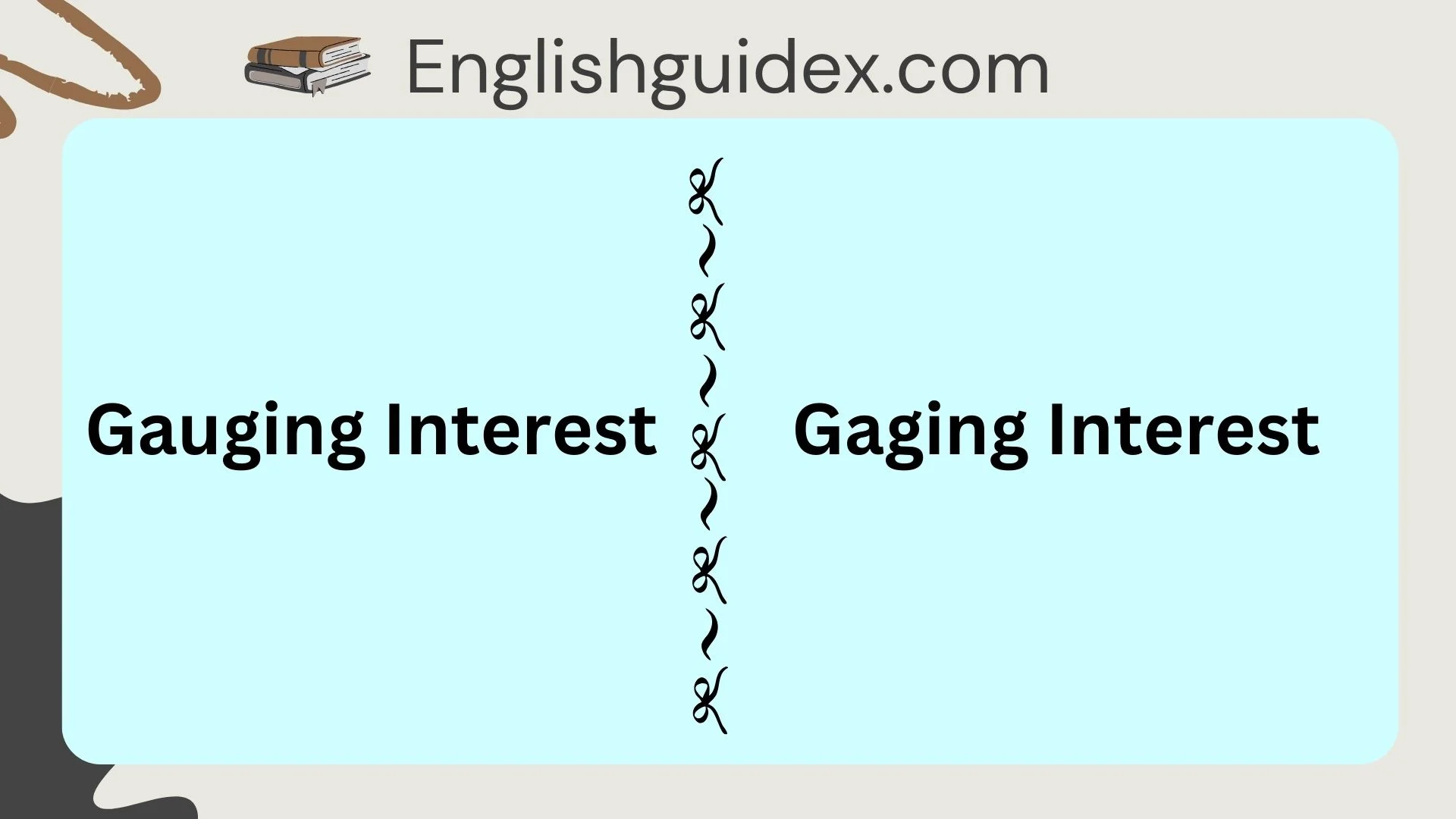
When most people pause before writing the phrase, they’re usually wondering which spelling looks professional and which one readers expect. To clear it up fast:
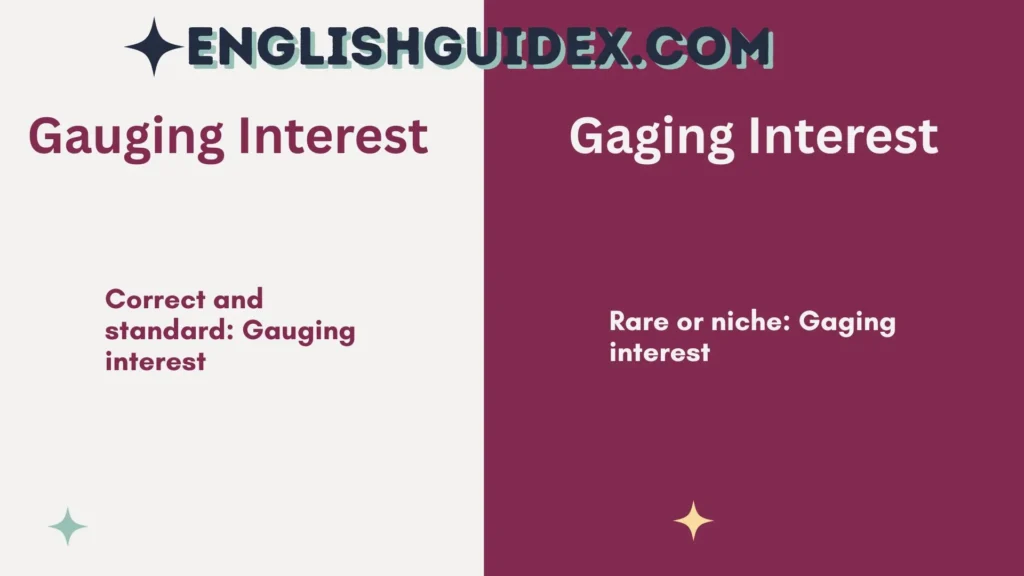
- Correct and standard: Gauging interest
- Rare or niche: Gaging interest
- Reason: “Gauge” means measure, assess, evaluate, which directly matches the intended meaning.
Writers use gauging interest in business communication, marketing, investing, education, customer research, and internal workplace messaging. The alternative spelling gaging interest occasionally appears in highly technical fields, but using it in regular writing can make the content look incorrect, outdated, or uninformed.
Gauging vs. Gaging: The Core Difference
The two words look similar, but they don’t share equal weight in modern English. One aligns with common usage; the other has a narrow path.
Gauge means:
- to measure
- to assess
- to evaluate demand or readiness
- to estimate size, capacity, interest, or reaction
You see it tied to:
- gauge pressure
- gauge audience response
- gauge performance
- gauge market demand
Gage, however, carries older, specialized meanings:
- a measuring device/tool in machining
- a pledge or token in archaic writing
- a technical spelling variation in certain engineering environments
Think of it this way: If you’re talking about tools or metalworking, “gage” might show up. If you’re talking about people, audiences, or demand, gauging is the term you want.
Etymology & Origin (Where This Confusion Started)
The modern spelling gauge traces back to Old French terms like gauge/galge, referring to a measurement standard or calibrating object. Early merchants, toolmakers, and craftsmen adopted it to describe the act of checking or measuring quantities.
The spelling gage split off later. It simplified the spelling in some trades and appeared in pockets of technical literature. That created a dual-track evolution:
| Word | Modern Use | Field Association |
|---|---|---|
| Gauge | Standard, modern English | Business, marketing, education, communication |
| Gage | Technical or legacy term | Machining, fabrication, measurement tools |
As industry and education standardized, gauge dominated everyday writing. “Gage” survived as a specialist spelling instead of a mainstream version.
Usage in Modern English (Where Each Belongs Today)
Most professional writing favors the spelling gauging interest because it communicates clearly across departments and industries. It avoids confusion and feels familiar to the reader’s eye.
Where you’ll see “gauging interest”:
- Business emails
- Marketing research reports
- Product launch planning
- Event organization
- Classroom or student engagement surveys
- Investor or client prospecting conversations
Where “gaging” might show up:
- Tool and die manufacturing
- Precision machining documentation
- Aviation component standards
- Metalworking instructions
- Calibration devices (e.g., “gage blocks”)
It isn’t that gaging is always wrong; it’s that it’s rarely right for communication about people, information, behavior, or demand.
Why “Gauging Interest” Is the Standard Today
If someone sees “gaging interest” outside of a workshop or technical document, they may assume it’s a typo. That reaction matters because spelling affects credibility. When your goal is to build trust, communicate authority, or win a reader’s confidence, the standard spelling performs better.
Using “gauging interest” does three things:
- Shows familiarity with modern spelling
- Demonstrates attention to detail
- Improves clarity by matching reader expectations
In professional communication, clarity earns respect. In marketing, clarity earns conversions.
When “Gaging” Can Be Correct
Let’s imagine a machinist calibrating precision components. In that niche, “gage blocks” or “gage pins” describe specific products. Some brands and manuals retain the spelling intentionally. If you’re speaking directly to those audiences, spelling consistency matters more than general rules.
Example contexts where “gage” may appear:
- Engineering manuals
- Tooling catalogs
- Aviation component specs
- Metalworking inspection tools
The key: that still doesn’t justify “gaging interest” in everyday writing. Context determines correctness.

Real Examples in Sentences
Correct general usage:
- “We’re gauging interest to see how many people want early access.”
- “Before launching, the team is gauging customer demand.”
- “Teachers often gauge interest to plan elective courses.”
Incorrect outside technical fields:
- “We’re gaging interest for the new class.” ❌
- “Please complete this form as we are gaging interest.” ❌
Correct inside technical niches:
- “We ordered new gage blocks for calibration.” ✔️
- “This shop uses Class ZZ gage pins for precision.” ✔️
Practical Ways to Gauge Interest in Real Life
If the goal is to test interest before committing time or resources, the smartest move is evidence gathering. Whether the audience consists of customers, coworkers, investors, or students, people reveal intent through actions.
Methods to Gauge Interest
- Soft landing pages
- Waitlists or beta signups
- Surveys and pulse checks
- Direct outreach messages
- Demo requests or previews
- Polls and quick feedback forms
What to Measure
| Metric | What It Shows |
|---|---|
| Sign-ups | Intent to act |
| Replies or messages | Engagement level |
| Click-throughs | Curiosity or early demand |
| Pre-orders | Commitment and urgency |
| Demo requests | High-value interest |
A simple principle guides this:
People act faster when they care. When they don’t care, they don’t move.
Tracking behaviors makes the decision clearer than simply guessing.
Synonyms & Alternatives for Natural Writing
If you want to avoid repeating the same phrase, rotate vocabulary to maintain flow and clarity:
- Assessing interest
- Testing demand
- Measuring response
- Sizing up engagement
- Feeling out the room
- Taking the temperature
- Weighing market appetite
Pick the one that fits the tone. For example, “taking the temperature” sounds informal; “assessing demand” feels analytical.
Case Study: Using the Right Spelling in Business Messaging
A small software team planned a limited beta launch. They needed proof that there was interest before investing development hours. Their early communication used the phrase “gauging interest” in their outreach emails. That single phrase led readers to interpret the message as professional, intentional, and focused on the audience’s needs.
They collected:
- beta waitlist sign-ups
- qualitative feedback
- feature priority insights
The spelling choice didn’t close deals alone, but it reinforced credibility. Precision improves perception, and perception impacts response.
Quotes That Help Frame the Decision
“If language is a tool, clarity is the sharpest edge.”
“Readers trust what feels familiar. They reject what feels off.”
“The spelling that conveys intent wins. The spelling that confuses loses.”
FAQs (Before the Conclusion)
Is “gaging interest” wrong?
It’s not universally wrong, but it’s incorrect in general writing. It only survives in technical pockets.
Does spelling affect credibility?
Yes. People question language before they question data. Clear writing supports trust.
Are both spellings interchangeable?
No. They diverged in meaning, usage, and audience. Choose based on context.
Which spelling belongs in business, marketing, or education?
Use gauging interest to maintain clarity and authority.
What if my audience uses the technical spelling?
Match the audience. Tools and machining professionals may expect “gage.” Everyone else expects “gauge.”
Conclusion
If the goal is to measure reaction, test response, or determine demand, gauging interest is the correct and trusted spelling.
It works across settings because readers recognize it and understand its purpose instantly. Save gaging for manuals, machining, or calibration tools. Everywhere else, clarity wins.
Language evolves, but confusion doesn’t persuade. The right spelling does.

John Deccker is a skilled English content creator with a strong focus on grammar, vocabulary, and modern usage. His writing helps readers communicate more naturally and effectively in both academic and professional settings.