Language evolves the way people do. One moment a phrase means “God be with ye” and centuries later it’s a simple farewell typed at the end of a text message.
That’s exactly what happened to the word goodbye—a term that now appears in multiple spellings and creates constant confusion:
Is it “goodbye,” “good-bye,” or “good bye”?
This guide cuts through that confusion. No fluff. No vague language history. Just real clarity, practical usage, and examples you can apply right away.
The Origin of “Goodbye” — A Farewell With Spiritual Roots
Centuries ago, people didn’t say “goodbye.” They said something far more intimate and spiritual:
“God be with ye.”
At the time, farewells carried a blessing, not a punctuation mark. Over time, spoken language twisted and compressed the phrase, the same way modern texting turns “I will talk to you later” into “ttyl.”
How the Evolution Happened
| Stage of Change | Form of the Phrase | How People Said It |
|---|---|---|
| Original Blessing | God be with ye | Formal, spiritual, emotional |
| Early Contraction | God b’wye | Shortened, conversational |
| Transitional Stage | Goodbwye / good-bye | Printed language influences |
| Modern Standard | Goodbye | Everyday spelling |
As printing spread and dictionaries gained authority, the spelling good-bye emerged first, then slowly lost its hyphen as language simplified.
Goodbye vs Good-bye vs Good bye: Which One Is Correct Today?
Three spellings circulate, but they don’t carry equal weight. Here’s the clearest answer possible:
The Most Accepted and Standard Form
✔️ Goodbye — the dominant modern spelling.
Teachers, editors, publishers, and most modern writing guides favor goodbye because it’s clean, simple, and consistent.
The Traditional or Stylistic Form
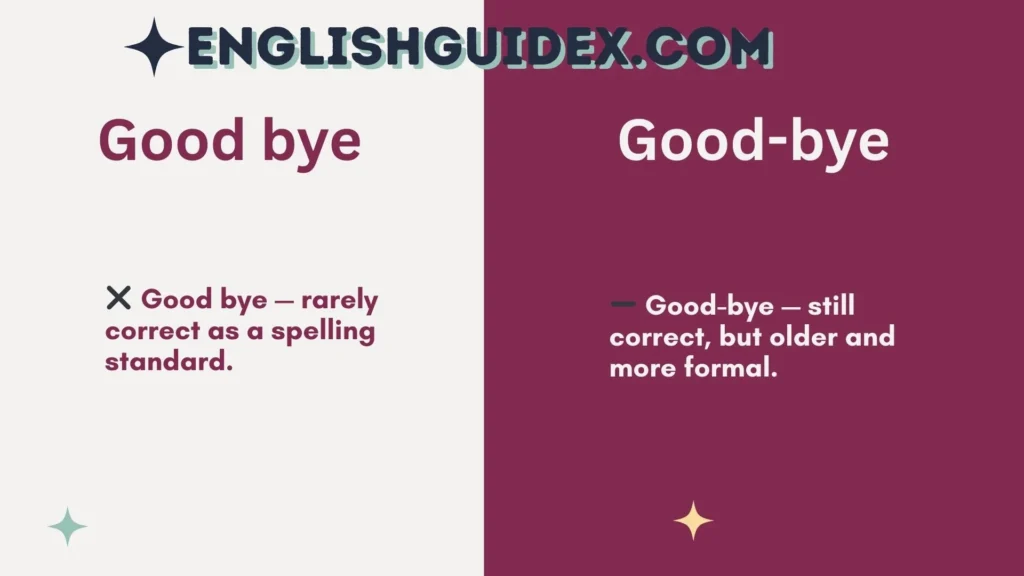
➖ Good-bye — still correct, but older and more formal.
Writers sometimes choose this version to add emotional weight, especially in literature or heartfelt letters. It feels nostalgic.
The Least Accepted Form
✖️ Good bye — rarely correct as a spelling standard.
It appears mostly in outdated text or old writing. You can use it stylistically, but it’s not considered standard English.
What Dictionaries and Style Guides Say
Modern writing relies heavily on editorial standards, so looking at expert references gives clarity.
General Consensus Across Style Guides
- Goodbye is the primary preferred form.
- Good-bye is listed as acceptable but old-fashioned.
- Good bye appears mainly as two separate words when functioning grammatically (for example, “to say good bye to someone” in older styles).
Fact: Even though “goodbye” wasn’t the oldest spelling, it became the standard because communication needed consistency.
Practical Rule to Remember
| If You Want… | Use This Form |
|---|---|
| Modern clarity | Goodbye |
| Poetic emphasis or emotional tone | Good-bye |
| Outdated literary feel | Good bye |
Regional Variations: Does Location Affect the Spelling?
Dialects and regions subtly shift preferred spellings.
| Region | Most Common Form | Notes |
|---|---|---|
| United States | Goodbye | Dominant in schools, publishing, and business |
| United Kingdom | Good-bye / Goodbye | Hyphen shows up more often in literature |
| Canada | Goodbye | Same as US, modern standard |
| Australia | Goodbye | Hyphens mostly disappear in digital writing |
| Older Texts Worldwide | Good bye | Historical but mostly retired |
Digital communication is pushing every region toward a single version: “Goodbye.”
Common Misconceptions About the Word “Goodbye”
Many people assume they’re using the “wrong” form, but confusion comes from outdated assumptions rather than grammar errors.
Misconceptions to Stop Believing
- Myth: “Good-bye” is the only correct version.
Reality: It’s correct but not required. - Myth: “Good bye” must be used because “good” modifies “bye.”
Reality: This is an outdated grammatical interpretation. - Myth: Spelling changes tone.
Reality: Tone comes from phrasing, not punctuation.
Choosing the Best Version Based on Context
The spelling you pick should match your goal, audience, and emotional tone.
Formal Communication
- Emails
- Resignation letters
- Academic writing
- News and business communication
Best choice: Goodbye
Emotional or Personal Sentences
- Breakups in novels
- Poetic endings
- Dramatic dialogue
Best choice: Good-bye
Casual or Digital Communication
- Text messages
- Social media posts
- Everyday chatting
Best choice: bye, see ya, take care, etc.
Why “Goodbye” Matters Culturally
This isn’t just a spelling debate—it’s a cultural shift. As language modernized, farewells became shorter and less religious.
Think of how people say goodbye now:
- “See you”
- “Later”
- “’Night”
- “Take care”
- “Peace”
The emotional connection faded as language leaned toward simplicity. Some writers deliberately use good-bye to restore that emotional weight.
“Removing the hyphen didn’t just change the spelling. It changed the feeling.”
— Editorial commentary, literary tradition
Case Studies: When Each Spelling Works Best
1. Business Email
❌ It was great working with you. Good-bye.
✔️ It was great working with you. Goodbye.
2. Novel Dialogue
✔️ He hesitated at the door, whispering, “Good-bye.”
3. Short Text Message
✔️ bye, talk later
Creative Alternatives to Saying Goodbye
Sometimes, the best farewell isn’t the classic one. Here are options depending on tone:
Friendly & Warm
- Catch you later
- Talk soon
- Take care
Professional
- Regards
- Until next time
- With appreciation
Emotional / Dramatic
- Farewell
- Until we meet again
- May our paths cross again
Casual
- Bye
- Later
- Cya
Quick Reference Table
| Spelling | Tone | Best Use |
|---|---|---|
| Goodbye | Standard | Emails, general writing, modern tone |
| Good-bye | Emotional / Dramatic | Narratives, older styles |
| Good bye | Outdated | Historical reference only |
FAQs
What is the most correct spelling?
Goodbye is the modern standard and most accepted.
Is “good-bye” wrong?
It’s not wrong. It’s just older and more dramatic.
Can I ever use “good bye”?
Yes, but only for stylistic or historical effect.
Which spelling should students use?
Students should use goodbye for clarity and consistency.
Which form looks most professional?
Goodbye — clean, modern, and widely approved.
Conclusion
Language changes, but clarity lasts. Today, goodbye leads as the standard spelling because it’s simple, modern, and easy to use across personal and professional contexts.
You can still choose good-bye for emotional emphasis or good bye for historical or stylistic purposes—but when in doubt, choose the version most readers expect.
If a spelling helps your writing connect with someone more deeply, that’s the right one in that moment.
And with that… goodbye.

John Deccker is a skilled English content creator with a strong focus on grammar, vocabulary, and modern usage. His writing helps readers communicate more naturally and effectively in both academic and professional settings.