Easter Sunday brings with it a phrase that resonates through centuries of Christian tradition: “He is risen”. But if you’ve ever wondered whether it should be “He is risen” or “He has risen,” you’re not alone.
This small grammatical difference sparks debates among writers, preachers, and everyday believers alike. Understanding the difference is more than a matter of grammar—it’s about history, theology, translation, and the very meaning of the resurrection itself.
In this article, we’ll dive deep into the origins, grammatical nuances, theological significance, and modern usage of both phrases, helping you use them correctly in writing, sermons, or conversation.
Understanding “He Is Risen”: Origins and Meaning
The phrase “He is risen” has been part of English-speaking Christianity for centuries. Its roots trace back to early Bible translations such as Wycliffe’s Bible (1382) and Tyndale’s Bible (1526), reaching wide popularity through the King James Version (1611).
In Greek, the phrase comes from ἐγήγερται (egēgertai), which literally means “he has been raised.” Early English translators rendered this in the present tense, saying “He is risen” to convey that Christ’s resurrection is an ongoing, living reality, not merely a past event.
- Liturgical significance:
Churches still use “He is risen” in hymns, Easter proclamations, and liturgical readings. It carries a poetic, reverent tone that emphasizes victory over death. - Example: “He is risen indeed! Alleluia!” – Traditional Easter greeting.
The choice of “is” over “has” also reflects older English usage, where the present tense was sometimes used to indicate completed actions with continuing relevance—a nuance modern English grammar sometimes loses.
“He Has Risen”: Grammatical Clarity
While “He is risen” is beautiful and traditional, modern English often favors “He has risen.” This is present perfect tense, which expresses a completed action with current significance.
- Grammatical point:
- Present perfect = action completed but still relevant now → “He has risen.”
- Present tense (archaic) = ongoing state → “He is risen.”
Examples in modern English:
- Correct: “Christ has risen from the dead, fulfilling prophecy.”
- Less formal/traditional: “He is risen” (used mainly in religious contexts).
Using “has risen” aligns with contemporary English rules, making it easier for readers unfamiliar with archaic forms to understand the resurrection’s ongoing importance.
Scriptural Evidence Across Translations
Examining scripture across translations shows why both phrases exist. The differences are subtle but meaningful.
| Bible Version | Key Verse (Matthew 28:6) | Phrase Used | Notes |
|---|---|---|---|
| King James Version (1611) | “He is not here: for he is risen, as he said.” | He is risen | Traditional, poetic, widely used in hymns |
| New International Version (NIV) | “He is not here; he has risen, just as he said.” | He has risen | Modern English, clearer grammar |
| English Standard Version (ESV) | “He is not here, for he has risen, as he said.” | He has risen | Accurate to Greek, formal style |
| New Living Translation (NLT) | “He isn’t here! He has risen from the dead.” | He has risen | Simple, conversational |
Fact: Even in translations that use “has risen,” the Greek remains the same. The variance reflects English style rather than theological disagreement.
Theological and Liturgical Implications
The verb tense impacts theology and how we understand the resurrection:
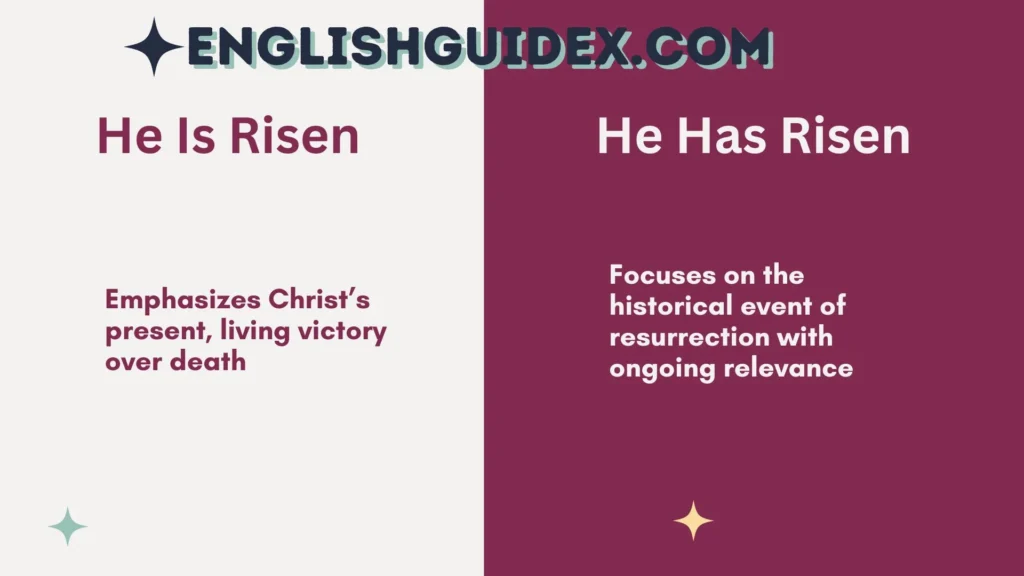
- “He is risen”
- Emphasizes Christ’s present, living victory over death
- Used in liturgical proclamations, traditional hymns, and Easter greetings
- “He has risen”
- Focuses on the historical event of resurrection with ongoing relevance
- Preferred in modern Bible translations and teaching materials
Quote:
“The resurrection is not just something that happened; it is something that is happening, something that transforms the present.” – Theologian N.T. Wright
Denominational usage varies:
- Catholic and Orthodox traditions often retain “He is risen” in liturgy.
- Protestant and evangelical churches may prefer “He has risen” for clarity in teaching.
Historical Context of the Phrase
The difference also reflects how English evolved:
- Middle English (1100–1500): Present tense could express completed actions. Hence, “He is risen” was grammatically correct.
- Early Modern English (1500–1700): Archaic forms persisted in religious texts, even as everyday English evolved.
- Modern English: “Has risen” conforms to present perfect rules taught in schools today.
Interestingly, archaic forms often survive in religious contexts because they convey a sense of sacred tradition.
Modern English Usage and Style Considerations
If you’re writing, preaching, or crafting a greeting card, here’s a practical guide:
- Use “He is risen” when:
- Addressing a traditional or liturgical audience
- Quoting scripture in KJV style
- Writing poetic, reverent content
- Use “He has risen” when:
- Writing for modern readers
- Explaining the resurrection in educational or casual contexts
- Seeking clear grammar in contemporary English
Tips for writers:
- In blogs, articles, and social media, “He has risen” is easier to read and avoids confusing archaic structure.
- In church bulletins or Easter cards, “He is risen” adds historic gravitas.
Common Misconceptions and Pitfalls
Many people mix these phrases or misuse them. Some key points:
- Misconception: “He is risen” is grammatically wrong.
- Reality: It’s archaic but still correct in religious contexts.
- Misconception: Only one version is theological correct.
- Reality: Both convey the same truth; differences are stylistic and translational.
- Social media traps: People often post “He has risen indeed!” without understanding context. Both versions are fine, but pairing is key: “He is risen!” → “He is risen indeed!”
“He has risen!” → “He has risen indeed!”
Example table of greetings:
| Greeting | Correct Pairing | Usage |
|---|---|---|
| He is risen! | He is risen indeed! | Traditional/Easter |
| He has risen! | He has risen indeed! | Modern writing |
Making the Right Choice: Practical Guidelines
Here’s a quick-reference framework to decide which phrase to use:
| Factor | He is risen | He has risen |
|---|---|---|
| Audience | Traditional, churchgoers | Modern readers, students |
| Context | Hymns, liturgy, sermons | Articles, blogs, teaching |
| Tone | Poetic, reverent | Clear, instructional |
| Translation | KJV, Wycliffe, Tyndale | NIV, ESV, NLT |
Decision rule: If you want historical or liturgical weight, use “He is risen.” If you want clarity and modern grammar, use “He has risen.”
FAQs
What is the difference between “He is risen” and “He has risen”?
“He is risen” is traditional, present tense, emphasizing ongoing victory. “He has risen” is modern, present perfect, emphasizing completed action with current relevance.
Can I use “He has risen” in a church service?
Yes, it’s grammatically correct and understandable, but it may sound less traditional than “He is risen.”
Why does the King James Bible use “He is risen”?
Early English grammar allowed present tense to express completed actions. KJV translators kept this to reflect both meaning and poetic style.
Which phrase is more common today?
Modern translations and writers tend to use “He has risen” for clarity, while liturgical contexts still prefer “He is risen.”
Do the Greek or Hebrew texts prefer one phrase over the other?
No, the original Greek uses ἐγήγερται, which can be rendered both ways. The difference in English is stylistic, not theological.
Conclusion
Whether you say “He is risen” or “He has risen,” you’re proclaiming the same eternal truth: Christ conquered death, and His resurrection impacts us today.
Understanding the subtle differences in grammar, history, and theology enriches how we write, speak, and celebrate this central Christian belief.
By choosing the right phrase for your audience and context, you can convey both reverence and clarity, keeping the Easter message alive in hearts and minds.

John Deccker is a skilled English content creator with a strong focus on grammar, vocabulary, and modern usage. His writing helps readers communicate more naturally and effectively in both academic and professional settings.