When you see the words “Hola” and “Ola”, they look almost identical. They even sound the same.
But one of them means hello, and the other refers to the kind of wave surfers chase along a coastline.
That single missing letter shifts the meaning entirely. This guide breaks down the difference so you never mix them up again, especially in writing, conversations, travel, or branding.
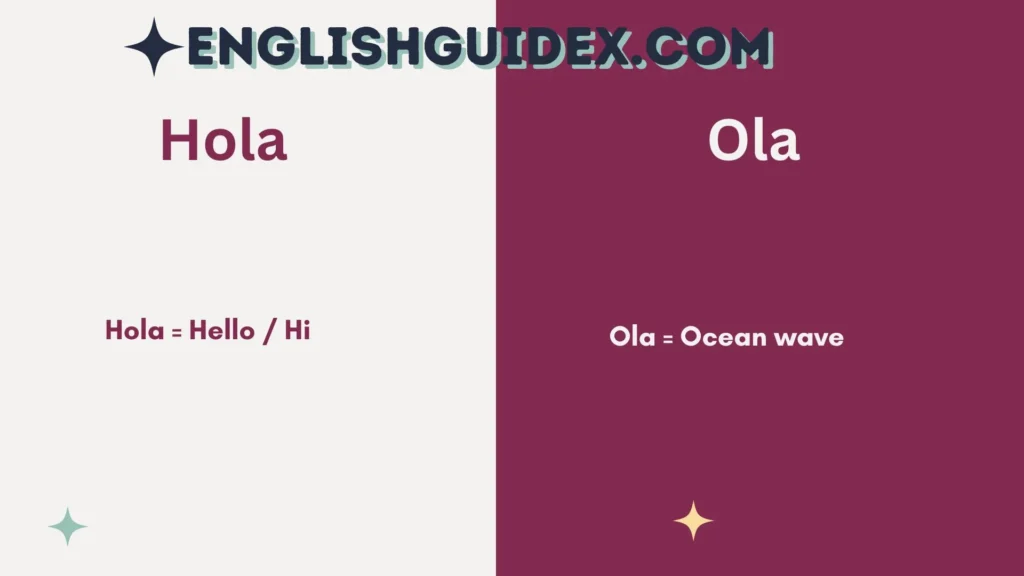
Short answer upfront:
Hola = Hello / Hi
Ola = Ocean wave
But this topic goes deeper than a quick definition. Spanish carries history, culture, etiquette, and pronunciation habits that shape how people use the word.
If you understand those layers, you’ll greet people confidently and avoid awkward mistakes, especially if you speak English or you’re learning Spanish for daily life, travel, or professional use.
What “Hola” Really Means (and Why People Use It Everywhere)
The word hola means hello, and Spanish speakers use it exactly the way English speakers use hi. It’s friendly, neutral, and safe in almost any casual situation. Unlike formal greetings such as “Buenos días” or “Buenas tardes”, hola doesn’t rely on time of day or formality level.
Common uses of “Hola”
- Greeting friends or family
- Starting a text, DM, or WhatsApp conversation
- Approaching someone in customer service
- Introducing yourself politely but casually
- Meeting someone for the first time in a relaxed setting
Example sentences
- Hola, ¿cómo estás? = Hi, how are you?
- Hola, mucho gusto. = Hello, nice to meet you.
- ¡Hola! ¿Todo bien? = Hey! Everything good?
English speakers sometimes hesitate, worried about sounding “too Spanish,” but the truth is simple: Hola is one of the easiest Spanish greetings to integrate naturally.
The Origin of “Hola” and Why the H Is Silent
The H in hola stays silent because Spanish inherited the letter from older languages where aspiration faded over centuries. It originally evolved from older greeting forms used in Latin-speaking regions. Even today, that silent consonant hints at historical evolution rather than phonetic purpose.
Quick historical breakdown
| Time Period | Development |
|---|---|
| Latin era | Greeting roots influenced Iberian speech |
| Old Spanish | “F” sound shifted → silent consonant phase |
| Modern Spanish | Standardized spelling preserves the H, silent in speech |
Nothing about the H changes pronunciation. It just signals history.
How to Pronounce “Hola” Correctly
Pronounce hola as if the H doesn’t exist. Start with a clean vowel, not a breathy English “H” sound.
Correct: OH-lah
Incorrect: HO-la (English H sound)
If you say “hola” like “holla,” as in English slang, Spanish speakers instantly notice. It doesn’t sound offensive—just foreign.
Pronunciation guide for English speakers
- Open the “O” sound like in oak
- Keep the “la” soft, not heavy like “law”
- Avoid adding extra emphasis or speed
Hola Across Different Spanish-Speaking Regions
While hola works everywhere, tone and follow-up phrases shift with region. Spanish isn’t identical worldwide, so the greeting changes slightly depending on culture, age, and environment.
| Region | How “Hola” Sounds in Practice | Notes |
|---|---|---|
| Spain | ¡Hola, tío! / informal energy | “Tío” (dude/bro) is common slang |
| Mexico | Hola, buenos días / polite combo | Double greeting feels respectful |
| Argentina | ¡Hola, che! / casual | “Che” adds local tone |
| Caribbean | Holá (quick, clipped) | Rhythm sounds faster |
| US Latino communities | Mix of English + Spanish | “Hola, how are you?” is normal |
In highly formal situations, professionals may switch to:
- Buenos días – Good morning
- Buenas tardes – Good afternoon
- Buenas noches – Good evening/night
But hola still works in most social contexts without sounding childish or sloppy.
What “Ola” Means (and Why It’s Not a Greeting)
The word ola means wave, like seawater curling toward the shore. It’s literal, physical, and completely unrelated to saying hello. This is where most newcomers make mistakes, especially in writing.
Example sentences
- La ola del mar era enorme. = The wave in the sea was huge.
- Vimos una ola gigante en la playa. = We saw a giant wave at the beach.
- Los surfistas siguieron la ola. = The surfers followed the wave.
If you write ola in a message where you meant hola, you accidentally say:
“Wave, how are you?”
Not ideal.
Hola vs Ola: Simple Comparison Chart
| Word | Meaning | Category | Sound | When to Use |
|---|---|---|---|---|
| Hola | Hello, Hi | Greeting / Communication | OH-lah | Talking to a person |
| Ola | Wave | Ocean / nature / science | OH-lah | Talking about water, surfing, weather |
Even though they sound identical, only context reveals the meaning. In writing, spelling matters more than pronunciation.
Why Spanish Has Homophones Like “Hola” and “Ola”
Homophones—words that sound the same but mean different things—exist because Spanish spelling evolved faster than pronunciation changes. Over time, silent letters stayed in the alphabet, while speaking habits simplified.
Examples of Spanish homophones
- Hecho / echo
- Votar / botar
- Haya / haya / allá / allá
- Bello / vello
If those look confusing, remember the rule:
If you can swap the word and it breaks meaning, you’ve chosen the wrong one.
How English Speakers Can Use “Hola” Naturally (Without Sounding Forced)
If you’re learning Spanish or mixing it into English, you can introduce hola in a subtle, confident way. You don’t need perfect grammar to greet someone kindly.
Ways to use “Hola” effortlessly
- Start emails or messages:
Hola María, hope your day’s going well! - Meeting someone new:
Hola, soy (your name). Nice to meet you. - On vacation:
Hola, ¿puedo ver el menú? → Can I see the menu? - Customer service:
Hola, ¿me ayudas por favor?
Strong conversational openers
- Hola, un momento por favor. → Hello, one moment please.
- Hola, ¿hablas inglés? → Hi, do you speak English?
- Hola, solo estoy mirando. → Hi, I’m just looking.
These make you sound respectful and human, not performative.
Hola in American English, Advertising & Social Culture
US companies use hola intentionally. It signals friendliness, cultural awareness, and inclusion. You see it in commercials, storefront signs, social media posts, and big brand marketing campaigns.
Where it appears:
- Retail (targeting bilingual shoppers)
- Music and entertainment (Latin influence in US pop)
- Social events and street culture
- Online slang, memes, captions
It’s not uncommon to hear:
“Hola! Welcome! Come in!”
Mixing English and Spanish isn’t unusual—it’s modern communication.
Common Mistakes to Avoid
People often make the same errors when learning Spanish. These habits are easy to fix.
❌ Writing “ola” as a greeting on signs, menus, or branding
❌ Pronouncing the H like English “H”
❌ Adding unnecessary accents → holá (incorrect)
❌ Overusing hola in formal interviews or ceremonies
❌ Writing it casually but using overly formal tone afterward
Correct greeting examples
- Hola, mucho gusto.
- Hola, ¿en qué puedo ayudarte?
- Hola, buen día.
Case Study: One Letter, Big Consequence
A café opened with branding that read:
“Ola Café – Fresh Coffee & Smiles!”
People assumed it was a beach or surfing café. Locals joked about the ocean theme. The owner changed signage to:
“Hola Café – Coffee, Community, Connection”
Immediately, visitors understood the message. Same name, new meaning—business improved.
Famous Quote About Communication
“Language is the doorway to connection, not perfection.”
Using hola isn’t about sounding fluent. It’s about extending warmth.
Frequently Asked Questions (FAQs)
Why do “Hola” and “Ola” sound the same?
Because Spanish pronunciation dropped the “H” sound centuries ago, leaving both words with identical vowel openings.
Is it rude to use Hola with strangers?
No. It’s friendly and widely accepted. In very formal settings, switch to Buenos días / tardes / noches.
Can I write Hola with an accent as Holá?
No. The accent doesn’t exist. Holá is considered incorrect.
Do Spanish speakers use Hola in professional emails?
Yes, when the tone is friendly or semi-formal. It’s not appropriate for legal letters, government forms, or strict corporate communication.
Is Hola slang?
No. It’s a standard greeting recognized globally.
Conclusion
The words hola and ola share sound but not meaning. You greet people with hola. You talk about the ocean with ola.
One simple letter separates conversation from coastline. When you choose the right one, you communicate with clarity, confidence, and respect.
If you’re saying hello, it’s H-O-L-A.
If there’s water involved, it’s O-L-A.
Start small. Use it lightly. Let it feel natural.

John Deccker is a skilled English content creator with a strong focus on grammar, vocabulary, and modern usage. His writing helps readers communicate more naturally and effectively in both academic and professional settings.