When you ask someone “How long?” or “How much time?” you’re not just choosing between two phrases.
You’re actually deciding the tone, the expectation, and the level of precision you want in the answer. One sounds casual and natural. The other feels measured, scheduled, and sometimes more formal.
This guide breaks down both expressions in depth. No fluff. No vague explanations. Just clear instruction backed by examples, patterns, and real-life usage.
How Long or How Much Time? Understanding the Core Difference
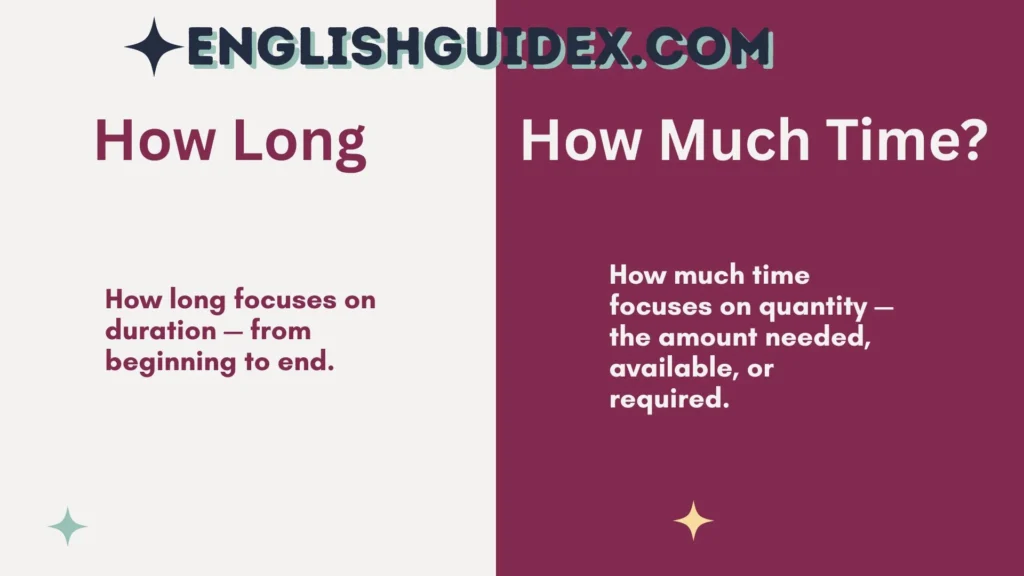
How long focuses on duration — from beginning to end.
How much time focuses on quantity — the amount needed, available, or required.
Think of it like this:
| Phrase | Think About It Like | What You Expect |
|---|---|---|
| How long | A timeline | A duration answer (minutes, hours, days) |
| How much time | A measuring cup | A specific amount or a limit |
If you want simplicity, choose How long.
If you need an exact number, choose How much time.
Understanding Duration in English (Why This Matters)
English speakers treat time like a resource. It flows, it gets used, and you can run out of it. That mindset shapes how each question works.
Time can be:
- Measured (5 hours, 20 minutes, 2 years)
- Experienced (a journey, an event, a condition)
- Allocated (schedule, planning, deadlines)
This is why people instinctively switch between both phrases depending on context.
Example Thought Process:
- If I want a casual estimate → “How long is it?”
- If I need to plan in detail → “How much time will this require?”
That’s the foundation everything else builds on.
How Long: Natural, Conversational, Common in Real English
People use how long constantly in daily speech. It’s direct, friendly, and doesn’t force a precise answer. It invites explanation rather than a strict number.
Meaning
“How long” asks for the entire length of something, from start to finish.
Think duration. Not quantity. Not measurement. Just the span.
Where It Fits Best
- Experiences: movies, travel, school, events
- Actions: staying, waiting, learning, driving
- States: living somewhere, being employed, being married
Grammar Patterns
| Structure | Example |
|---|---|
| How long + does/did + subject + verb? | How long does it take to bake bread? |
| How long + have/has + subject + past participle? | How long have you worked here? |
| How long + will it take + to… ? | How long will it take to install this? |
These patterns sound natural in American English.
Context Examples for “How Long”
| Situation | Natural Question |
|---|---|
| Watching something | How long is the documentary? |
| Travel | How long does the train ride take? |
| Skills & habits | How long did it take to master driving? |
| Life changes | How long have you lived in that city? |
Quote that captures the tone:
“How long?” is what you ask when you expect a story, not a stopwatch result.
How Much Time: Measured, Precise, and Schedule-Focused
If how long is casual, how much time is strategic.
It gives the conversation structure and expectations.
Meaning
“How much time” asks for a measurable amount, often to plan or manage something.
It’s the phrase of planners, managers, students, surgeons, project leaders — anyone who must allocate time sensibly.
Where It Fits Best
- Deadlines
- Time limits
- Project planning
- Task scheduling
- Assessing workload
Grammar Patterns
| Structure | Example |
|---|---|
| How much time + will/does + subject + need? | How much time will the repair need? |
| How much time + do we have + before/until? | How much time do we have before the flight? |
| How much time + should I allocate + for…? | How much time should I allocate for revision? |
When the situation has pressure or importance, this phrase is the better match.
Examples of “How Much Time”
| Context | Natural Question |
|---|---|
| Scheduling | How much time do we have until the meeting starts? |
| Productivity | How much time should I block for this assignment? |
| Personal planning | How much time will packing take? I need to leave by 3. |
| Workload | How much time will the new project require? |
Quote that captures the mood:
“How much time?” turns minutes into decisions.
How Long vs How Much Time — Head-to-Head Comparison
| Category | How Long | How Much Time |
|---|---|---|
| Tone | Natural, neutral | Structured, formal |
| Precision | Approximate | Specific |
| Use Case | Experiences, timelines | Planning, limits, schedules |
| Best For | Everyday talk | Work, school, deadlines |
| Example | How long is the movie? | How much time do we have before it starts? |
Rule of Thumb:
If no one cares about precision → How long
If someone will be late, charged, or graded → How much time
When Both Work (But Don’t Mean the Same Thing)
Some questions accept both, but the intention changes.
Example 1
- How long do you need? → I want an estimate.
- How much time do you need? → I want an exact number.
Example 2
- How long will dinner take? → Curious
- How much time will dinner take? → Planning around it
Subtle difference. Big impact.
Mistakes Non-Native Speakers Should Avoid
- Asking How much time? in casual moments
- Forgetting auxiliary verbs (do/does/will/have/has)
- Mixing present perfect and present simple
- Asking How long time? (incorrect phrase)
Incorrect vs Correct
| ❌ Incorrect | ✔️ Correct |
|---|---|
| How long time will it take? | How long will it take? |
| How much time the movie is? | How long is the movie? |
| How long do we have time? | How much time do we have? |
One tiny shift changes whether you sound fluent or awkward.
Conversation Templates You Can Use Today
| Situation | Natural Sentence |
|---|---|
| Travel | How long will the trip take by car? |
| Work | How much time should I reserve for this task? |
| Appointments | How long will the appointment last? |
| Planning | How much time do we have before the deadline? |
| Personal life | How long have you known each other? |
Use these until they feel automatic.
Quick Duration Tools to Estimate Time
- Stopwatch or timer for habits
- 10–20% extra buffer for unexpected delays
- Digital planners for tracking blocks of time
- “Backward scheduling” from deadlines
Example of backward scheduling:
If something is due at 4 PM, and it takes 3 hours:
Start no later than 1 PM, add 20 minutes buffer, so begin 12:40 PM.
Case Study: Two Learners, Two Approaches
Maria (beginner):
She asked How much time? for everything. Her questions sounded stiff, even when she meant something casual.
After correction:
She used How long? in daily talk and reserved How much time? for deadlines. Her conversations felt more native.
James (intermediate):
He said How long? even when he needed specifics.
After correction:
He used How much time? at work when assigning tasks. His team understood expectations clearly.
Lesson:
Using the right phrase builds confidence and avoids confusion.
Mini-Quotes for Memory
“How long?” listens to the story.
“How much time?” watches the clock.
“How long?” opens the conversation.
“How much time?” organizes the decision.
Frequently Asked Questions
Can I use “How much time” in casual conversation?
Yes, but it may sound more formal than needed. Choose it when precision matters.
Is “How long time” correct in English?
No. English never combines the words long and time like that.
Which phrase is more common in the US?
How long in everyday life; How much time in planning, business, or scheduling.
Can both phrases be used for future events?
Yes, but the tone changes. How long? = estimate. How much time? = planning.
Is “How long” ever considered formal?
It can be, but it’s generally neutral and works across all tones.
Conclusion
Choosing between How long and How much time isn’t a grammar test. It’s a decision about tone, precision, and expectation. One phrase asks for clarity. The other asks for measurement. Mastering both removes hesitation and instantly makes your English feel more fluent.
Use How long for duration.
Use How much time for measurement.
Know the purpose, choose the tone, and the sentence writes itself.

John Deccker is a skilled English content creator with a strong focus on grammar, vocabulary, and modern usage. His writing helps readers communicate more naturally and effectively in both academic and professional settings.