Understanding the difference between “impatient” vs. “inpatient” matters, because they look almost identical but point to completely different ideas.
One word describes a feeling. The other refers to a medical status. Get them mixed up and you might confuse someone’s mood with hospital care.
This guide breaks everything down in plain English, without jargon. You’ll see examples, memory tricks, sentence breakdowns, and real-world context so you never mix these two up again.
Impatient vs. Inpatient: Why People Get Confused
English can be sneaky. One letter can flip the meaning of a word, and this pair is a perfect example.
People confuse these words because:
- They look similar at a glance.
- They sound similar when said quickly.
- Spellcheck sometimes auto-corrects them incorrectly.
- Both relate to the root word patient, but in opposite ways.
One is emotional, one is medical. One is a feeling, one is a physical location.
If you grasp that core difference, everything else falls into place.
What “Impatient” Means (Emotion, Behavior & Tone)
The word impatient describes someone who has little or no patience. It’s about emotion, not healthcare. It shows up when someone wants something to happen faster or refuses to wait calmly.
Simple definition:
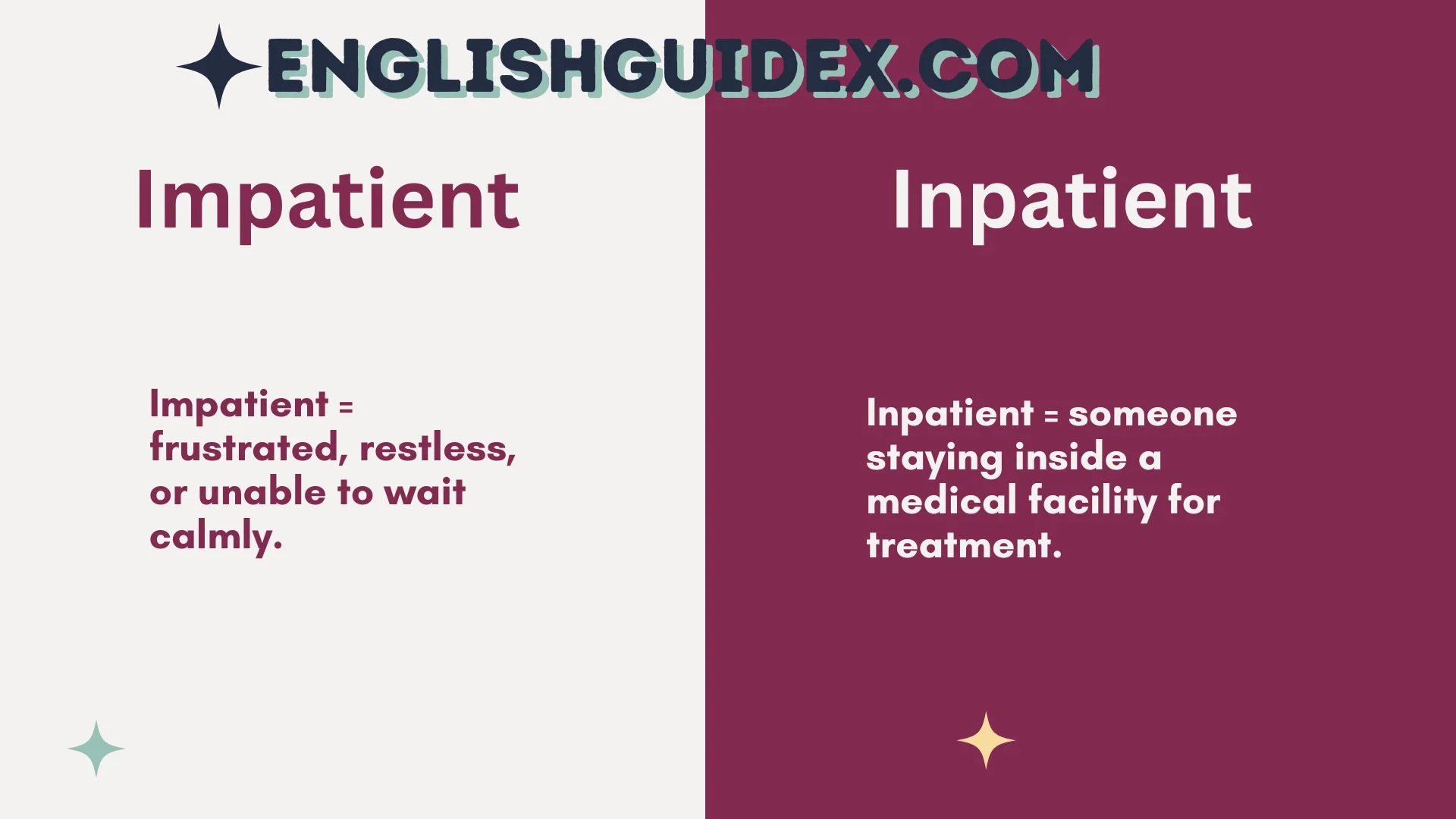
Impatient = frustrated, restless, or unable to wait calmly.
Examples of Being Impatient
People become impatient when:
- A delivery arrives late
- Someone talks too slowly
- Traffic is backed up for miles
- They’re waiting for test results or promotions
- Technology loads slower than expected
These situations trigger frustration, urgency, or restlessness.
Emotional Traits Linked to Impatience
People who feel impatient often show:
- Tense body language
- Short answers or interruptions
- Quick decisions without thinking
- Snappy tone or rushed movements
This makes the word essential in describing feelings, relationships, and communication.
How “Impatient” Appears in Real Sentences
| Sentence | Meaning |
|---|---|
| “I’m impatient with the slow service.” | Frustrated with waiting. |
| “She gets impatient when people talk in circles.” | Doesn’t like delays or unclear answers. |
| “He grew impatient after weeks without an update.” | Waiting too long caused irritation. |
| “Don’t be impatient—good work takes time.” | Advice to slow down and stay calm. |
Notice how each example describes emotion or behavior, never medical care.
Expressions & Idioms Using “Impatient”
- “Impatient for results”
- “Growing impatient”
- “Impatient with someone”
- “Impatient to begin”
- “Impatient beyond reason”
- “Barely containing impatience”
- “Her impatience showed through her tone”
- “My patience is wearing thin”
These show up everywhere from offices to classrooms, arguments to negotiations.
Where “Impatient” Comes From (Language Roots)
Understanding the construction helps:
- Patient → calm, willing to wait
- Im- → prefix meaning not or opposite of
Put together:
Impatient = not patient
This same pattern appears in words like:
- Impossible (not possible)
- Immature (not mature)
- Imperfect (not perfect)
The prefix instantly reverses the meaning.
What “Inpatient” Means (Medical Term, Healthcare, Hospitals)
Inpatient has nothing to do with emotion. It describes a person who is admitted to a medical facility and stays overnight or longer for treatment.
Simple definition:
Inpatient = someone staying inside a medical facility for treatment.
When Someone Is an Inpatient
A person becomes an inpatient when:
- They’re checked into a hospital room or ward
- They need monitoring after a procedure
- They require surgery with recovery time
- They’re admitted for mental health treatment
- They need supervised rehabilitation or detox
If someone only comes in for a quick appointment and leaves later that day, they are not an inpatient—they are an outpatient.
Inpatient vs. Outpatient (Quick Table)
| Term | Definition | Location | Time Spent |
|---|---|---|---|
| Inpatient | Admitted for treatment | Inside hospital / clinic | Overnight or longer |
| Outpatient | Not admitted | Comes in for visit and leaves | Same day |
If they stay inside, it’s inpatient.
If they come and go, it’s outpatient.
Examples of “Inpatient” in Sentences
| Sentence | Meaning |
|---|---|
| “He was admitted as an inpatient after surgery.” | Stayed at hospital. |
| “The inpatient wing is on the third floor.” | Part of the building for those staying. |
| “Insurance covers inpatient treatment for recovery.” | Healthcare cost context. |
| “She entered an inpatient rehab program.” | Residential care program. |
These examples focus on location, medical monitoring, and physical presence.
Side-by-Side Comparison Chart: Impatient vs. Inpatient
| Word | Type | Meaning | Field | Easy Clue |
|---|---|---|---|---|
| Impatient | Adjective | Feeling frustrated or unable to wait | Everyday emotion & behavior | Impaitent = I’m annoyed |
| Inpatient | Noun/Adjective | Someone admitted to stay in a medical center | Medical & healthcare contexts | Inpatient = IN the hospital |
Memory Tricks to Never Forget the Difference
1. The “IN” Trick
Inpatient has the word in, like inside a medical facility.
2. The “I’m” Trick
I’mpatient → I’m annoyed, I feel restless.
3. The Location Trick
- If the sentence talks about rooms, buildings, admission, treatment, the word is inpatient.
- If it describes emotion, frustration, behavior, the word is impatient.
4. Pronunciation Reminder
They’re pronounced slightly differently:
- Impatient → im-PAY-shent
- Inpatient → in-PAY-shent (clear separation of the N)
A tiny pause before the “n” can help lock this in.
Common Mistakes to Avoid
A lot of errors come from rushing. Here’s what to watch for:
❌ Using “inpatient” instead of “impatient” when describing emotions
❌ Writing “impatient” in medical reports or insurance documents
❌ Confusing outpatient with inpatient
❌ Letting autocorrect replace emotional language with medical terms
❌ Assuming the prefix in- always means not—here it refers to location, not negation
Inpatient doesn’t mean “not patient.” It means “inside the facility.”
This is the number one misunderstanding.
Case Studies: Real-World Scenarios
Case Study 1: The Frustrated Employee
- Incorrect: “Mark felt inpatient waiting for his promotion.”
- Correct: “Mark felt impatient waiting for his promotion.”
→ He wasn’t in a hospital; he was frustrated.
Case Study 2: The Hospital Admission
- Incorrect: “She was an impatient at the clinic for three days.”
- Correct: “She was an inpatient at the clinic for three days.”
→ She stayed for treatment, so the medical term applies.
Case Study 3: The Mixed Context
- “He grew impatient with the delay, and later became an inpatient after the accident.”
→ This sentence uses both correctly.
→ First emotional, then medical.
Practice Section: Choose the Correct Word
Try filling in the blanks:
- “I feel __________ waiting in long lines.”
- “He stayed as an __________ after knee surgery.”
- “Don’t get __________; they’ll call soon.”
- “The nurse moved the __________ to a private room.”
- “Traffic makes her __________ every morning.”
Answers: impatient, inpatient, impatient, inpatient, impatient
Frequently Asked Questions (FAQs)
What is the main difference between “impatient” and “inpatient”?
Impatient refers to frustration or lack of patience. Inpatient refers to someone admitted to a hospital for treatment.
Is “inpatient” always related to hospitals?
Yes. It’s a medical term used when someone stays overnight or longer inside a healthcare facility.
Can someone be both impatient and an inpatient at the same time?
Absolutely. An inpatient can feel impatient if the treatment or recovery process takes longer than expected.
Is there ever a situation where “inpatient” describes emotion?
No. “Inpatient” never describes feelings; it always refers to medical status.
How can I remember the difference quickly?
Think: Inpatient = IN the hospital. Impatient = I’m annoyed.
Conclusion
Impatient vs. inpatient comes down to a single letter, but that tiny difference separates a feeling from a medical status. Use the emotional term when talking about frustration or restlessness. Use the medical term when someone is checked into a hospital or facility.
If you slow down, check context clues, and apply the memory tricks, you’ll never confuse the two again.

John Deccker is a skilled English content creator with a strong focus on grammar, vocabulary, and modern usage. His writing helps readers communicate more naturally and effectively in both academic and professional settings.