
This guide clears up the confusion between newfound, new-found, and new found by exploring their history, modern usage, style-guide rules, and real-world examples.
It takes you from not sure to fully confident—so you make the right call every time.
Why the “Newfound or New-Found” Question Matters
Writers, editors, students, and everyday readers run into conflicting spellings. Some books use new-found, others use newfound. Spellcheckers often flag one version, older novels prefer the other. Without clarity, it creates doubt, inconsistency, and second-guessing.
This guide settles that debate.
In a nutshell:
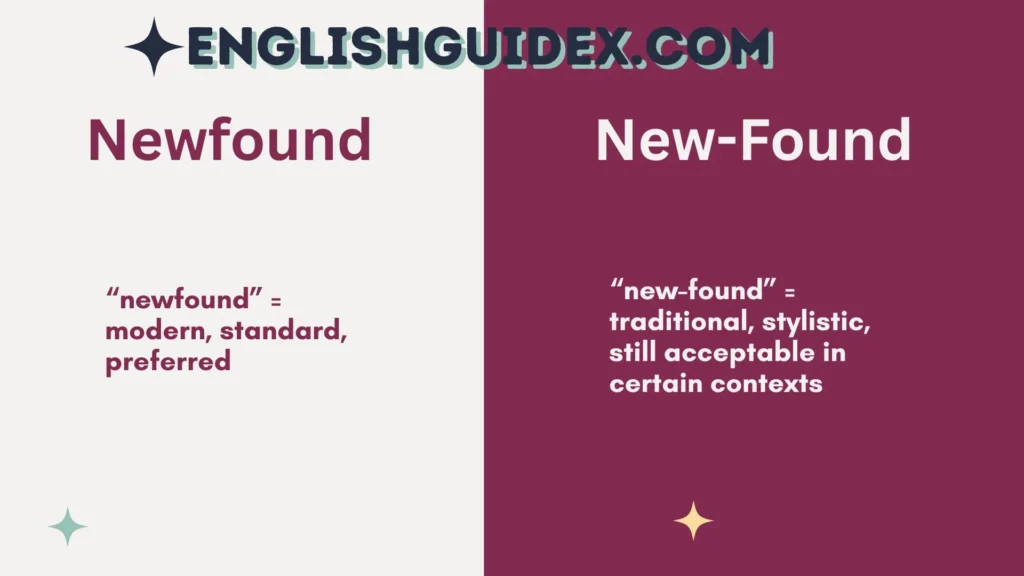
- “newfound” = modern, standard, preferred
- “new-found” = traditional, stylistic, still acceptable in certain contexts
- “new found” = incorrect except in rare cases like proper nouns
You’ll see why that’s true—not just be told it is.
Newfound or New-Found: What the Word Means
The word refers to something recently discovered, acquired, or realized. It acts as a compound adjective, meaning it modifies a noun.
Common uses:
- Newfound confidence
- Newfound freedom
- Newfound appreciation
- Newfound territory
- Newfound wealth
The word always describes something previously absent that now exists.
“Newfound” expresses a shift—a before and after moment in a person, place, or idea.
Historical Origins of “Newfound”
The spelling new-found came first. Early English writing used hyphens heavily because printing conventions, spacing, and compound word rules were inconsistent. Hyphens helped clarify meaning and prevent visual confusion.
Why the hyphen originally existed:
- Dictionaries were not standardized
- Printers created spelling variations
- Language was transitioning from Middle English
- Readers needed visual guidance to decode compounds
As English evolved, hyphens dropped across many words:
| Older Form | Modern Form |
|---|---|
| to-day | today |
| any-thing | anything |
| some-time | sometime |
| new-found | newfound |
This pattern is exactly why newfound is now dominant.
The Shift to the Modern Spelling “Newfound”
Over time, closed compounds (two words merged into one) simplified everyday English. The modern version—newfound—reflects this change.
Reasons it became standard:
- Faster reading and writing
- Fewer visual interruptions
- Consistency across digital text
- Global English adoption and teaching standards
If you write for:
- Business
- News media
- Blogging
- Marketing
- Academia
- Web content
…then newfound is the safest and most accepted spelling.
Is “New-Found” Still Correct? Yes, But Limited
The hyphenated spelling isn’t wrong—it’s just not modern default. Instead, it signals tone and intention.
When you might keep new-found:
- Reproducing historical text
- Writing period-accurate literature
- Matching the style of classical works
- When a publisher requests it
- UK traditional spelling preferences
Why it feels old-fashioned:
It creates a dated tone, similar to spelling “to-day” or “any-thing” in a modern article.
Use new-found only when tone matters more than standardization.
What About “New Found”?
In standard grammar, new found (two words) is incorrect.
It breaks the structure of a compound adjective, changing the meaning and interrupting clarity. This version is rejected in academic, professional, and journalistic writing.
The only exception:
It can appear in proper nouns, like place names.
Examples:
- New Found Lake — A lake in New Hampshire (proper noun)
- New Found Gap Road — Geographic name
Outside names, avoid this form.
Regional Differences: US vs UK Usage
Language isn’t static. Regional preferences shape spelling.
| Region | Preferred Form | Notes |
|---|---|---|
| US English | newfound | Default in modern writing |
| UK English | newfound / new-found | Both seen; hyphen more common in older publications |
| Canada | newfound | Matches US trend |
| Australia | newfound | Standard form |
| Academic English | newfound | Most accepted in linguistic standards |
In digital and international communication, newfound generally wins.
Style Guides on “Newfound” vs. “New-Found”
Authoritative style guides matter because they decide what’s correct for professional publishing. They provide consistent rules for editors, journalists, and authors.
| Authority / Source | Preferred Form | Rationale |
|---|---|---|
| AP Stylebook | newfound | Clear, modern, concise |
| Chicago Manual of Style | newfound | Hyphens removed unless needed for clarity |
| Merriam-Webster Dictionary | newfound (primary) | Hyphen appears only historically |
| Oxford English Dictionary | newfound / new-found | Hyphen remains in some UK contexts |
| Modern Publishing Standards | newfound | Web-first and SEO friendly |
If you write for the internet, use newfound.
Case Studies: Real Usage in Context
These examples show how each spelling functions differently.
Contemporary Business Writing
❌ “The company gained new-found market leverage.”
✔️ “The company gained newfound market leverage.”
Period-Correct Historical Tone
✔️ “The explorers celebrated their new-found lands.”
Used intentionally to match historical context.
Incorrect General Use
❌ “She discovered a new found happiness.”
🚫 Not acceptable as standard grammar.
Proper Noun Exception
✔️ “They rented a cabin by New Found Lake.”
Because the name cannot be altered.
How to Decide Which One to Use
This checklist settles the decision in seconds.
Use newfound when:
- Writing blog posts, articles, essays
- Submitting academic papers
- Publishing business content
- Writing modern fiction
- Creating SEO content
Use new-found when:
- Reproducing quotes
- Writing in an older stylistic voice
- Targeting traditional UK editorial rules
Never use:
- new found (two words) unless it’s part of a name
Examples in Sentences
Correct (Modern)
- “She felt a newfound sense of purpose after the seminar.”
- “They explored the island with newfound curiosity.”
Acceptable for Tone
- “The pioneers sought prosperity in their new-found home.”
Incorrect
- “He enjoyed his new found career success.” (Wrong)
Quick Comparison Table
| Spelling | Correct? | When to Use | Tone |
|---|---|---|---|
| newfound | ✔️ Standard | Modern writing, websites, media | Contemporary |
| new-found | ✔️ Optional | Historical tone, some UK texts | Classical / Traditional |
| new found | 🚫 Incorrect | Only proper nouns | Not grammatical |
FAQs on “Newfound or New-Found”
### Is “newfound” one word or two?
One word. “Newfound” is the standard spelling in modern writing.
### Can I still use new-found with a hyphen?
Yes, but only stylistically. It’s not the preferred default.
### Is new found ever correct?
Only in proper nouns like place names. Otherwise, avoid it.
### Which spelling is better for SEO and web writing?
“Newfound” helps consistency, search recognition, and reader trust.
### Does UK English accept newfound?
Yes, though “new-found” still appears in older UK materials.
Conclusion
The English language streamlines words as usage stabilizes. Newfound stands as the modern, professional, and widely recognized choice.
Hyphenated versions survive in niche contexts, but the closed form leads in clarity and authority. When in doubt, choose newfound.
It’s the spelling that meets modern standards, aligns with major style guides, and builds trust in your writing.

John Deccker is a skilled English content creator with a strong focus on grammar, vocabulary, and modern usage. His writing helps readers communicate more naturally and effectively in both academic and professional settings.