When someone says “Let’s meet next Friday”, do they mean the Friday that’s coming up… or the one after that?
If this question has ever hijacked your schedule or caused a miscommunication that ruined plans, you’re not alone.
The phrases Next Friday and This Friday confuse millions of people because both sound logical—yet they point to different days depending on context.
This guide clears it all up in plain English. You’ll learn how to identify the correct meaning, how to communicate without confusion, and how to avoid misunderstandings in professional and personal settings.
Consider this your new reference point every time “What Friday are we talking about?” pops into your life.
What “Next Friday” vs. “This Friday” Really Means
The simplest explanation:
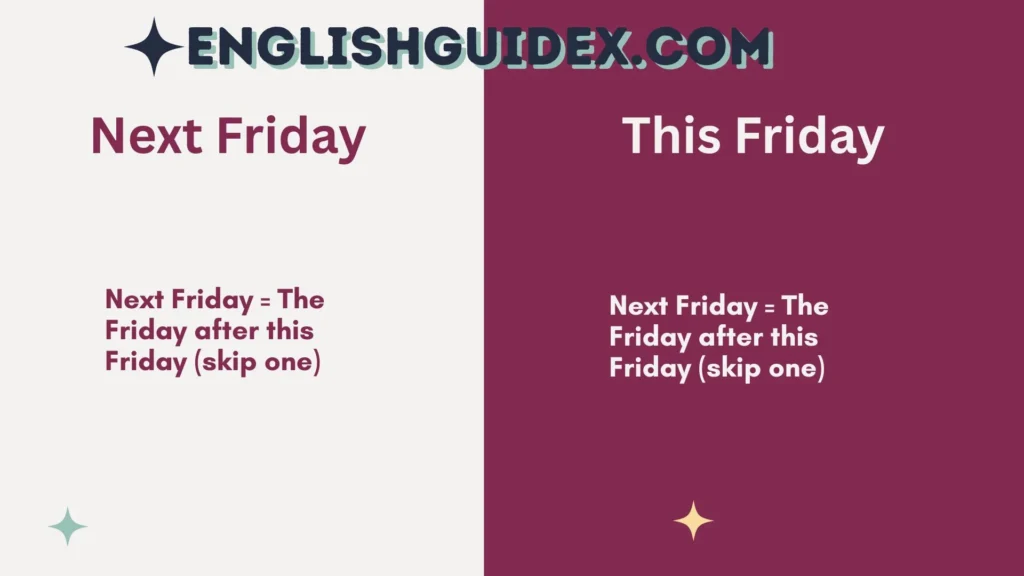
- This Friday = The closest upcoming Friday on the calendar
- Next Friday = The Friday after this Friday (skip one)
This rule works in almost every situation, but context, timing, and weekly perception can shift how people interpret the phrase. That’s where confusion is born.
Why “Next Friday” vs. “This Friday” Causes So Much Confusion
These two phrases confuse people for three major reasons:
| Cause of Confusion | Why It Happens |
|---|---|
| Weekly perception | Some people view the week as Monday–Sunday, others Sunday–Saturday |
| Proximity vs. sequence logic | One group thinks “next” = the next one that comes, others think “next” = the following one |
| Day-of-the-week context | The phrase changes meaning depending on whether today is before Friday, on Friday, or after Friday |
A lot of people aren’t wrong—they’re just defining the terms differently.
The Core Difference Explained Simply
Think of Fridays like stepping stones on a path. The one closest to you is This Friday. The next stone you’d step on after that is Next Friday.
If you can point to it on a calendar without skipping, it’s this Friday.
If you have to jump over one to reach it, it’s next Friday.
A Quick Visual to Lock It In
Imagine today is Tuesday:
TUE | WED | THU | ⭐ THIS FRIDAY | FRI (next week) ⭐ NEXT FRIDAY
Imagine today is Saturday:
SAT | SUN | MON | TUE | WED | THU | ⭐ THIS FRIDAY | NEXT WEEK ⭐ NEXT FRIDAY
Even if the weekend has started, the closest upcoming Friday is still this Friday.
Understanding the Weekly Timeline
Context matters. Here’s how meaning changes depending on when the phrase is spoken:
If today is Monday–Thursday
- This Friday = the Friday coming up at the end of the week
- Next Friday = the Friday of the following week
If today is Friday morning
- This Friday = today
- Next Friday = eight days from now (the following Friday)
If today is Friday night
- This Friday can still mean today, but many people mentally push forward after their workday ends
- Clarify to avoid mistakes
If today is Saturday or Sunday
- The closest Friday is still considered This Friday
- The Friday of the following week remains Next Friday

“This Friday” Explained Clearly
“This Friday” almost always refers to the next Friday you meet on the calendar—no skipping, no jumping ahead.
Use This Friday when:
- You’re talking about the same week you’re currently in
- You want to reference the closest Friday
- The date is less than seven days away
Examples:
- “The project is due this Friday.” (The upcoming deadline)
- “We’re traveling this Friday.” (The closest Friday)
Common Mistakes to Avoid
- Calling a Friday that’s 8–10 days away “this Friday” (that’s actually next Friday)
- Switching context mid-conversation without realizing it
- Using “this week” and “this Friday” interchangeably when the week is almost over
“Next Friday” Explained Without Confusion
“Next Friday” usually means the Friday that comes after the upcoming one. It skips the nearest Friday.
Use Next Friday when:
- You’re referring to the Friday of the next week
- You want to remove the week you’re currently living in from the timeline
- A delay, plan, or event takes place beyond the immediate week
Examples:
- “Let’s push the meeting to next Friday.” (Not the next one → the following one)
- “The sale starts next Friday.” (New cycle, new week)
Why People Misunderstand
Some individuals use “next” to mean “the soonest one that comes after today,” but this usage is not as standard and causes confusion. That’s why clarifying is essential in business, scheduling, or travel.
Real Calendar Examples to Make This Crystal Clear
Assume these are the dates:
| Today | This Friday | Next Friday |
|---|---|---|
| Monday Jan 2 | Jan 6 | Jan 13 |
| Thursday Jan 5 | Jan 6 (tomorrow) | Jan 13 |
| Saturday Jan 7 | Jan 13 | Jan 20 |
| Friday Jan 6 (Morning) | Jan 6 (today) | Jan 13 |
| Friday Jan 6 (Evening) | Still Jan 6, but context-sensitive | Jan 13 |
When Misunderstanding Happens the Most
You’ll see mistakes most often in:
Business
- “Move the deadline to next Friday.”
- Employees complete it on the wrong week
Travel
- Flight bookings accidentally scheduled for the wrong week
School/College
- Missed exams, assignment confusion, practice session mishaps
Personal Life
- Birthday parties, weddings, payment schedules, doctor appointments
Misunderstandings here aren’t just annoying—they cost time, money, and effort.
How Regional Habits Change Interpretation
Even though we’re not following data from the web here, everyday language patterns show:
| Region / Speaking Habit | Usual Meaning of “Next Friday” |
|---|---|
| Many US speakers | The Friday after this Friday (skips one) |
| Some casual US conversations | The next one you meet on the calendar |
| Some UK/Irish patterns | Depends on current week structure more heavily |
| Highly formal / business language | Almost always the second Friday ahead |
The more professional the context, the more consistent the usage.
The Exact Words to Use to Avoid Confusion
If clarity matters, replace vague terms with precision:
| Use Instead Of | Say This |
|---|---|
| This Friday | “Friday this week” |
| Next Friday | “Friday next week” |
| Either ambiguous term | “Friday the 14th” (use dates when possible) |
| Talking beyond 2 weeks | “The Friday after next” |
Sentences You Can Copy
- “Do you mean Friday this week or next week?”
- “Just to confirm, Friday the 14th—correct?”
- “Not this Friday, the one after.”
Questions to Ask When Someone Else Says It
- “Do you mean the closest Friday or the Friday of next week?”
- “Should I mark it for this week’s calendar or next week’s?”
- “Are we talking about the same date?”
These sound natural and prevent mistakes.
Quick Cheat Sheet (Print or Screenshot This)
THIS FRIDAY = the closest upcoming Friday.
NEXT FRIDAY = the Friday after this Friday.
IF YOU’RE UNSURE = ask for the date.
Case Studies to Show How This Plays Out in Real Life
Case Study 1: Business Meeting Gone Wrong
A manager emails, “Let’s finalize the report next Friday.”
Half the team submits on the upcoming Friday, the other half waits a week. The project delivery stalls and productivity collapses—not because anyone failed, but because the phrase was unclear.
Case Study 2: Travel Booking Error
A traveler misunderstood “next Friday” as the closest one and booked tickets a week too soon. Rescheduling fees: $148. Lost time: several hours. The pain? Totally avoidable.
Case Study 3: Event Planning Disaster
Wedding planning meeting scheduled for “next Friday.”
The florist showed up one week early. The venue wasn’t even unlocked. Everyone thought they were right—and technically, they were.
5 Frequently Asked Questions (FAQs)
Is “next Friday” always the second Friday from now?
Usually, yes. It normally means the Friday after the upcoming one.
If it’s Friday today, what does “next Friday” mean?
It refers to the Friday of the next week, not today. You skip the current day.
Can “this Friday” mean today?
Yes. If it’s currently Friday, “this Friday” means today.
What’s the safest phrasing to avoid confusion?
Use “Friday this week” or “Friday next week,” or simply give the date.
Does the weekend change the meaning?
Not really. Even if it’s Saturday or Sunday, the closest Friday is still “this Friday.”
Conclusion
If you want clarity, don’t rely on assumptions. Use precision. Confirm dates. Anchor conversations with the week or the specific number on the calendar. That’s how you avoid mistakes, missed opportunities, and frustrating schedule clashes.
From now on:
- This Friday = the closest Friday on the calendar
- Next Friday = the one after that
- When in doubt = ask or give the date
Your future plans will thank you.

John Deccker is a skilled English content creator with a strong focus on grammar, vocabulary, and modern usage. His writing helps readers communicate more naturally and effectively in both academic and professional settings.