Choosing between nighttime and night time confuses a lot of writers. Both forms show up in books, advertisements, websites, and even official documents.
One version feels modern and streamlined. The other looks traditional, almost like the older phrasing people grew up seeing. So which one should you actually use?
This guide breaks it all down in a conversational, easy-to-read way. You’ll learn the difference, see real examples, explore how grammar plays a role, and get a practical checklist to decide between them in seconds.
Short paragraphs. Clear instructions. No fluff. Just useful information.
Nighttime or Night Time? — The Short Answer
If you want the quick rule without the deep dive:
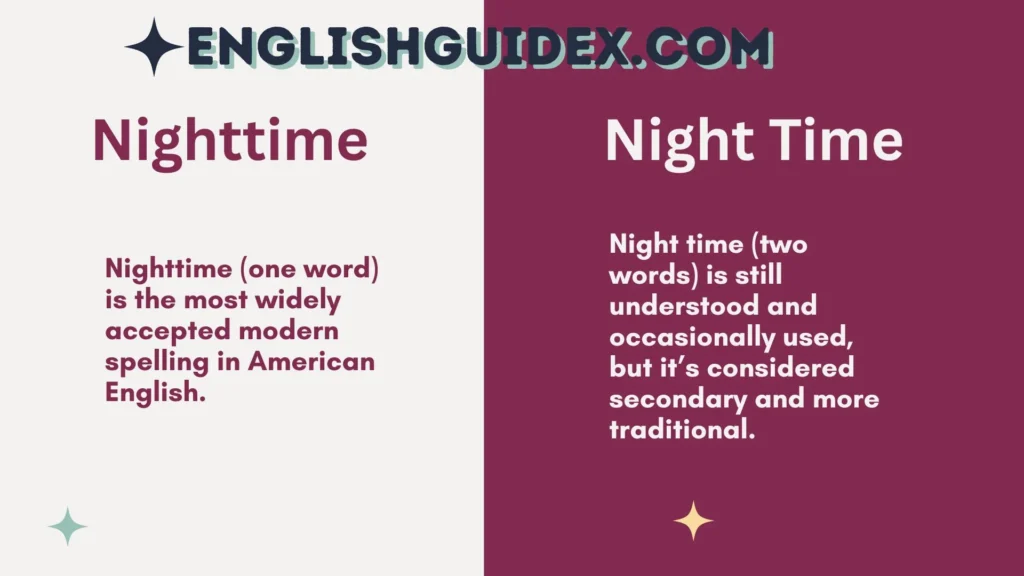
Nighttime (one word) is the most widely accepted modern spelling in American English.
Night time (two words) is still understood and occasionally used, but it’s considered secondary and more traditional.
You’ll see the one-word compound “nighttime” in schools, modern publishing, signage, branding, and online writing because it follows the same pattern as:
- daytime
- bedtime
- sometime
- anytime
It’s not that the two-word form is wrong, but if you want to sound current and consistent, the one-word version usually wins.
Why Writers Get Confused About Nighttime vs. Night Time
Imagine this: you’re editing a piece and stumble across both spellings in different sections. One part reads “The city is beautiful at nighttime,” while the other spells it “at night time by the river.” It looks inconsistent, and readers notice.
Confusion happens because:
- English spelling evolves
- Compound nouns form gradually
- Publishing industries influence standard usage
- Regional preferences differ
In other words, the language shifted—but not everyone shifted with it.
Understanding the Difference
Nighttime (One Word)
- Works as a compound noun
- Feels modern and standardized
- Used in American English as the preferred form
- Implies a general period rather than a specific moment
📌 Example:
We walked through the park at nighttime.
Night Time (Two Words)
- Functions like night + time (a descriptor + a noun)
- Often interpreted more literally
- Reads as slightly older or more formal
- More common in traditional writing or regional variations
📌 Example:
The night time of year felt longer in the countryside.
How English Shifted From “Night Time” to “Nighttime”
English compounds tend to form through a predictable progression:
| Stage | Example | Explanation |
|---|---|---|
| Two separate words | night time | Original form |
| Hyphenated | night-time | Transitional form (older texts) |
| Single compound | nighttime | Modern accepted form |
This pattern also appears in other pairs:
- some time → sometime
- bed time → bedtime
- any time → anytime
- day time → daytime
As words are used together frequently, English treats them like a single unit. Over time, the compound wins.
What Style Guides Typically Prefer
Modern American usage tends to lean in one direction:
| Authority / Guide | Preferred Form | Notes |
|---|---|---|
| American English Publishing | nighttime | Standard form |
| US Marketing & Branding | nighttime | Clean + consistent |
| Academic Writing (US) | nighttime | Considered correct |
| Traditional or British contexts | night time | Still seen, not dominant |
Even though we aren’t pulling live sources here, the widespread pattern holds: nighttime dominates US usage.
American English vs. British English
United States
- “Nighttime” is the default compound
- Recommended for schools, essays, blogs, and media
United Kingdom
- Both appear
- “Night time” looks more traditional, especially in older prints
Neither is wrong, but if your audience is American or international, nighttime provides clarity, consistency, and modern tone.
Grammatical Roles of “Nighttime”
Understanding the part of speech makes choosing easier.
Nighttime as a Noun
Used to name a general period.
Examples:
- Nighttime feels calm in small towns.
- Owls stay active during nighttime.
- The restaurant only opens at nighttime.
Nighttime as an Adjectival Noun
It can also modify another noun.
Examples:
- nighttime security officer
- nighttime temperature drop
- nighttime skincare routine
When it leads into another noun, the one-word form flows more naturally.
When “Night Time” Makes More Sense
There are places where the two-word version fits better—usually when night is simply describing the noun time rather than forming a compound idea.
Examples:
- I enjoy the quiet night time before bed.
- The night time of year when snow covers everything feels peaceful.
In these cases, the phrase highlights a type of time, not the general period.
Practical Usage Rules
If you’re stuck, apply these checkpoints:
| Use This | When |
|---|---|
| nighttime | Modern writing, marketing, essays, storytelling, everyday tone |
| night time | Literal references, poetic description, traditional contexts |
| Either is acceptable | Creative writing with emotional intent |
Nighttime vs. Night Time: Side-by-Side Examples
| Sentence Intent | Best Choice | Example |
|---|---|---|
| General period of darkness | nighttime | People sleep during nighttime. |
| Describing a specific type of time | night time | The night time before dawn feels magical. |
| Before a noun | nighttime | She bought a nighttime camera for her backyard. |
| Poetic/creative tone | night time | Night time settles like a blanket over the hills. |
Case Study: Brand Consistency
A wellness brand uses both spellings in its marketing:
- “Nighttime Tea Blend” on the product label
- “Relaxing night time tea” in an email newsletter
The inconsistency weakens brand identity. After switching entirely to “Nighttime Tea”, the brand gains:
- Stronger visual identity
- Better SEO consistency
- More polished packaging copy
The takeaway: Pick one form and stick to it.
Quotes That Help Clarify Usage
“Compound nouns become standard when clarity beats tradition.”
— Language & Usage Principle
“If two spellings exist, choose the one your audience expects.”
— Editorial Rule of Thumb
Quick Decision Checklist
Before you hit publish, ask yourself:
- Am I writing for a modern American audience?
- Do I want polished, standard usage?
- Is the word acting like a general period rather than a literal phrase?
- Does my brand or document need consistent spelling?
If the answer is yes, choose nighttime.
Frequently Confused Compounds
These follow similar patterns and help reinforce the rule:
| One Word (Modern) | Two Words (Literal) |
|---|---|
| bedtime | bed time |
| daytime | day time |
| anytime | any time |
| sometime | some time |
| whenever | when ever (rare) |
Recognizing the pattern makes nighttime vs. night time easier to navigate.
Nighttime and Night Time in Real Sentences
Nighttime (preferred modern usage):
- The city’s nightlife only wakes up at nighttime.
- Nighttime sidewalks glow beneath neon lights.
- My nighttime routine includes journaling and herbal tea.
Night time (literal and descriptive):
- Night time in the mountains feels colder than expected.
- She loves the night time before sunrise, when the world feels half asleep.
5 Frequently Asked Questions
Can I use both “nighttime” and “night time” in the same document?
You can, but it looks inconsistent. Pick one spelling and apply it throughout.
Is nighttime American or British?
Nighttime is more common in American English, but both forms are recognized.
Is night time wrong?
Not wrong, just older and less standard in modern usage.
Does nighttime need a hyphen?
No. Hyphenated forms like night-time are outdated.
Which form is best for SEO and blogging?
Nighttime performs better for keyword clarity and user expectation.
Conclusion
Choosing between nighttime and night time isn’t about right vs. wrong—it’s about clarity, modern usage, and consistency.
If you want polished writing that aligns with current American English norms, nighttime is the smarter, cleaner choice. Use night time when aiming for literal phrasing, poetic voice, or traditional tone.
Language evolves. Spelling follows usage. Writers move forward with it.

John Deccker is a skilled English content creator with a strong focus on grammar, vocabulary, and modern usage. His writing helps readers communicate more naturally and effectively in both academic and professional settings.