

Every English learner has stared at the phrase at least once and wondered: is it of course or ofcourse?
Only one of them is correct, and the difference matters more than people think—especially when writing emails, academic papers, business communication, or online content.
This guide breaks everything down clearly, using conversational language, examples, lists, sentence variations, and even a few case studies to make the concept impossible to forget.
What’s the Correct Spelling: “Of Course” or “Ofcourse”?
The correct spelling is of course — always two separate words.
The spelling “ofcourse” is incorrect ❌ in standard English.
Why? Because the phrase isn’t a single unit; it’s a combination of a preposition (of) and a noun (course) that formed a common expression over time.
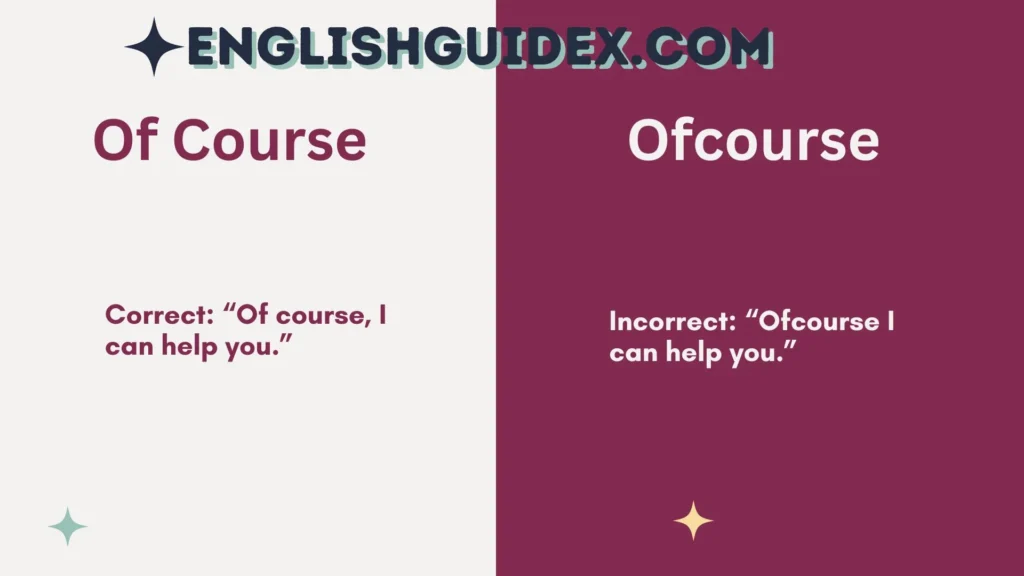
Correct: “Of course, I can help you.”
Incorrect: “Ofcourse I can help you.”
Think of it this way:
| Version | Correct? | Why |
|---|---|---|
| of course | ✅ Yes | Proper structure, grammatically valid |
| ofcourse | ❌ No | Not recognized formally or academically |
| Of Course | ✅ Yes | Capitalized at start of sentence/title |
If you write for exams, professional emails, corporate memos, academic papers, or published content, always use of course.
What “Of Course” Actually Means (In Plain English)
The phrase of course is used to show agreement, permission, politeness, or something obvious. It communicates that something is expected, natural, or understood.
It can mean:
- “Yes, definitely.” (agreement)
- “Sure, go ahead.” (permission)
- “Naturally, that makes sense.” (obviousness)
- “I’m not surprised.” (expectation)
Examples Based on Usage:
| Usage Type | Example Sentence |
|---|---|
| Agreement | “Of course, I support your choice.” |
| Permission | “Can I join you later?” “Of course.” |
| Obviousness | “Of course she’s excited; it’s her first job.” |
| Reassurance | “Of course you belong here.” |
So when in doubt, ask yourself:
Am I showing agreement, permission, or stating the obvious?
If yes, “of course” is the right fit.
Where “Of Course” Comes From (Useful Origin Breakdown)
The phrase originally described the natural course of things — something expected to happen, like the course of a river or the course of an event.
Over centuries, language evolved. The literal meaning shifted into an idiom expressing expectation or obviousness.
Timeline Summary:
| Era | Development |
|---|---|
| Early usage | literal: “in the course/natural order of events” |
| Later usage | blended into conversational shorthand |
| Modern use | idiom meaning agreement or obvious truth |
In simple words:
It started literal ➜ became figurative ➜ became normal conversational English.
This history explains why it’s two words: it never began life as a compound.
How to Use “Of Course” in Real Sentences
Short examples help the phrase stick in memory. Try reading them aloud.
To Agree
- “Of course, I’ll send the report today.”
- “Of course we can reschedule.”
To Sound Polite
- “Of course you may speak first.”
- “Of course—take your time.”
To State the Obvious
- “Of course water freezes at 0°C.”
- “Of course he apologized; he was wrong.”
To Reassure
- “Of course you’re capable of succeeding.”
- “Of course you can trust me.”
Why People Misspell It as “Ofcourse”
Even native speakers get this wrong, and it usually happens for a few predictable reasons:
- It sounds like one word when spoken quickly
- Auto-correct or typing shortcuts combine it
- Confusion with other compound words like “therefore” or “anymore”
- Casual texting habits replacing formal spelling
This mistake becomes risky when:
- Applying for a job
- Writing business emails
- Publishing web content
- Submitting academic assignments
In those situations, accuracy reflects professionalism.
Grammar Rules: Placement and Proper Punctuation
“Of course” can appear at the beginning, middle, or end of a sentence. Placement affects tone.
| Placement | Example | Tone |
|---|---|---|
| Beginning | “Of course, I’ll wait for you.” | Neutral, clear |
| Middle | “I will, of course, attend the meeting.” | Polite, formal |
| End | “You’re invited, of course.” | Soft, warm |
Comma Rules
- Use a comma when at the beginning:
“Of course, I’ll be there.” - Use commas on both sides when in the middle:
“You can, of course, ask questions.” - No comma needed when answering directly:
A: Can I call you later? B: Of course.
Tone Matters: Friendly vs. Sarcastic
Tone can flip the meaning. Same spelling, different attitude.
| Tone | Sentence | Meaning |
|---|---|---|
| Friendly | “Of course! Happy to help.” | Enthusiastic, kind |
| Neutral | “Of course, I understand.” | Accepting, composed |
| Sarcastic | “Of course he forgot again.” | Annoyed, critical |
Pro tip: If you aren’t trying to sound irritated, avoid pairing “of course” with negative context.
Using “Of Course” to Signal the Obvious
Sometimes it replaces phrases like:
- obviously
- naturally
- as expected
- no surprise
- that’s normal
Example:
“Of course the sun rises in the east.”
Here, the speaker points out a fact everyone knows.
Alternatives to “Of Course” (When You Want a Different Tone)
Try these replacements depending on context:
| Meaning | Alternative |
|---|---|
| Agreement | “Absolutely,” “Definitely,” “Sure thing” |
| Permission | “Go ahead,” “Feel free,” “Please do” |
| Obviousness | “Naturally,” “Obviously,” “Clearly” |
| Reassurance | “Trust me,” “No doubt about it,” “You’re fine” |
Examples From Everyday Writing
Here’s how “of course” appears in natural text:
Dialogue:
“Can I ask you something?”
“Of course. What’s on your mind?”
Narration:
Of course she felt nervous; first days always bring butterflies.
Business Writing:
“Of course, the invoice will be processed within two business days.”
Quick Decision Checklist
Before you hit send, ask:
- Am I showing agreement or permission?
- Does the sentence sound polite and natural?
- Does spelling it as two words protect clarity?
- Would sarcasm confuse the situation?
If “yes,” then of course is the right choice.
Case Study: Why Accuracy Matters in Professional Writing
A marketing manager emailed a client:
“Ofcourse, we received your design assets.”
The client replied with concern:
“Is this the standard of writing your team uses?”
That tiny error made the entire company look careless.
Correct spelling maintains trust, clarity, and credibility.
FAQs About “Of Course”
What does “of course” mean?
It expresses agreement, permission, or something expected or obvious.
Is “ofcourse” ever correct?
No. It isn’t recognized in formal English or professional writing.
Do I need a comma after “of course”?
At the start or mid-sentence, yes. In a short reply, no.
Is “of course” too casual for business writing?
Not at all; it can sound polite and professional when used correctly.
Can I use “of course” in academic essays?
Yes, as long as tone remains neutral and contextually appropriate.
Conclusion
The phrase of course stays correct, natural, and professional when written as two words. It expresses agreement, permission, politeness, and the obvious. “Ofcourse” should be avoided in every formal context.
When in doubt, remember:
Of course is right.
Ofcourse is always wrong.

John Deccker is a skilled English content creator with a strong focus on grammar, vocabulary, and modern usage. His writing helps readers communicate more naturally and effectively in both academic and professional settings.