Last updated on December 2nd, 2025 at 04:29 pm
In professional communication, phrases like “I will look into it” are common, but repeating the same expression can make your language sound flat or unprofessional.
Using other ways to say “I will look into it” professionally allows you to sound proactive, confident, and polished. Choosing the right words can convey attention, accountability, and responsiveness, which are essential in workplace interactions.
This article is designed for English learners and professionals who want to expand their vocabulary in business communication.
You’ll discover 12+ alternative phrases, complete with explanations, examples, and guidance on formal, informal, and casual usage.
By learning these alternatives, you’ll sound more fluent, articulate, and professional in emails, meetings, and conversations.
What Does “I Will Look Into It” Mean?
“I will look into it” is a way to express that you will investigate, check, or review a matter before providing a response or solution.
Grammar Explanation
- I will → future tense showing intention
- look into → phrasal verb meaning investigate or examine
- it → refers to the issue, problem, or request
It is widely used in professional and semi-formal contexts to acknowledge a task without committing to immediate action.
When to Use “I Will Look Into It”
You can use this phrase in multiple contexts:
✔ Formal Contexts
- Workplace emails
- Meetings with clients or managers
- Project follow-ups
✔ Informal Contexts
- Team chats
- Casual workplace conversations
- Internal messages with colleagues
✔ Written Use
- Emails
- Slack messages
- Memos or reports
✔ Spoken Use
- Phone calls
- Meetings
- Video conferences
Is It Professional or Polite to Say “I Will Look Into It”?
Yes. “I will look into it” is professional, polite, and neutral. It communicates that you are taking responsibility to investigate an issue.
Business Suitability
- Appropriate for emails, meetings, and conversations
- Conveys accountability without over-promising
- Shows willingness to follow up
Situations to Avoid
- Avoid using it if you already know the solution or if a more assertive response is needed (e.g., “I will resolve this immediately”).
Pros and Cons of Using “I Will Look Into It”
Pros:
- Polite and professional
- Clear and neutral
- Shows willingness to act
- Versatile in most business contexts
Cons:
- Can sound vague if overused
- Lacks urgency or decisiveness
- Repetitive if used in multiple communications
12 Alternative Phrases for “I Will Look Into It”
Here are 12 professional alternatives, complete with explanations, examples, and usage guidance:
1. Phrase: I’ll Investigate This Matter
Meaning: You will examine the issue carefully.
Explanation: Slightly formal; conveys thoroughness.
Example Sentence: “I’ll investigate this matter and provide an update by tomorrow.”
Best Use: Formal, Business
Worst Use: Casual team chats
Tone: Formal / Neutral
2. Phrase: I’ll Review the Details
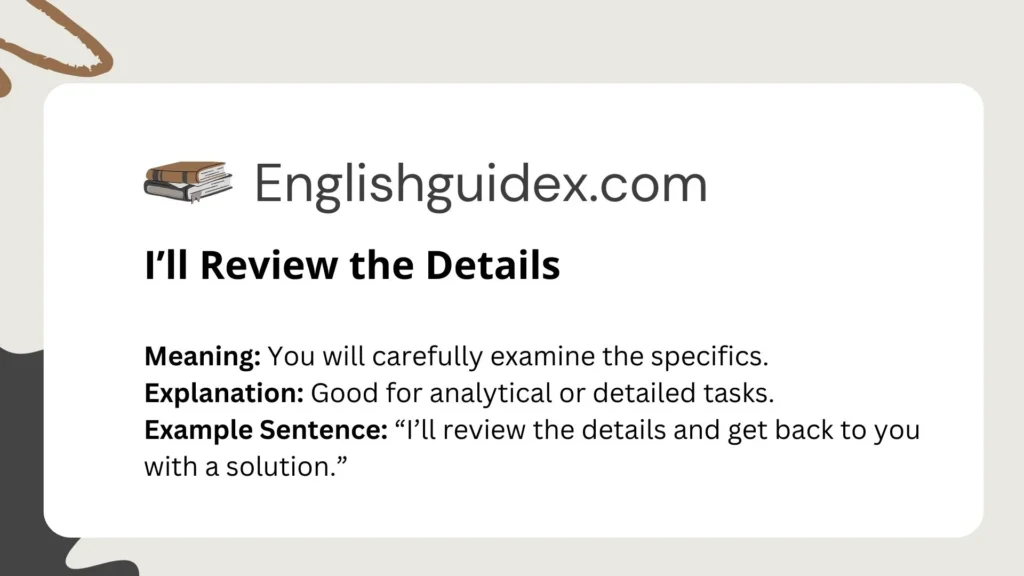
Meaning: You will carefully examine the specifics.
Explanation: Good for analytical or detailed tasks.
Example Sentence: “I’ll review the details and get back to you with a solution.”
Best Use: Formal, Business
Worst Use: Very casual conversations
Tone: Formal / Neutral
3. Phrase: I’ll Look Into This
Meaning: Slight variation, simple and neutral.
Explanation: Polite and professional; slightly less formal.
Example Sentence: “I’ll look into this and follow up with you shortly.”
Best Use: Semi-formal, Business, Internal emails
Worst Use: Highly formal reports
Tone: Neutral / Friendly
4. Phrase: I’ll Examine the Situation
Meaning: You will study or analyze the matter.
Explanation: Formal, suitable for meetings and reports.
Example Sentence: “I’ll examine the situation and provide recommendations.”
Best Use: Formal, Business
Worst Use: Casual chats
Tone: Formal / Neutral
5. Phrase: I’ll Check on This
Meaning: You will verify or investigate the issue.
Explanation: Casual and approachable; fits team communication.
Example Sentence: “I’ll check on this and let you know what I find.”
Best Use: Informal, Internal teams
Worst Use: Formal client emails
Tone: Friendly / Neutral
6. Phrase: I’ll Follow Up on This
Meaning: You will investigate and report back.
Explanation: Professional, proactive phrase; emphasizes accountability.
Example Sentence: “I’ll follow up on this and share the results by end of day.”
Best Use: Formal, Business, Semi-formal
Worst Use: Casual conversations
Tone: Formal / Neutral
7. Phrase: I’ll Look Into the Issue
Meaning: You will examine the problem carefully.
Explanation: Specific and slightly more formal than “I’ll look into this.”
Example Sentence: “I’ll look into the issue and propose a solution.”
Best Use: Formal, Business
Worst Use: Casual chats
Tone: Neutral / Formal
8. Phrase: I’ll Investigate Further
Meaning: You will dig deeper into the matter.
Explanation: Conveys attention to detail; implies ongoing work.
Example Sentence: “I’ll investigate further and provide you with a detailed report.”
Best Use: Business, Professional
Worst Use: Casual team messages
Tone: Formal / Emphatic
9. Phrase: I’ll Take a Closer Look
Meaning: You will examine carefully.
Explanation: Friendly yet professional; works for emails or spoken communication.
Example Sentence: “I’ll take a closer look at the data and update you.”
Best Use: Semi-formal, Internal teams
Worst Use: Strictly formal letters
Tone: Friendly / Neutral
10. Phrase: I’ll Assess the Situation
Meaning: You will evaluate or appraise the matter.
Explanation: Suitable for professional reports, meetings, and strategic planning.
Example Sentence: “I’ll assess the situation and provide actionable recommendations.”
Best Use: Formal, Business
Worst Use: Casual chats
Tone: Formal / Neutral
11. Phrase: I’ll Look Into It and Report Back
Meaning: You will investigate and provide a response.
Explanation: Emphasizes accountability and follow-up.
Example Sentence: “I’ll look into it and report back by this afternoon.”
Best Use: Formal, Business
Worst Use: Casual conversations
Tone: Neutral / Professional
12. Phrase: I’ll Explore the Options
Meaning: You will investigate possibilities and solutions.
Explanation: Suggests thorough examination and problem-solving.
Example Sentence: “I’ll explore the options and get back to you with the best approach.”
Best Use: Business, Formal, Professional
Worst Use: Informal chats
Tone: Formal / Neutral
Comparison Table (Top 7 Alternatives)
| Phrase | Tone | Best Use | Worst Use |
|---|---|---|---|
| I’ll Investigate This Matter | Formal | Business, Reports | Casual chats |
| I’ll Review the Details | Formal | Emails, Meetings | Informal conversations |
| I’ll Check on This | Friendly | Team chats, Internal | Formal client emails |
| I’ll Follow Up on This | Neutral | Business, Professional | Very casual chats |
| I’ll Take a Closer Look | Friendly | Semi-formal | Formal reports |
| I’ll Assess the Situation | Formal | Reports, Strategic Planning | Casual conversations |
| I’ll Explore the Options | Formal | Professional, Decision-making | Informal texting |
FAQs
Q1: Can these alternatives be used in emails to clients?
Yes. Phrases like “I’ll investigate this matter” or “I’ll follow up on this” are highly professional and client-friendly.
Q2: Which phrase is best for team chats?
“I’ll check on this” or “I’ll take a closer look” works best in informal or internal team messages.
Q3: Is “I’ll explore the options” appropriate for meetings?
Yes. It shows proactivity and problem-solving skills during discussions.
Q4: How can I sound more confident than just saying “I will look into it”?
Use phrases like “I’ll assess the situation” or “I’ll investigate further” to sound decisive and professional.
Q5: Are these phrases suitable for spoken communication?
Absolutely. Most alternatives can be used in emails, calls, or meetings to sound polished and proactive.
Conclusion
Using alternatives to “I will look into it” enhances your professional communication. While the original phrase is polite and neutral, alternatives like “I’ll investigate this matter” or “I’ll assess the situation” help convey decisiveness, accountability, and confidence.
By varying your word choice, you can adapt to formal meetings, client emails, internal chats, or casual workplace conversations.
Experimenting with these phrases will make you sound more fluent, professional, and confident in English.

David Jonson is an experienced English language writer who specializes in clear, practical, and learner-friendly content. He helps students and professionals improve their communication skills with confidence.