Last updated on December 2nd, 2025 at 04:39 pm
When someone says “I’m sorry for your loss,” they’re offering comfort and acknowledging that someone has died. It’s a standard phrase, simple and sincere. But—especially for English learners or professionals—knowing other expressions matters.
Different words bring different tones. Some feel more formal, others more personal. Picking the right phrase can help you show the right level of support and respect.
In this article you’ll learn what the phrase means, when to use it, how professional it is—and, most importantly, 20+ good alternatives you can use in both formal and informal situations.
What Does “I’m Sorry for Your Loss” Mean?
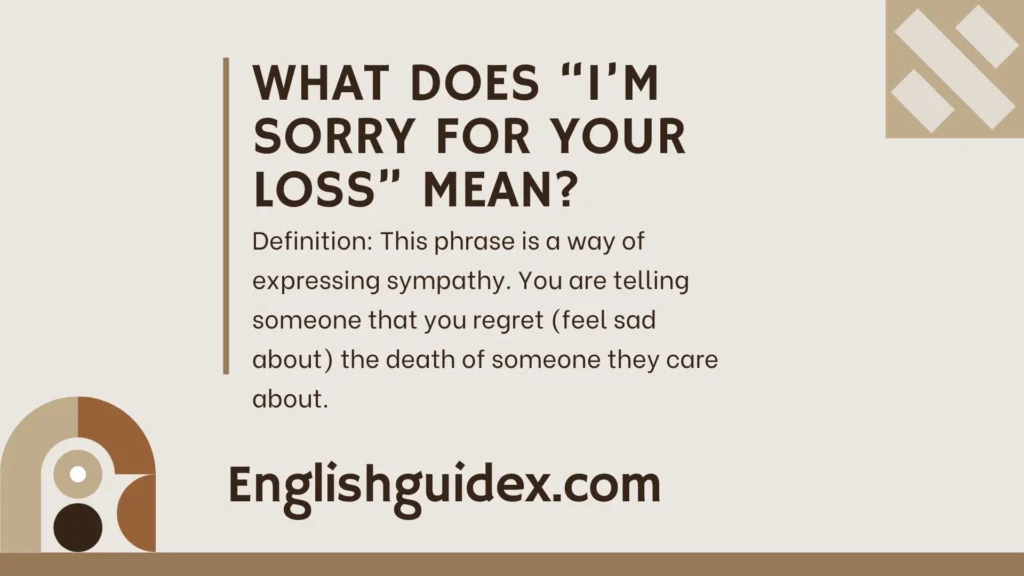
Definition: This phrase is a way of expressing sympathy. You are telling someone that you regret (feel sad about) the death of someone they care about.
Grammar / Structure:
- I’m sorry = “I regret,” or “I feel sadness.”
- for your loss = “because of what you have lost,” i.e., someone in their life has died and they are experiencing grief.
It’s a full sentence, present tense, direct address (“you/your”).
When to Use “I’m Sorry for Your Loss”
Practical Usage Contexts:
- Spoken: When you meet someone who has just lost a loved one. You might say it in person: “I’m so sorry for your loss.”
- Written: In a condolence card, email, or message: “Dear [Name], I’m sorry for your loss.”
- Formal / Informal: It works in both—but it leans safe and neutral, so it fits most contexts.
- Business / Corporate: You can use it in a business email when a colleague has lost someone—but often you might choose something more formal (see later).
Is It Professional / Polite to Say “I’m Sorry for Your Loss”?
Yes. It is polite, respectful, and acceptable in most situations. According to guidance on expressing sympathy, the phrase “I’m sorry for your loss” is “a simple and succinct way of communicating your empathy.” everplans.com+1
In professional settings: It’s fine—but if you’re in a corporate/official context, you might prefer something a bit more formal such as “Please accept my deepest condolences.” betterplaceforests.com+1
Pros and Cons of Using “I’m Sorry for Your Loss”
Pros:
- ✅ Clear and widely understood.
- ✅ Neutral tone: suitable for many situations (formal, informal).
- ✅ Expresses sympathy without overstepping.
Cons:
- ❗ Some might feel it’s too generic or over-used (“cliché”). everplans.com+1
- ❗ It doesn’t always convey deeper personal connection or specific support.
- ❗ In very informal contexts, it can feel too formal; in very personal contexts, it might feel too minimal.
List Section: 20 Alternative Phrases
Here are 20 alternative ways to say “I’m sorry for your loss,” each explained with meaning, usage, example, best use, worst use, and tone.
1. Phrase: My deepest condolences
Meaning: I offer you my very sincere sympathy for your loss.
Explanation: More formal and slightly stronger than the basic phrase; common in written/official messages.
Example Sentence: “My deepest condolences to you and your family on the passing of your father.”
Best Use: Formal / Business / Written.
Worst Use: Very casual chat with a close friend (might sound too stiff).
Tone: Formal.
2. Phrase: Please accept my heartfelt sympathy
Meaning: I hope you will accept how genuinely sorry I am for what has happened.
Explanation: Adds “heartfelt” to show deeper emotion; polite and warm.
Example Sentence: “Please accept my heartfelt sympathy during this difficult time.”
Best Use: Formal letters, cards, emails.
Worst Use: Text message to a close friend where you want a very casual tone.
Tone: Formal / Warm.
3. Phrase: My heart goes out to you
Meaning: I feel deep sympathy and I am emotionally with you in your suffering.
Explanation: Slightly less formal, emotionally expressive.
Example Sentence: “My heart goes out to you and your children after your loss.”
Best Use: Semi-formal, spoken or written.
Worst Use: Very formal corporate email where you need formal diction.
Tone: Friendly / Emphatic.
4. Phrase: I’m keeping you in my thoughts
Meaning: I will think of you, caring about you, as you go through this.
Explanation: Slightly softer than direct “sorry for your loss”; good if you want to show ongoing support.
Example Sentence: “I’m keeping you in my thoughts as you navigate this hard time.”
Best Use: Informal or semi-formal.
Worst Use: Very formal condolence where a stronger phrase is more appropriate.
Tone: Neutral / Supportive.
5. Phrase: You are in my thoughts and prayers
Meaning: I’m thinking of you and also offering spiritually/with care for you in prayer.
Explanation: Has a spiritual/religious touch; common in compassionate messages.
Example Sentence: “During this loss, you are in my thoughts and prayers.”
Best Use: Informal or when you know the person is comfortable with spiritual language.
Worst Use: With someone who is not religious or in a purely business/professional setting.
Tone: Friendly / Empathic.
6. Phrase: I was so saddened to hear of your loss
Meaning: I felt great sorrow when I heard about what happened.
Explanation: Personalizes the message by referencing your reaction; good for closer relationships.
Example Sentence: “I was so saddened to hear of your loss and want you to know I’m here for you.”
Best Use: Semi-formal, when you have a moderate connection with the person.
Worst Use: Very casual chat with a close friend (could feel more formal than needed).
Tone: Neutral / Warm.
7. Phrase: May you find comfort in fond memories
Meaning: I hope the good memories you have will give you peace and comfort.
Explanation: Focuses on positive recollection rather than just the sadness.
Example Sentence: “May you find comfort in fond memories of her and the love you shared.”
Best Use: Written (cards, emails) or spoken with sensitivity.
Worst Use: In a quick casual message where you just want to say “sorry”.
Tone: Gentle / Reflective.
8. Phrase: I’m here if you need anything
Meaning: I offer my support and availability for help.
Explanation: Moves from just “I’m sorry” to “I will help”; good for showing you’re present.
Example Sentence: “I’m here if you need anything—whether it’s someone to talk to or help with arrangements.”
Best Use: Informal or semi-formal where you know the person.
Worst Use: In very formal business context where you don’t have that relationship.
Tone: Friendly / Supportive.
9. Phrase: Sending you warmth and strength
Meaning: I’m sending you emotional support, comfort and inner strength.
Explanation: Metaphorical “warmth” and “strength” make it gentle yet powerful.
Example Sentence: “Sending you warmth and strength as you cope with the passing of your loved one.”
Best Use: Semi-formal or informal.
Worst Use: Very traditional formal setting where simple phrases are preferred.
Tone: Friendly / Empathic.
10. Phrase: I share in your sorrow
Meaning: I sympathize and feel sadness along with you.
Explanation: Emphasizes that you also feel the pain and you’re not just observing.
Example Sentence: “I share in your sorrow and offer you my deepest sympathy.”
Best Use: Formal or semi‐formal.
Worst Use: Very casual where you may want something shorter.
Tone: Formal / Supportive.
11. Phrase: May your loved one rest in peace
Meaning: I hope the person who died is at peace and you find peace too.
Explanation: Common in memorial cards or when you address the deceased’s memory.
Example Sentence: “May your loved one rest in peace, and may you find comfort in the days ahead.”
Best Use: Formal, especially in writing.
Worst Use: If the person doesn’t believe in “resting in peace” (religious/atheist mismatch).
Tone: Formal / Respectful.
12. Phrase: You and your family are in my thoughts
Meaning: I’m thinking of you and your family in this tough time.
Explanation: Acknowledges not just one individual but the family’s loss.
Example Sentence: “You and your family are in my thoughts after [Name]’s passing.”
Best Use: Semi‐formal, especially when addressing broader group.
Worst Use: In a very casual setting where “family” may be too formal.
Tone: Neutral / Supportive.
13. Phrase: Allow yourself time to grieve
Meaning: It’s okay to take time and feel sadness; you don’t have to rush.
Explanation: Encouraging phrase; gives permission to feel grief.
Example Sentence: “Please allow yourself time to grieve—take as long as you need.”
Best Use: Informal or semi-formal with close acquaintance.
Worst Use: Purely corporate email where you might not know the person well.
Tone: Friendly / Gentle.
14. Phrase: My sincere sympathies
Meaning: I offer sincere (genuine) sympathy.
Explanation: Simple, polite, slightly more formal than basic phrase.
Example Sentence: “You have my sincere sympathies at this sad time.”
Best Use: Formal or business written message.
Worst Use: Very intimate personal message where you might want a more personal phrase.
Tone: Formal / Respectful.
15. Phrase: I can’t imagine what you’re going through, but I care
Meaning: I don’t fully know your pain, but I care about you and your suffering.
Explanation: Acknowledges you don’t know exactly how they feel—humble and supportive.
Example Sentence: “I can’t imagine what you’re going through, but I care deeply and am here for you.”
Best Use: Informal or semi-formal when you know the person somewhat.
Worst Use: Very formal setting where too personal might feel odd.
Tone: Friendly / Empathic.
16. Phrase: May you be surrounded by love and memories
Meaning: I hope you are supported by people who love you and hold good memories.
Explanation: Encourages positive environment of support and recollection.
Example Sentence: “May you be surrounded by love and memories that bring comfort in this hard time.”
Best Use: Semi-formal or informal.
Worst Use: Very formal where simpler phrase is fine.
Tone: Gentle / Warm.
17. Phrase: Thinking of you in your time of sorrow
Meaning: I am thinking about you while you are experiencing this sorrow.
Explanation: Traditional phrasing often seen in sympathy cards.
Example Sentence: “Thinking of you in your time of sorrow and hoping you find peace.”
Best Use: Formal or written condolences.
Worst Use: Very casual where you might want something more personal.
Tone: Formal / Considerate.
18. Phrase: Wishing you strength for the days ahead
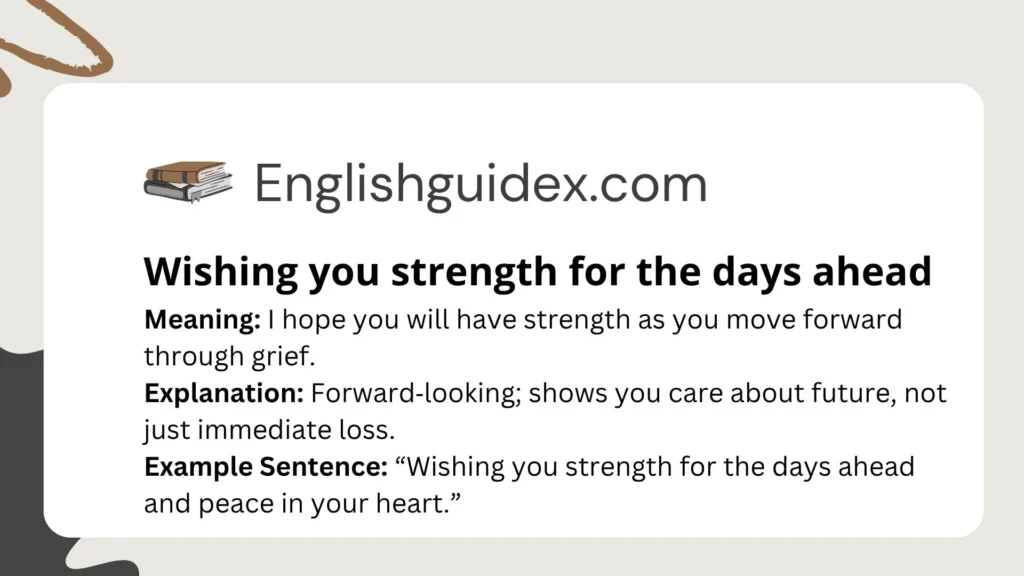
Meaning: I hope you will have strength as you move forward through grief.
Explanation: Forward‐looking; shows you care about future, not just immediate loss.
Example Sentence: “Wishing you strength for the days ahead and peace in your heart.”
Best Use: Semi-formal or informal.
Worst Use: If you know the person dislikes “wishing” style phrasing or prefers short direct message.
Tone: Friendly / Uplifting.
19. Phrase: My thoughts are with you during this difficult time
Meaning: I am thinking about you while you go through a hard period.
Explanation: Polite, safe, slightly formal but usable in many settings.
Example Sentence: “My thoughts are with you during this difficult time and always.”
Best Use: Semi-formal, professional but caring.
Worst Use: Very casual chat among close friends (might feel slightly distant).
Tone: Neutral / Professional.
20. Phrase: I wish you peace and comfort in the days ahead
Meaning: I hope you find peace and comfort in the future as you grieve.
Explanation: Expresses hope for healing and calm; sensitive and encouraging.
Example Sentence: “I wish you peace and comfort in the days ahead as you remember your loved one.”
Best Use: Semi-formal or written message.
Worst Use: Quick verbal remark in very informal context (could feel too wordy).
Tone: Gentle / Reflective.
21. Phrase: Please know that I am here for you
Meaning: I want you to know I’m available to help, listen, or support.
Explanation: Clearly offers support; good for close relationships or friends.
Example Sentence: “Please know that I am here for you—call any time you need someone to talk to.”
Best Use: Informal or semi-formal.
Worst Use: In a formal business setting where over-personal may feel out of place.
Tone: Friendly / Supportive.
22. Phrase: May the memories of your loved one bring you peace
Meaning: I hope remembering the person brings comfort rather than pain.
Explanation: Focuses on memory and comfort rather than just grief.
Example Sentence: “May the memories of your loved one bring you peace and solace.”
Best Use: Written cards or messages, semi-formal.
Worst Use: Very brief verbal message where simpler phrase is better.
Tone: Reflective / Warm.
23. Phrase: I am so sorry you’re going through this
Meaning: I regret that you have to face this difficult situation.
Explanation: Less formal; direct and personal; acknowledges their ongoing experience.
Example Sentence: “I am so sorry you’re going through this and I wish I could ease your pain.”
Best Use: Informal or semi-formal among friends.
Worst Use: Formal corporate email where you want distance and professionalism.
Tone: Friendly / Empathic.
24. Phrase: You are not alone in your grief
Meaning: You’re not facing this by yourself; I (and others) stand with you.
Explanation: Emphasis on shared experience or support network.
Example Sentence: “You are not alone in your grief—we are all here to support you.”
Best Use: Informal or semi-formal when you know the person.
Worst Use: Formal message to someone you don’t know; might feel presumptive.
Tone: Warm / Supportive.
25. Phrase: My sincere condolence to you and your family
Meaning: I express my genuine sympathy to you and your family.
Explanation: Very formal; good for corporate or distant relationships.
Example Sentence: “Please accept my sincere condolence to you and your family at this sad time.”
Best Use: Formal letters, business contexts.
Worst Use: Very casual friend chat where it might feel too detached.
Tone: Formal / Respectful.
26. Phrase: I will remember [Name] with affection
Meaning: I will keep good memories of the deceased; I cared for them.
Explanation: Adds a personal memory of the person who died; expresses value.
Example Sentence: “I will remember John with affection and his kindness to everyone.”
Best Use: When you knew the deceased; semi-formal.
Worst Use: When you didn’t know the person at all; might feel odd.
Tone: Reflective / Warm.
27. Phrase: Please let me know how I can help
Meaning: Offering specific support rather than just words.
Explanation: Action-oriented; moves beyond sympathy to practical help.
Example Sentence: “Please let me know how I can help with anything during this difficult time.”
Best Use: Informal or semi‐formal with acquaintance or friend.
Worst Use: Very formal business where you don’t have relationship or offer may conflict.
Tone: Friendly / Supportive.
28. Phrase: May you find hope and healing in time
Meaning: I hope you gradually recover and find hope after the pain.
Explanation: Focuses on future healing; sensitive and supportive.
Example Sentence: “May you find hope and healing in time, surrounded by caring friends and family.”
Best Use: Semi‐formal or informal.
Worst Use: When you need a brief message; this is a bit longer.
Tone: Gentle / Encouraging.
Comparison Table
Here’s a quick table comparing some of the top alternatives by tone and usage:
| Phrase | Tone | Best Usage |
|---|---|---|
| My deepest condolences | Formal | Written cards / business email |
| My heart goes out to you | Friendly / Emphatic | Semi-formal messages |
| I’m here if you need anything | Supportive / Casual | Close friend / informal |
| Wishing you strength for the days ahead | Uplifting | Semi‐formal notes |
| You are not alone in your grief | Warm / Supportive | Informal or friend-to-friend |
FAQs
Q1: Can I still say “I’m sorry for your loss” in a business context?
Yes. It’s polite and acceptable. But if you want extra formality, use something like “Please accept my deepest condolences.” betterplaceforests.com+1
Q2: Are there situations when it’s better not to say “I’m sorry for your loss”?
If you don’t know the person well, you may keep it very brief and simple. Also if the person has experienced a non-death loss (job loss, breakup), you may want a phrase that fits that context rather than using language that implies death. (Though “loss” can work broadly, some will feel the death context more strongly.)
Q3: How informal is “I’m here if you need anything”?
It is quite informal-friendly. Best used when you know the person fairly well and feel comfortable offering help. In formal business messages, you might say “Please let me know if there is anything I can do to support you.”
Q4: What should I avoid when expressing condolences?
Avoid clichés that might feel hollow (e.g., “At least they’re in a better place,” unless you know their beliefs). Also don’t minimize the person’s feelings (e.g., “It’s not so bad,”). The key: be sincere. Wild Grief | Grieving Together in Nature
Q5: How long should a condolence message be?
Short is okay—one or two sentences can suffice if genuine. But if you know the person, a few lines (sharing a memory or offering support) can be more comforting.
Conclusion
Using the right words matters. While “I’m sorry for your loss” is perfectly fine, knowing other ways to say it helps you match your tone, relationship, and setting.
Whether you need something formal, friendly, business-appropriate, or personal, the phrases above give you plenty of options.
Try them out, adapt them to your style, and speak or write with genuine care. Your words can offer real comfort.

David Jonson is an experienced English language writer who specializes in clear, practical, and learner-friendly content. He helps students and professionals improve their communication skills with confidence.