When you stumble across words like quaff and coif, they can look deceptively simple. At first glance, they seem like they might even be related.
After all, both are short, quirky, and sound a little unusual. But in reality, quaff and coif occupy entirely different corners of the English language.
Understanding their meanings, proper usage, and historical context is essential if you want to use them correctly—and sound smart while doing it.
Let’s dive deep into these fascinating words.
Understanding Homophones and Rare Vocabulary
Before we tackle quaff vs coif, it helps to understand homophones.
Homophones are words that sound alike but have different meanings and spellings. For instance:
- Pair vs Pear
- Sea vs See
- Brake vs Break
These similarities often confuse learners and even native speakers. Words like quaff and coif aren’t exactly homophones, but their rarity and unusual spelling can make them equally tricky.
Learning such words does more than just prevent mistakes—it expands your vocabulary, makes reading historical texts easier, and improves your overall fluency.
What Does Quaff Mean?
The word quaff immediately conjures images of medieval banquets or hearty celebrations. Its primary usage revolves around drinking, but it has a specific nuance.
Quaff as a Verb
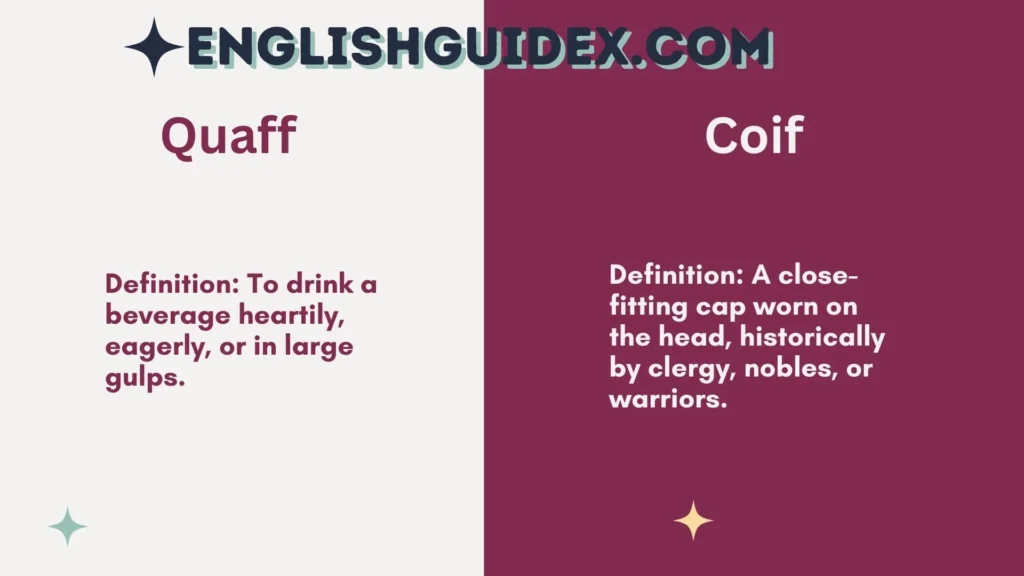
- Definition: To drink a beverage heartily, eagerly, or in large gulps.
- Example: “After running the marathon, she quaffed a bottle of water in one go.”
- Tone: Often used in literary or playful contexts rather than everyday casual speech.
Quaff as a Noun
- Less common, but it refers to the act of quaffing.
- Example: “A quaff of ale lifted the spirits of the weary travelers.”
Origin of the Word Quaff
- Etymology: Comes from Middle English quaffen, derived from Old Norse kaff.
- Historically associated with mead, ale, or wine, particularly in ceremonial or festive drinking.
Quaff in Literature and History
- In medieval texts, knights would often “quaff mead” to celebrate victories.
- Shakespeare occasionally used similar terms to depict joyful drinking.
Quick Tip: Anytime you see quaff, think drinking with gusto, not just a casual sip.
What Does Coif Mean?
If quaff brings images of mugs and mead, coif brings to mind hair, caps, and medieval fashion.
Coif as a Noun
- Definition: A close-fitting cap worn on the head, historically by clergy, nobles, or warriors.
- Example: “The knight adjusted his coif before putting on his helmet.”
Coif as a Verb
- Definition: To arrange or style hair carefully.
- Example: “She coifed her hair into an elaborate braid for the ball.”
Historical Context of Coif
- Coifs were essential in medieval Europe, especially under armor to protect the head.
- Clergy and royalty wore coifs as a sign of status and formality.
- The fashion element continued into the Renaissance, appearing in portraits and literature.
Fun Fact: The term coif eventually evolved in hairstyling, leading to modern references in salons where “to coif” still means to style hair neatly.
Quaff vs Coif – Detailed Comparison
At this point, the difference should be clearer. But let’s break it down with a direct comparison.
Part of Speech and Meaning
| Word | Part of Speech | Meaning | Usage Context | Pronunciation |
|---|---|---|---|---|
| Quaff | Verb/Noun | To drink heartily | Literary, casual, historical | /kwɑːf/ |
| Coif | Noun/Verb | Cap or hairstyle / arrange hair | Fashion, medieval, historical | /kɔɪf/ |
Key Takeaways:
- Quaff = drinking. Think celebration or feast.
- Coif = hair or headwear. Think style, protection, or medieval fashion.
- Context clues usually make the meaning obvious. If someone’s holding a mug, it’s probably quaff. If they’re in front of a mirror, it’s coif.
Examples Using Quaff
Understanding a word fully comes from seeing it in action. Here are practical and historical examples of quaff:
- Casual Modern Usage: “He quaffed a soda after finishing his workout.”
- Historical Usage: “The villagers quaffed ale as the festival drums played through the night.”
- Literary Usage: “Sir Lancelot quaffed deeply from his goblet, celebrating the victory with mirth.”
Notice how quaff implies more than just drinking—it’s enthusiastic, joyful, or ceremonial.
Examples Using Coif
Similarly, seeing coif in context clarifies its meaning:
- Modern Usage: “She coifed her hair into soft waves for the wedding.”
- Historical Usage: “The medieval knight’s coif was padded for comfort under his helmet.”
- Fashion Context: “Hairstylists today still coif hair before photo shoots or runway shows.”
Common Mistakes: Interchanging Quaff and Coif
People occasionally mix these words up—not because they sound alike, but because both are rare and formal-sounding.
- Mistake Example: “He coifed the ale from the bottle.” ❌
- Corrected: “He quaffed the ale from the bottle.” ✅
Tips to Avoid Mistakes:
- Associate quaff with drinking. Visualize mugs or goblets.
- Associate coif with hair or caps. Picture a medieval knight or a hairstylist.
- If unsure, check context clues in the sentence.
Practical Tips for Using Quaff and Coif Correctly
- Use quaff when talking about drinks, especially in literary, historical, or playful contexts.
- Use coif when referring to hair arrangements or head coverings.
- To remember:
- Quaff → Quaff a beverage
- Coif → Coif a coiffure
- Avoid “I coifed a drink” mistakes—it sounds funny and incorrect!
Case Studies: Quaff and Coif in Literature
Case Study 1: Quaff in Historical Novels
- In novels depicting medieval banquets, knights often quaff ale or mead.
- Example: “The warriors quaffed deeply from golden goblets, laughing and singing.”
Case Study 2: Coif in Art and Texts
- Portraits from the 15th century show nobles wearing elaborate coifs, often under hats or armor.
- In literature, phrases like “he coifed his hair” indicate careful grooming or preparation.
Comparison Table: Modern vs Historical Usage
| Word | Modern Usage | Historical Usage | Notes |
|---|---|---|---|
| Quaff | Drinking beer, soda, or wine casually | Banquets, festivals, celebrations | Emphasizes enthusiasm and volume |
| Coif | Hairstyling, fashion | Armor padding, noble caps, clergy attire | Can be noun or verb depending on context |
Fun Facts and Mnemonics
- Quaff → Sounds like “cough,” imagine coughing down a drink!
- Coif → Think “coif your hair” or “cap on head.”
- Medieval knights’ coifs were both fashion and armor, a dual-purpose innovation.
- Shakespearean texts often use quaff to indicate joyous drinking.
FAQs
What is the difference between quaff and coif?
Answer: Quaff means to drink heartily; coif refers to a hairstyle or head covering.
Can coif be used as a verb?
Answer: Yes, it means to style or arrange hair.
Is quaff still used in modern English?
Answer: Yes, mostly in literary, playful, or historical contexts.
How do I remember which is which?
Answer: Quaff → drink. Coif → hair or cap. Use visual associations.
Are there other rare words like quaff and coif?
Answer: Yes, words like goblet, carafe, and wimple share similar historical or literary contexts.
Conclusion
Mastering quaff vs coif is more than memorizing definitions—it’s about context, history, and usage.
- Quaff = enthusiastic drinking, often in literary or historical texts.
- Coif = hair arrangement or head covering, with medieval roots.
Using them correctly makes your English more precise, colorful, and confident. Next time you’re reading a medieval tale or attending a fancy banquet, you’ll know whether to quaff a drink or adjust your coif!

David Jonson is an experienced English language writer who specializes in clear, practical, and learner-friendly content. He helps students and professionals improve their communication skills with confidence.