When you write a sentence that includes the word reevaluation or re-evaluation, you’re stepping into one of those tricky corners of English where spelling, clarity, and reader perception collide.
While both spellings appear in published writing, professional editors, teachers, and business writers debate which one is “right.” The truth? The correct choice depends on context, clarity, and audience expectations—not guesswork or outdated grammar myths.
This guide breaks everything down in a friendly, conversational way that makes sense whether you’re writing academic assignments, business emails, website copy, or personal work.
You’ll learn how hyphenation influences meaning, what modern American English prefers, when clarity demands a hyphen, and how to make consistent choices that make your writing feel polished and intentional.
Reevaluation or Re-evaluation? (Short Answer Up Front)
- In modern American English, the preferred spelling is reevaluation.
- The hyphenated form re-evaluation appears when clarity might suffer, especially for readers unfamiliar with the word or when vowel collisions feel visually confusing.
- In the UK and Commonwealth English, re-evaluation is more common due to regional hyphenation tendencies.
So the choice isn’t arbitrary. It’s strategic.
Why This Matters More Than Most Writers Realize
Hyphen decisions may seem small, but they change how smoothly a sentence reads. They affect professionalism. They shape comprehension. They determine whether your writing feels American, British, or stylistically neutral. Even automated tools like Grammarly and spellcheck apps rely on standardized patterns—meaning your choice can influence how a document is judged.
Every time you choose between reevaluation and re-evaluation, you’re signaling to the reader:
- The style guide you’re following
- The region your English aligns with
- How much you prioritize clarity over tradition
Language isn’t only about rules—it’s also about results.
Why Hyphenation Matters in American English
Hyphens serve as a clarity tool, not decoration. They bridge meanings that could collapse into confusion.
A few key reasons hyphens still matter:
- They prevent misreading when prefixes create unintended words
- They separate vowel collisions that slow the eyes or change pronunciation
- They support professional tone by eliminating ambiguity
- They help maintain reader flow and reduce cognitive friction
Think of hyphens as a little traffic director in a sentence. They control flow so readers don’t crash into confusion.
The Prefix “Re-”: What It Actually Does
The prefix re- carries two major meanings:
| Prefix Meaning | Example | Meaning |
|---|---|---|
| To do again | reapply | apply again |
| Back/return to previous state | reenter | enter again or go back in |
In most cases, the prefix attaches cleanly to the base word—without a hyphen.
However, when a base word starts with a vowel, reading becomes harder. That’s when the hyphen steps in.
The Foundational Rule
In American English, re- words are rarely hyphenated unless the lack of hyphen alters meaning.
No hyphen needed when:
- The meaning doesn’t change
- The base word begins with a consonant
- The pronunciation remains obvious
Hyphen needed when:
- The base word begins with a vowel
- The unhyphenated spelling becomes confusing
- There is a risk of misinterpretation
Simple. Practical. Readability first.
Reevaluation vs. Re-evaluation: The Detailed Comparison
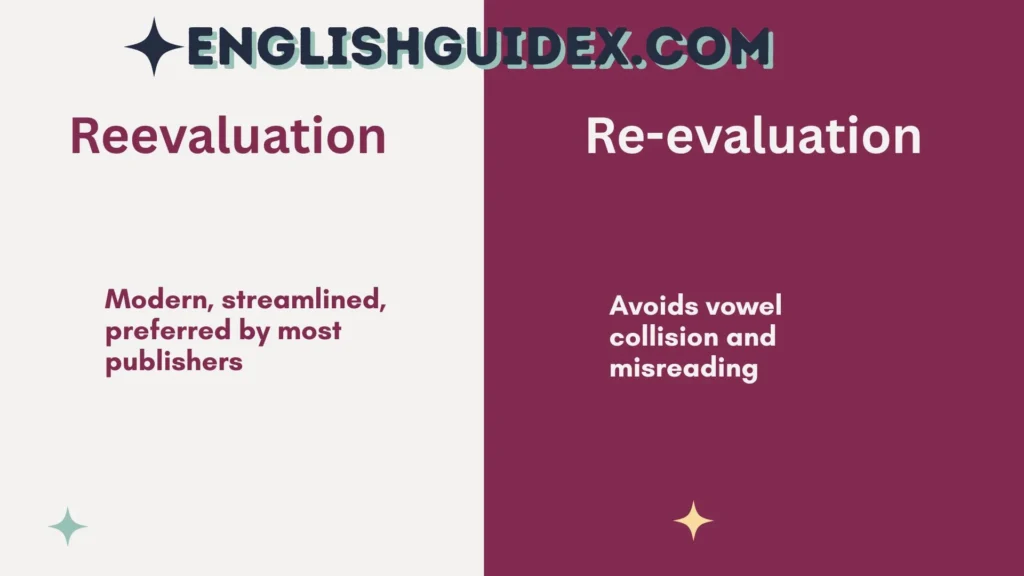
| Form | Region/Preference | Why It’s Used | Tone |
|---|---|---|---|
| Reevaluation | US standard | Modern, streamlined, preferred by most publishers | Clean, efficient, contemporary |
| Re-evaluation | UK/Commonwealth | Avoids vowel collision and misreading | Traditional, academic, clarity-first |
Example in a business setting:
“We completed a reevaluation of the client’s proposal to improve efficiency.”
Example where the hyphen improves clarity:
“A re-evaluation of emergency protocols will occur after the audit.”
The difference isn’t correctness—it’s intention.
When the Hyphen Changes Meaning Entirely
Sometimes removing a hyphen doesn’t just change the look of a word—it changes the meaning of the word itself.
| Without Hyphen | With Hyphen | What It Means |
|---|---|---|
| recover | re-cover | Heal vs cover again |
| resign | re-sign | Quit vs sign again |
| recreation | re-creation | Leisure vs create again |
| reevaluate | re-evaluate | Standard US vs clarity variant |
The reader’s interpretation depends on the hyphen. One tiny mark prevents massive confusion.
Examples of Meaning Shifts That Demand Hyphens
Imagine the chaos if we didn’t use hyphens:
- “I need to re-sign the contract.” (sign it again)
- “I need to resign the contract.” (quit entirely)
Those are opposite intentions. That hyphen saves careers.
Another case:
- “The project requires recreation standards.”
Sounds like a gym membership policy. - “The project requires re-creation standards.”
Clear. They must create something again.
When in doubt, clarity leads.
Professional, Academic & Business Writing Recommendations
In real-world writing, consistency matters more than chasing perfection.
Use “reevaluation” when:
- Writing for American corporate audiences
- Submitting resumes, cover letters, or proposals
- Publishing digital content, UX writing, or marketing material
- You want clean, uninterrupted flow
Use “re-evaluation” when:
- A professor, employer, or editor requires it
- Writing for an international (non-US) audience
- The vowels clash and slow comprehension
- You notice readers stumble or mispronounce the word
Either choice is defensible. Consistency is non-negotiable.
Case Study #1: Academic Writing
A university research paper might choose re-evaluation for clarity because unfamiliar readers benefit from slower pacing. Professors often favor clarity over efficiency, especially in technical writing.
“This study offers a re-evaluation of 2018 survey results using updated demographic models.”
Case Study #2: Corporate Communications
Businesses prioritize speed, readability, and brand tone. That makes reevaluation the cleaner choice.
“Our Q4 reevaluation of performance metrics showed a 17% gain in conversion efficiency.”
It reads faster. It feels modern. It aligns with US brand voice.
Case Study #3: Screen & Mobile UX Writing
On mobile screens, hyphens visually interrupt text flow. Without space to waste, shorter wins.
“Reevaluation scheduled. Review next steps inside dashboard settings.”
Digital language is evolving. Hyphens are falling away because screens demand concise structure.
Reevaluation, Re-evaluation & Capitalization Rules for Titles
When a hyphen appears in a title or headline, capitalization depends on the style guide.
| Style Guide | Rule |
|---|---|
| Chicago Manual | Capitalize both sides of the hyphen |
| AP Style | Capitalize only the first element unless it’s a proper noun |
| MLA/APA | Follow title case rules, typically capitalizing both parts |
Correct Title Examples:
- Reevaluation Strategies for Workplace Leadership
- Re-evaluation of Hiring Models in Corporate America
- Reevaluation After Market Disruption: A Practical Framework
Regional Differences
If you work internationally, be aware of expectations:
| Region | Preferred Form |
|---|---|
| United States | Reevaluation |
| Canada | Mixed usage |
| UK / Commonwealth | Re-evaluation |
| Australia / New Zealand | Hyphen common but shifting |
The world isn’t unanimous—but trends point toward simplification.
Reevaluation vs. Re-evaluation Cheat Sheet
- Writing for the U.S.? → reevaluation
- Writing for international academic readers? → re-evaluation
- If clarity suffers? → use the hyphen
- If your document already uses one form? → stay consistent
Intentionality beats confusion every time.
FAQs
What is the correct American spelling: reevaluation or re-evaluation?
Reevaluation is preferred in American English, while re-evaluation appears when clarity or tradition requires a hyphen.
Is reevaluation acceptable in academic writing?
Yes. It’s becoming more common, but some professors or journals still prefer the hyphenated form.
Why do some dictionaries list both forms?
Because usage varies by region, purpose, and audience. Both are correct; context decides the best version.
Does the hyphen change pronunciation?
Not significantly. It influences pacing more than sound, helping the eye break the vowel sequence.
Should I pick one version and stick to it?
Yes. Consistency strengthens credibility, especially in professional or published work.
Conclusion
Language isn’t about being technically perfect. It’s about being understood.
If you write for American readers, prefer:
Reevaluation
If clarity or region requires it, choose:
Re-evaluation
Either can be correct. But only one is correct for your situation.
Choose the version that makes your reader’s path smooth, not stressful. That’s how real professionals write.

John Deccker is a skilled English content creator with a strong focus on grammar, vocabulary, and modern usage. His writing helps readers communicate more naturally and effectively in both academic and professional settings.