
Choosing between requester and requestor looks like a tiny decision, but it affects clarity, tone, and even legal accuracy.
One spelling is used in everyday communication. The other appears in specialized fields like IT, procurement, and law. Pick the wrong one and your writing might feel inconsistent, outdated, or just plain confusing.
This guide walks you through both spellings, where they belong, and how to use them in sentences like a professional. Everything here is designed to be practical, easy to follow, and realistically applicable to workplace communication.
Requester or Requestor? Understanding Meaning, Usage, and Context
Most readers don’t want a lecture. They want a clear answer. So here’s the fast breakdown:
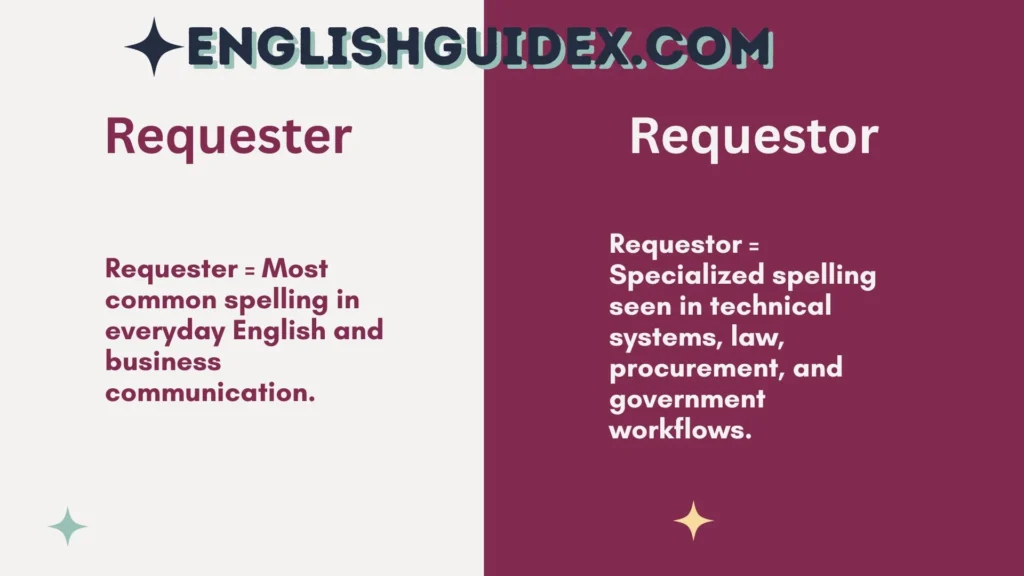
- Requester = Most common spelling in everyday English and business communication.
- Requestor = Specialized spelling seen in technical systems, law, procurement, and government workflows.
You’ll see both in the real world, but you shouldn’t use them interchangeably.
Simple rule: If you’re talking to people, use requester. If you’re talking to systems, contracts, or policies, you might need requestor.
What “Requester” and “Requestor” Actually Mean
At their core, both words refer to a person or entity that asks for something—documents, access, payment, resources, information, authorization, etc.
| Spelling | Common Use | Tone/Feel | Where It Shows Up |
|---|---|---|---|
| Requester | Most everyday writing | Clear, neutral | Emails, business docs, reports, guides |
| Requestor | Specific industries or systems | Technical, formal | Contracts, procurement, IT dashboards, legal forms |
Quick Examples
- The requester submitted the ticket to customer support.
- The requestor field must be completed before access is approved.
Both work, but the audience changes everything.
Which One Dominates in Modern English?
Language shifts as people do. Over time, requester has become the dominant spelling in modern English because:
- It mirrors common English word formation (worker, driver, reader).
- It sounds natural in conversation.
- It aligns with business writing standards.
- Style guides used in corporate and educational settings lean toward it.
Meanwhile, requestor has stayed relevant because technical environments need consistent terminology. Once a spelling becomes part of a contract template, database field, or government form, it rarely changes.
In other words:
- Conversations evolve.
- Systems resist change.
This is why both spellings survive.
How Language Trends Shape the Preference
Language trends aren’t random. They’re driven by audience, readability, and the environments where words appear.
Why requester feels natural:
- It rolls off the tongue more easily.
- Readers subconsciously expect -er endings.
- It avoids the “technical” tone that requestor gives off.
Why requestor stays alive:
- Legal documents require consistency.
- IT systems prefer fixed labels over conversational spelling.
- Procurement and compliance teams preserve old terminology for accuracy.
Think of it like this:
- Requester = People-first language
- Requestor = System-first language
Requestor in British English and Industry Contexts
While requester appears globally, requestor shows up in more niche settings, especially in fields that deal with rules, audits, and authorization.
Industries where “Requestor” is still common:
- Procurement departments
- Access control systems (IAM – Identity and Access Management)
- Banking and financial authorization workflows
- Government process paperwork
- Legal contracting and policy writing
Typical Places You’ll Spot It
- Onboarding access forms
- Vendor setup paperwork
- Compliance and auditing templates
- System-generated email notices
If your form, system, or contract already uses requestor, don’t switch it. Consistency is more important than preference.
Examples of “Requestor” in Specialist Environments
IT & Cybersecurity
- The requestor must validate their identity before system access is granted.
- Only the original requestor can approve modification of this ticket.
Procurement & Purchasing
- Funds will not be released until the requestor’s authorization is confirmed.
- The requestor submitted a materials requisition for the upcoming project.
Legal
- The requestor accepts responsibility for providing accurate documents.
Here, the spelled-out term acts as a label, not a conversational word. That’s what separates the two.
Everyday Language: When to Use “Requester”
If you’re writing anything meant to be read naturally, use requester. It matches everyday patterns.
Best places to use requester:
- Workplace emails
- Customer service communication
- HR documents for staff
- Instructional guides or manuals
- University forms and letters
- Business correspondence
Examples
- Please contact the requester for clarification.
- The requester asked for an update before Friday.
- Our team notified the requester about the account review.
It’s simple, clean, and familiar.
Sentence Examples You Can Copy Today
Requester (General Use)
| Sentence Type | Example |
|---|---|
| Customer service | The requester asked for help resetting their login. |
| Business | Each requester must submit receipts with the reimbursement form. |
| Email etiquette | I contacted the requester to confirm the delivery date. |
Requestor (Specialized Use)
| Sentence Type | Example |
|---|---|
| Legal | Each requestor agrees to the disclosure conditions before approval. |
| IT | Only the requestor can modify the access request. |
| Procurement | The system shows the original requestor as pending verification. |
Incorrect vs Correct
| Incorrect | Correct |
|---|---|
| The requestor emailed customer support about shipping. | The requester emailed customer support about shipping. |
| The requester must sign the system audit form. | The requestor must sign the system audit form. |
Small change. Big difference.
Why Both Spellings Exist (Without Overcomplicating It)
English absorbs influences like a sponge:
- French gave us the base word request.
- Early English adapted it into new forms.
- Legal and bureaucratic systems froze a version in place.
- Everyday language evolved past it.
The takeaway: One form moved forward. The other stayed where rules mattered more than rhythm.
Language behaves like software. Once it’s deployed in the wrong place, updating it costs too much.
Etymology & Origin of “Requester”
The word request comes from:
- Old French requestr meaning “to ask formally”
- Latin requaerere meaning “to seek, inquire, or demand”
As English developed:
- Adding -er to verbs became the dominant pattern
- Think: teacher, speaker, reporter, adviser, printer, listener
- So requester became the natural evolution
Requestor appeared later as:
- A functional term in administrative writing
- A locked-in label in systems and statutes
- Less about speaking, more about classification
Decision Guide: Which One Should You Use?
Use this table to decide instantly:
| Situation | Best Choice |
|---|---|
| Writing emails | Requester |
| Customer or support language | Requester |
| Internal documentation | Requester |
| Government forms | Requestor |
| IT or cybersecurity access control | Requestor |
| Procurement and purchase orders | Requestor |
| Legal contracts that already use one form | Match existing spelling |
Simplest rule:
If humans will read it → Requester
If rules or systems demand it → Requestor
5 Case Studies That Clarify Real Usage
Customer Support
- A company updates templates to “requester” to improve readability and reduce confusion for non-native speakers.
Procurement
- A vendor onboarding packet sticks with “requestor” because it matches audit records and budget approval forms.
SaaS / IT Software
- A dashboard field labeled “Requestor ID” can’t change without rewriting thousands of records.
Legal Contracts
- Once a contract includes “requestor,” it becomes a defined legal term that must remain consistent throughout.
Training Manuals
- A business rebrands internal documents from “requestor” to “requester” to improve tone and reduce intimidation.
These aren’t hypotheticals; they mirror common organizational shifts.
FAQs About Requester vs Requestor
Is requester or requestor more correct?
Both are correct, but requester is preferred in most everyday writing. Requestor is reserved for specialized use.
Does British English prefer requestor?
It appears more frequently there than in the US, but even in Britain, requester is more widely accepted.
Can I use them interchangeably?
Not recommended. Context determines the better choice.
What if my company already uses requestor?
Stick to it. Consistency is more important than switching to match trends.
Which one should be used in software systems?
If the database, UI label, or policy already uses requestor, keep that version.
Conclusion
Choosing between requester and requestor isn’t just a spelling choice—it’s a context choice. One sounds natural and modern.
One sits firmly in specialized environments and rule-based systems. If clarity and tone matter, default to requester. If legal wording, authorization, or IT fields require precision, keep requestor exactly as written.
Language evolves, but consistency protects professionalism.

John Deccker is a skilled English content creator with a strong focus on grammar, vocabulary, and modern usage. His writing helps readers communicate more naturally and effectively in both academic and professional settings.