Choosing between response and respond can feel like walking through language quicksand. One is a noun, one is a verb, but the deeper you go, the more nuance you discover.
And if you want to write clearly—whether in emails, reports, academic work, or everyday messages—you need to know how and when to use each one naturally.
This guide unpacks the full difference between response vs respond, how they work, how to spot errors instantly, and how to make your writing sound confident and correct.
Response vs Respond Explained Simply (Core Difference)
Before anything else, here’s the most direct explanation:
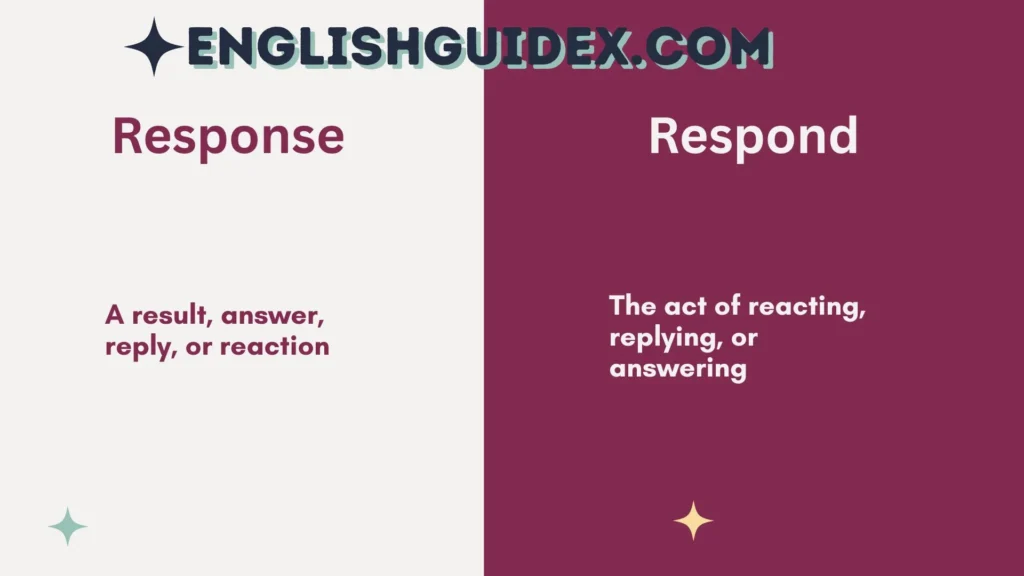
| Word | Part of Speech | Meaning | Example |
|---|---|---|---|
| Response | Noun | A result, answer, reply, or reaction | “She gave a helpful response.” |
| Respond | Verb | The act of reacting, replying, or answering | “She didn’t respond to the message.” |
Response = a thing
Respond = an action
If you remember only one rule, make it this:
If you can put “a,” “the,” or “my” before it → response.
If you can add tense, like “ed,” “will,” or “should” → respond.
Why These Two Words Confuse People
A lot of confusion comes from how interlinked they are. The verb respond produces a response.
The action comes first, the result comes second.
- Verb → Respond: Someone reacts, speaks, answers, behaves, takes action.
- Noun → Response: That action produces a reply, a result, a noticeable change.
Think of them almost like cause and effect:
Cause (respond) → Effect (response).
Grammar Breakdown: When to Use Response vs Respond
Spotting the correct word becomes easier once you know the signals to look for.
Clues That “Response” Is Correct
Look for markers that point to a thing, not an action:
- Articles: a, an, the
- Possessives: my, your, her, his, their
- Adjectives describing the result
Examples that work
- “I received a response.”
- “The customer provided an honest response.”
- “Their response surprised the committee.”
Clues That “Respond” Is Correct
Look for action signals:
- Helping verbs: will, can, should, didn’t
- Tense markers: responded, responds
- Requests or instructions: please respond
Examples that work
- “Please respond as soon as possible.”
- “He didn’t respond to the complaint.”
- “They will respond after reviewing the evidence.”
Sentence Comparisons That Make It Crystal Clear
| Incorrect | Correct |
|---|---|
| “I will give a respond soon.” | “I will respond soon.” |
| “Thanks for your respond.” | “Thanks for your response.” |
| “They didn’t response to the request.” | “They didn’t respond to the request.” |
| “I need your respond quickly.” | “I need your response quickly.” |
If the word does something, it’s usually respond.
If the word is something, it’s usually response.
How Response Works in Everyday Life
Sometimes response refers to communication. Other times, it’s a measured result, physical change, or outcome. Here are places where the noun shows up naturally:
Customer Service
- Response time
- Automated responses
- Final written response to a complaint
Marketing & Business
- Survey responses
- Engagement response rate
- Public response to a product launch
Science & Medicine
- Immune response
- Biological response
- Response to treatment or medication
Education & Testing
- Written response
- Response section on an exam
- Student response activities
In every one of these situations, response is a product, not an action.
How Respond Works in Real Interaction
You’ll see the verb form in moments where people act or speak:
| Situation | How “respond” fits |
|---|---|
| Messages | “I’ll respond once I see it.” |
| Workplace | “Employees must respond to requests within 24 hours.” |
| Emergency | “Paramedics responded immediately.” |
| Relationships | “He responded with empathy instead of anger.” |
| Legal | “The defendant failed to respond to the claim.” |
If there’s behavior happening → respond.
Case Studies: How Professionals Use Each Word
Short snapshots make the difference obvious in context.
Business Email Case Study
Incorrect: “I appreciate your quick respond.”
Correct: “Thanks for your quick response to the proposal.”
Here, the writer is referring to a thing received → response.
Medical Case Study
“The patient did not respond to the first round of treatment, but there was a positive response after the dosage adjustment.”
The action and result appear together.
Customer Support Case Study
“We try to respond to inquiries within one hour. Our average response time this month is 47 minutes.”
Action vs outcome again.
Psychological & Behavioral Perspective
In psychology, the words take on a deeper meaning:
- Respond = the moment a human takes action (internal or external)
- Response = the observable result that follows
Think of a stimulus → reaction chain:
Stimulus → Respond (action) → Response (result)
Examples in context:
- “Children respond differently to stressful environments.”
- “Their emotional response was stronger than expected.”
Etymology Snapshot: Where These Words Come From
Both words come from the Latin respondere, meaning:
to answer, reply, or make a pledge in return.
Over time, English evolved split forms:
- The noun: response
- The verb: respond
This is why they’re linked but not interchangeable—same root, different jobs.
Common Grammar Mistakes to Avoid
Watch out for these traps:
- ❌ Using “respond back” → redundant
✔️ Use respond alone - ❌ Writing “a respond” thinking it’s a noun
✔️ “a response” is correct - ❌ Writing “I’ll response soon”
✔️ “I’ll respond soon” is correct - ❌ Turning it into awkward passive voice
✔️ Use active voice whenever possible
Quick-Check Table for Instant Identification
| If the sentence needs… | Use |
|---|---|
| A noun, result, answer, outcome | Response |
| An action, behavior, reply, reaction | Respond |
| Past tense form | Responded |
| Modifier before (a/the/my) | Response |
Practical Phrases You Can Copy & Use
Smart Phrases With “Response”
- “Thanks for your thoughtful response.”
- “We received a strong response from customers.”
- “What was their response to the suggestion?”
Smart Phrases With “Respond”
- “Please respond when you have a moment.”
- “I’ll respond once I review everything.”
- “They need to respond to the final notice.”
Remember This 1-Sentence Trick
If you can replace the word with answer and the sentence still makes sense, it’s probably response.
If you can replace the word with reply, it’s probably respond.
5 FAQs About Response vs Respond
Do “response” and “respond” mean the same thing?
No. Response is a noun (a thing). Respond is a verb (an action).
Can I say “respond back”?
It’s grammatically unnecessary. “Respond” already implies replying.
Is “response time” or “respond time” correct?
Response time is correct.
Is it “I didn’t response” or “I didn’t respond”?
I didn’t respond is correct because it needs the verb form.
Is “response” pluralized as responses?
Yes. “Responses” is the correct plural.
Conclusion
When choosing between response vs respond, ask:
- Am I talking about a thing or an action?
- Is there a result or behavior being measured?
- Can I place “a/the/my” before it (response) or tense it (respond)?
If you can answer those questions, you’ll never mix them up again.
Final Rule:
Response = result
Respond = action

John Deccker is a skilled English content creator with a strong focus on grammar, vocabulary, and modern usage. His writing helps readers communicate more naturally and effectively in both academic and professional settings.