Confusing “scrap” vs. “scrape” is one of the most common writing errors in English. One letter changes the entire meaning, tone, and impact of a sentence.
This guide breaks down everything you need to understand about the proper use of scrap or scrape, with examples, visuals, case studies, and memory tricks to lock the knowledge into place.
Scrap or Scrape: Why These Two Words Confuse So Many Writers
English feels like it’s playing tricks sometimes. Words look similar, sound almost identical, and autocorrect jumps in like an overeager editor. You type fast, and suddenly:
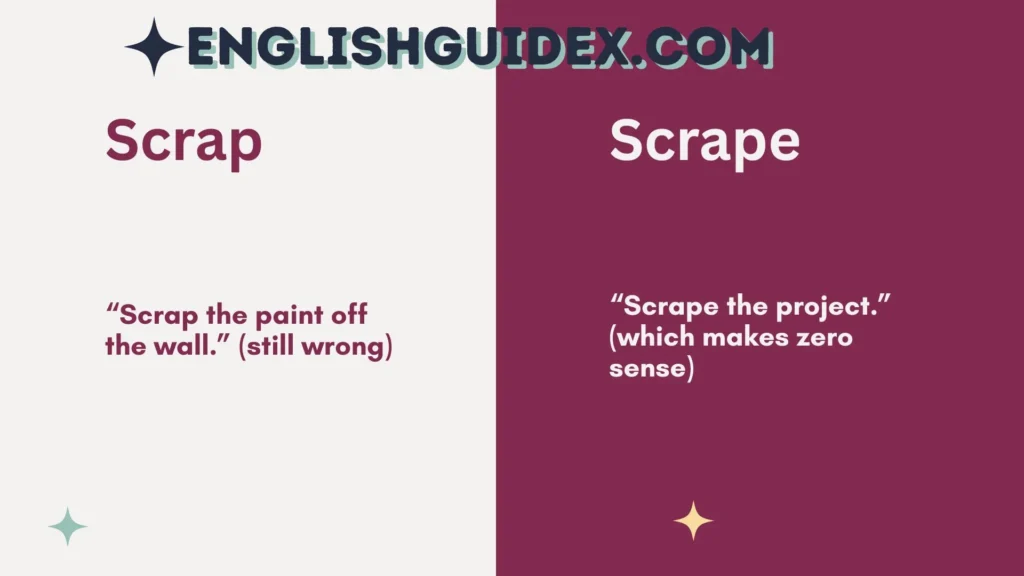
- “Scrape the project.” (which makes zero sense)
- “Scrap the paint off the wall.” (still wrong)
One letter changes the entire message. When writers mix these up, the sentence either becomes confusing or unintentionally hilarious. Imagine telling your boss:
“We should scrape the marketing strategy.”
You’d sound like you’re about to drag the strategy across a floor with a shovel.
The goal of this guide is simple: make sure that never happens again. By the end, you’ll instinctively know when to use scrap and when to use scrape, even without stopping to think.
Core Definitions: Scrap vs Scrape (Explained Clearly)
| Word | Meaning | Quick Definition | Sentence Example |
|---|---|---|---|
| Scrap | Discard or abandon | Throw it away or stop doing it | “Let’s scrap the plan.” |
| Scrape | Scratch or drag | Rub or drag against a surface to remove | “Scrape the ice off the windshield.” |
Scrap relates to removal by discarding.
Scrape relates to removal by contact/dragging.
If you’re tossing something out → scrap.
If you’re dragging something across another surface → scrape.
The Key Distinction in Plain Language
Think of the two as actions:
- Scrap = Kill the idea or throw away the object
- Scrape = Drag to remove or scratch the surface
A sentence can completely change meaning depending on the word:
❌ “We need to scrape the old product line.”
✔️ “We need to scrap the old product line.”
❌ “Scrap the gum off your shoe.”
✔️ “Scrape the gum off your shoe.”
One letter = two different worlds.
Common Misconceptions People Constantly Get Wrong
People mix up scrap vs scrape because:
- Predictive text auto-corrects incorrectly
- Both words look almost the same
- They sound similar in fast speech
- English rarely provides context clues
The most frequent mistakes:
| Incorrect Phrase | Why It’s Wrong | Correct Fix |
|---|---|---|
| Scrape the idea. | You can’t drag an idea across a surface. | Scrap the idea. |
| Scrap the ice off the car. | You are not discarding ice; you’re removing it by force. | Scrape the ice off the car. |
| We scraped the plan. | You didn’t drag the plan across anything. | We scrapped the plan. |
A helpful memory trick:
If it hits the trash → scrap.
If it hits the surface → scrape.
Why They’re Not Interchangeable
Even though the words feel similar, they operate in different mental categories.
Scrap = Emotional or strategic action
Used for:
- Ending projects
- Canceling ideas
- Discarding things
Example:
“We scrapped the proposal after the budget changes.”
Scrape = Physical or technical action
Used for:
- Cleaning or removing layers
- Dragging objects across surfaces
- Data extraction and digital tasks
Example:
“Developers scrape websites to collect data.”
One deals with decisions.
The other deals with motion.
Visualizing Each Word
Below is a visual-style breakdown for deeper understanding:
Scrap (Discard)
- 🗑️ Throwing papers in a trash bin
- ❌ Canceling a half-finished design
- 💡 Abandoning a strategy that no longer works
Scrape (Drag/Remove)
- 🧽 Removing gum from a table with a knife
- ❄️ Clearing ice from a windshield
- 🧹 Removing paint from wood with a tool
Think of “scrape” like friction.
Think of “scrap” like deletion.
The Technology Problem: Autocorrect, Spell Check & AI Slip-Ups
The digital writing world has made this confusion even worse.
Modern texting tools often:
- Default to scrape because it’s more commonly typed online
- Change scrap to scrape when followed by “the”
- Assume scraping refers to data scraping or coding
So instead of clarity, you end up with sentences like:
“We will scrape the marketing program next quarter.”
It reads like you plan to drag your marketing department down a hallway by the ankles.
When To Trust Autocorrect
| Trust It? | Context |
|---|---|
| ❌ No | Ideas, plans, decisions |
| ✔️ Yes | Surfaces, cleaning, friction |
| ⚠️ Maybe | Tech, programming, data contexts |
Humans still need to choose the right word — the algorithm won’t always save you.
Historical Origins (In Simple Terms)
Without getting lost in jargon:
- Scrap evolved from older words linked to broken pieces, abandoned material, or discarded fragments.
- Scrape stems from roots meaning to scratch, pull, rub, or drag against something.
Both came from different linguistic paths, but modern spelling patterns make them appear related.
Modern US Usage: What Native Speakers Actually Say
In the US, both words show up in everyday speech — just in different contexts:
Scrap is common when talking about:
- Business decisions
- Project cancellations
- Throwing out materials
- Reworking plans
“We scrapped the pitch after the client updated requirements.”
Scrape is common when talking about:
- Outdoors and weather
- Cleaning or construction
- Minor injuries
- Technical tasks (like scraping data)
“I scraped my knee on the pavement.”
Case Studies: Real Examples to Make It Stick
Construction Example
| Situation | Correct Word | Why |
|---|---|---|
| Removing paint from a wall | Scrape | Dragging against surface |
| Throwing out damaged panels | Scrap | Tossing/abandoning |
Business Example
| Situation | Correct Word | Why |
|---|---|---|
| Canceling a proposal | Scrap | Ending the idea |
| Extracting pricing data from sites | Scrape | Data friction/process |
Everyday Example
| Situation | Correct Word |
|---|---|
| Scraping burnt toast | ✔️ Scrape |
| Scrapping broken sunglasses | ✔️ Scrap |
A Quick Decision Guide
Memorize this:
If you drag → scrape.
If you discard → scrap.
Still stuck? Ask yourself:
Can I throw it away?
Yes → scrap
No → scrape
Do I have to drag something across a surface?
Yes → scrape
No → scrap
Short Examples You Can Repeat Out Loud
- “We scrapped the old business model.”
- “Scrape the gum off the bench.”
- “Don’t scrap that idea yet. Improve it first.”
- “Scrape the mud off your shoes before coming inside.”
FAQs: Scrap or Scrape (Quick Answers)
How do I remember the difference between scrap or scrape?
If it’s thrown away → scrap.
If it slides or scratches → scrape.
Can I say I’m scraping a project?
No. Use “scrapping a project.” Scrape refers to physical motion.
Is data scraping the same as scrapping?
No. Data scraping involves extracting information, not discarding it.
Which word means cancel something?
Scrap. Cancel, discard, or abandon.
Which word means remove by rubbing or dragging?
Scrape. Think friction or surface contact.
Conclusion
The confusion between scrap vs scrape comes from their visual similarity, not their meaning.
Once you separate the concepts — discard vs drag — the difference becomes crystal clear. Your writing gains precision.
Your sentences stop sounding accidental. And you avoid those embarrassing autocorrect moments that ruin professional communication.
With this guide, you now have:
- Practical definitions
- Visual and logical memory tricks
- Real-world usage charts
- Sentence templates you can rely on
- Context-based usage rules that always apply
Carry this knowledge into your writing, and you’ll never mix them up again.

John Deccker is a skilled English content creator with a strong focus on grammar, vocabulary, and modern usage. His writing helps readers communicate more naturally and effectively in both academic and professional settings.