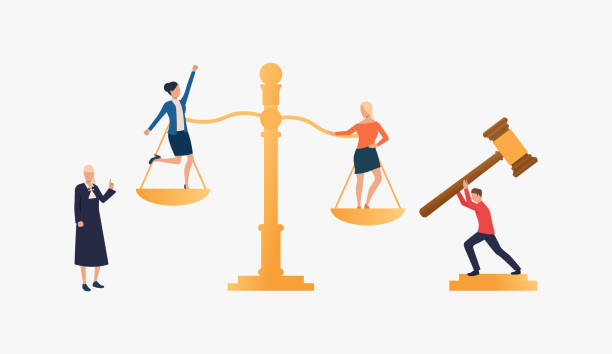
In the architecture of modern democracy, the judiciary often appears as the quietest branch. Unlike the fanfare of presidential signatures or the drama of legislative floor votes, the work of courts happens in the relative silence of chambers and the measured language of legal opinions. Yet, the power of the court is perhaps the most profound of all. It is the power to tell the sovereign people, through their elected representatives, “You have overstepped.” It is the power to protect an individual against the might of the state. But where does this power come from, and what are its limits?
Alexander Hamilton, writing in Federalist No. 78, famously described the judiciary as the branch that would “always be the least dangerous” because it holds “no influence over either the sword or the purse… It may truly be said to have neither FORCE nor WILL, but merely judgment” . This observation strikes at the heart of the judiciary’s unique position: it has no military to enforce its orders and no treasury to fund its projects. So, why do we obey?
The Foundation: Judicial Review
The cornerstone of judicial power in the United States is the doctrine of judicial review—the authority of courts to declare laws passed by Congress and actions of the executive branch unconstitutional. Interestingly, this power is not explicitly listed in the original text of the Constitution. It was asserted by the Supreme Court itself in the landmark 1803 case Marbury v. Madison .
In that decision, Chief Justice John Marshall articulated the court’s role, stating, “It is emphatically the province and duty of the judicial department to say what the law is” . By claiming the power to interpret the Constitution, the court positioned itself as the final arbiter of what the supreme law of the land actually means. This power extends beyond federal law to state actions and local ordinances, ensuring that all government activity conforms to constitutional principles .
Since Marbury, the Supreme Court has declared over 100 federal laws unconstitutional, reshaping public policy on everything from civil rights to campaign finance .
The True Source of Power: Public Trust
If the court has no army or police force, what makes its rulings stick? According to retired Supreme Court Justice Stephen Breyer, the answer lies not in coercion, but in the people. The power of the court “resides in the people—in their faith in the institution, their belief in the rule of law, and their understanding that the Court operates outside the political realm” .
This concept was highlighted by a question posed to Justice Breyer by the Chief Justice of Ghana: Where does a court get its power to make people obey? The answer is a fragile social contract. Americans accept rulings they disagree with—even highly controversial ones like Bush v. Gore—because of a deep-seated cultural belief in the rule of law. As Breyer noted, there were “no shots fired” after that decision because Americans view compliance with court rulings as “like the air we breathe” .
However, this reliance on public faith is also the court’s greatest vulnerability. When the court is perceived as just another political actor—what Breyer calls “junior league politicians” in robes—its moral authority erodes . If the public believes decisions are made to advance a political agenda rather than to interpret the law, the willingness to accept unfavorable rulings diminishes, threatening the stability of the rule of law itself .
Historical Limits: When Judgment Fails
History provides stark warnings that judicial power is ultimately dependent on executive enforcement. The Supreme Court has faced moments where its “judgment” was simply ignored. The most tragic example is the 1832 case Worcester v. Georgia, in which the Court ruled that Georgia law did not apply on Cherokee land. President Andrew Jackson refused to enforce the decision, reportedly quipping, “John Marshall has made his decision; now let him enforce it.” This failure led directly to the Trail of Tears .
Similarly, the 1954 decision in Brown v. Board of Education, which declared school segregation unconstitutional, faced massive resistance. It took years of federal pressure, and sometimes military intervention, to enforce the Court’s mandate in states that refused to comply . These examples illustrate the inherent limit of judicial power: the courts rely on the executive branch to carry out their orders.
The Power of Precedent and Inherent Authority
Beyond the high-profile act of striking down laws, the court’s power is exercised daily through stare decisis—the principle of letting prior decisions stand. This adherence to precedent provides stability and predictability in the law, ensuring that similar cases are treated similarly over time .
Furthermore, courts possess inherent powers necessary to function. These include the authority to manage court proceedings, maintain decorum, punish for contempt, and admit or disbar attorneys . As the Supreme Court noted in 1821, courts are “vested, by their very creation, with power to impose silence, respect, and decorum, in their presence, and submission to their lawful mandates” .
The Ongoing Debate: Activism vs. Restraint
The extent of judicial power remains a subject of intense debate. Critics argue that judicial review can be undemocratic, allowing a handful of unelected, life-tenured officials to overrule the will of the majority . This has fueled the philosophy of judicial restraint, which urges judges to defer to the elected branches of government whenever possible.
On the other side, proponents of judicial activism argue that courts must correct injustices that the majority ignores or perpetuates. They point to the protection of minority rights—which are often overlooked by legislatures responding to popular majorities—as a vital function of an independent judiciary . As Justice Goldberg once argued, democracy and an independent judiciary are “one and inseparable” .
Conclusion
The power of the court is a paradox: it is immense enough to shape a nation, yet fragile enough to depend entirely on public trust for its enforcement. It serves as the guardian of the Constitution and the protector of individual rights against the tyranny of the majority . While it lacks the sword and the purse, it holds something equally vital in a democracy: the authority of principle. Preserving that authority requires a vigilant public and a judiciary committed to the idea that its role is to interpret the law, not to satisfy a political constituency.
