English learners often stumble over the difference between wasn’t and weren’t. Though both are past-tense negatives of to be, their proper usage depends on the subject, context, and sometimes even the mood of the sentence.
Using the wrong form can make your English sound awkward or incorrect.
This guide will give you a complete understanding of wasn’t vs. weren’t, practical rules, exceptions, and plenty of examples you can use in real life. By the end, you’ll never confuse these two again.
Understanding the Basics of Wasn’t and Weren’t
Let’s start simple.
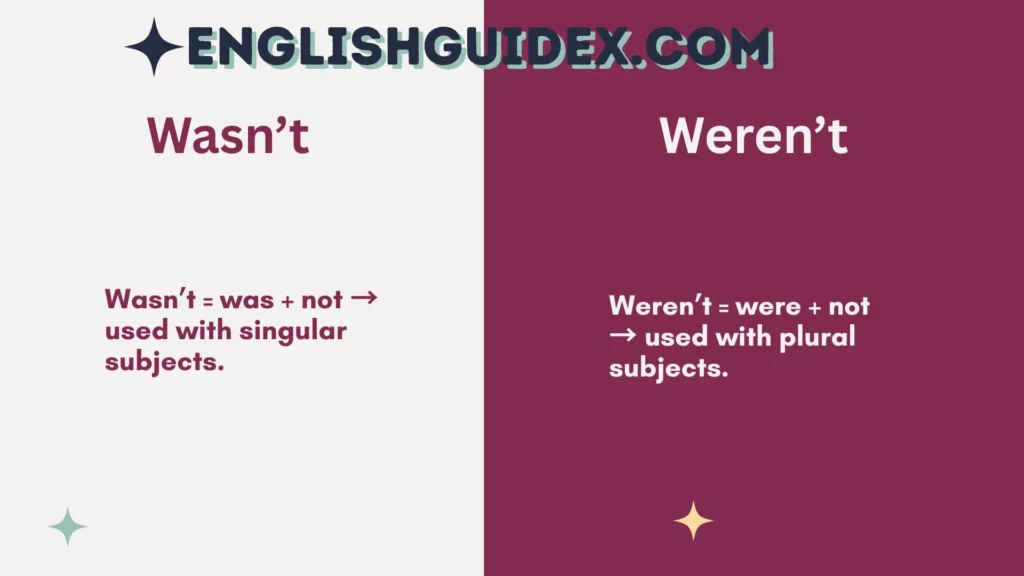
- Wasn’t = was + not → used with singular subjects.
- Weren’t = were + not → used with plural subjects.
Think of it like this: singular subjects need wasn’t, and plural subjects need weren’t, unless you are talking about a hypothetical situation (more on that later).
Quick Reference Table:
| Subject | Correct Form | Example Sentence |
|---|---|---|
| I | wasn’t | I wasn’t ready for the exam. |
| He/She/It | wasn’t | She wasn’t at the meeting yesterday. |
| We | weren’t | We weren’t invited to the party. |
| They | weren’t | They weren’t aware of the changes. |
| You | weren’t | You weren’t listening carefully. |
Notice that even though I is singular, it takes wasn’t, while you can take weren’t. This is one of the quirks of English.
Subject-Verb Agreement: Singular vs. Plural Usage
One of the most common mistakes is mixing singular and plural subjects. The key is to identify the subject first.
- Singular subjects always pair with wasn’t. Examples:
- He wasn’t happy with the decision.
- It wasn’t raining yesterday.
- Plural subjects always pair with weren’t. Examples:
- We weren’t prepared for the surprise test.
- The students weren’t in the classroom on time.
Tip: If the subject looks like it’s singular but actually represents a group (e.g., team, family), check if it acts as a unit (singular) or as individuals (plural).
- The team wasn’t ready. (acting as a single unit)
- The team weren’t wearing matching uniforms. (referring to individuals)
The Rule of Thumb for Wasn’t and Weren’t
Here’s an easy way to remember:
- Use wasn’t → with singular subjects: I, he, she, it
- Use weren’t → with plural subjects: we, you, they
- Use weren’t with hypothetical situations** even with singular subjects (subjunctive mood).
This simple rule covers most cases, but English loves exceptions. That’s why context matters.
The Subjunctive Mood: When Weren’t Works With Singular Subjects
English uses the subjunctive mood for hypothetical, wishful, or unreal situations. Here’s where you might see singular subjects paired with weren’t:
- I wish I weren’t so tired all the time.
- If he weren’t afraid of heights, he’d try skydiving.
- She acts as if she weren’t responsible for the mistake.
Key takeaway: Whenever the situation is imaginary, hypothetical, or contrary to fact, weren’t is correct even with singular subjects.
Wasn’t vs. Weren’t in Questions
Questions can be tricky, but following a simple pattern makes it easier.
- Singular subject → Wasn’t
- Wasn’t he supposed to call you?
- Wasn’t the meeting scheduled for 3 PM?
- Plural subject → Weren’t
- Weren’t they planning to join us?
- Weren’t we supposed to submit the report yesterday?
Common Mistakes to Avoid:
- ❌ Wasn’t they ready for the exam?
- ✅ Weren’t they ready for the exam?

Creating Negative Sentences: Correct Contractions
English loves contractions in everyday speech. Wasn’t and weren’t are essential for sounding natural.
- Wasn’t = was not → I wasn’t, he wasn’t, it wasn’t
- Weren’t = were not → we weren’t, they weren’t, you weren’t
Examples:
- I wasn’t aware of the changes.
- She wasn’t feeling well yesterday.
- We weren’t invited to the wedding.
- You weren’t paying attention during class.
Pro Tip: Avoid mixing singular subjects with plural contractions:
- ❌ He weren’t happy.
- ✅ He wasn’t happy.
Distinguishing Wasn’t and Weren’t: Examples for Everyday Use
Here’s a breakdown of practical examples for clarity:
| Context | Singular Subject | Plural Subject |
|---|---|---|
| Past Fact | He wasn’t at work yesterday. | They weren’t at work yesterday. |
| Hypothetical | I wish I weren’t late. | We wish we weren’t stuck in traffic. |
| Question | Wasn’t she in class yesterday? | Weren’t they at the park? |
| Negative Statement | It wasn’t a good idea. | The results weren’t satisfactory. |
Common Mistakes and Misconceptions
Even experienced English speakers slip up. Watch out for these:
- Using wasn’t with plural subjects:
- ❌ They wasn’t ready.
- ✅ They weren’t ready.
- Using weren’t for past facts with singular subjects (non-hypothetical):
- ❌ He weren’t there yesterday.
- ✅ He wasn’t there yesterday.
- Confusing wasn’t I vs. weren’t I:
- In standard English, weren’t I is often preferred for questions:
- Weren’t I supposed to call you?
- Though Wasn’t I is still grammatically acceptable in casual speech.
- In standard English, weren’t I is often preferred for questions:
Expanding Your Grammar Skills With Wasn’t and Weren’t
To truly master these words, practice is essential. Here are some effective exercises:
1. Fill-in-the-Blank Exercises:
- I ____ (wasn’t/weren’t) feeling well yesterday.
- They ____ (wasn’t/weren’t) invited to the party.
- If she ____ (wasn’t/weren’t) so tired, she would join us.
2. Sentence Correction Practice:
- ❌ He weren’t ready for the test. → ✅ He wasn’t ready for the test.
- ❌ Wasn’t they going to the cinema? → ✅ Weren’t they going to the cinema?
3. Speaking Exercises:
- Read negative sentences out loud.
- Switch singular/plural subjects to test agreement.
4. Case Study Example:
Imagine a classroom scenario:
The teacher asks: “Was everyone ready for the test?”
Some students say: “He wasn’t ready.” ✅ correct (singular)
Some students say: “They weren’t ready.” ✅ correct (plural)
By practicing in real-life contexts, you’ll start noticing patterns automatically.
Practical Tips for Mastery
Here’s a simple checklist to use in everyday English:
- Identify the subject → singular or plural?
- Check the context → real past fact or hypothetical?
- Apply the rule → wasn’t for singular, weren’t for plural, or subjunctive exceptions.
- Read aloud → if it sounds wrong, adjust.
- Use contractions naturally → I wasn’t, we weren’t, you weren’t.
FAQs About Wasn’t vs. Weren’t
What is the difference between wasn’t and weren’t?
Answer: Wasn’t is for singular subjects; weren’t is for plural subjects or hypothetical situations.
Can I use weren’t with singular subjects?
Answer: Yes, but only in hypothetical or wishful contexts (subjunctive mood).
Which one is correct: Wasn’t I or Weren’t I?
Answer: Both can be correct, but weren’t I is more common in standard English questions.
Do contractions matter in formal writing?
Answer: In formal writing, it’s better to write was not or were not, but contractions are fine in conversation and informal contexts.
Are there exceptions with collective nouns?
Answer: Yes. If the noun acts as a single unit → wasn’t; if referring to individuals → weren’t.
Conclusion
Mastering wasn’t vs. weren’t isn’t hard if you follow three rules: know your subject, understand the context, and remember the exceptions.
Practice using them in negative sentences, questions, and hypothetical statements. Soon, choosing the right word will become second nature, and your English will sound much more fluent and natural.
Tip: Keep a cheat sheet, read out loud, and practice daily—it’s the fastest path to mastery.

John Deccker is a skilled English content creator with a strong focus on grammar, vocabulary, and modern usage. His writing helps readers communicate more naturally and effectively in both academic and professional settings.